Chemistry · Ch 5 — Thermodynamics
Enthalpy of Solution
Enthalpy of Solution
Enthalpy of Solution
Definition: The enthalpy of solution of a substance is the enthalpy change when one mole of it dissolves in a specified amount of solvent.
The enthalpy of solution at infinite dilution is the enthalpy change observed on dissolving the substance in an infinite amount of solvent, when the interactions between the ions (or solute molecules) are negligible.
When an ionic compound dissolves in a solvent, the ions leave their ordered positions on the crystal lattice. These are now more free in solution. But solvation of these ions (hydration in case the solvent is water) also occurs at the same time.
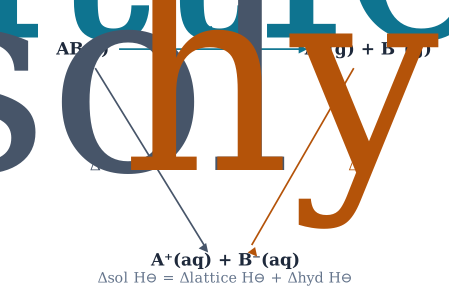
The enthalpy of solution of AB(s) in water is determined by the selective values of the lattice enthalpy, , and enthalpy of hydration of ions, :
Drawn by us to help you understand the concept clearly, and verified to make sure it's accurate. For exams, practice from your NCERT textbook's own diagram.
The diagram is a three-corner enthalpy cycle for dissolving an ionic solid AB(s) in water — the thermodynamic bookkeeping behind every "does this salt dissolve exothermically?" question.
The top edge takes the solid apart into free gaseous ions: AB(s) → A⁺(g) + B⁻(g). That step costs the full lattice enthalpy, — always a large positive number, because every ionic attraction in the crystal must be overcome.
The right edge then drops those gaseous ions into water: A⁺(g) + B⁻(g) → A⁺(aq) + B⁻(aq). Solvation (here, hydration) releases energy as water molecules organise around each ion, so is large and negative.
The left edge is the direct route — simply dissolving the solid — whose enthalpy change is the enthalpy of solution, . Because enthalpy is a state function, the direct route must equal the two-step route:
…
Example — NaCl:
For one mole of NaCl(s):
- Lattice enthalpy =
- (from literature)
The dissolution of NaCl(s) is accompanied by very little heat change.
For most ionic compounds, is positive and the dissociation process is endothermic. Therefore, the solubility of most salts in water increases with a rise in temperature. …