Chemistry · Ch 5 — Thermodynamics
Entropy and Spontaneity
Entropy and Spontaneity
Entropy and Spontaneity
What drives a spontaneous process when there is no change in enthalpy? Consider the diffusion of two gases into each other in a closed container that is isolated from the surroundings. Imagine two gases, A and B, separated by a movable partition. When the partition is withdrawn, the gases begin to diffuse into each other, and after some time, diffusion is complete.
Before the partition is removed, if you picked up a molecule from the left container, you would be certain it was a molecule of gas A. Similarly, any molecule from the right container would be gas B. After the partition is removed, you can no longer be sure — the molecule you pick could be either A or B. The system has become less predictable, more chaotic.
This suggests another postulate: in an isolated system, there is always a tendency for the system's energy to become more disordered or chaotic. This tendency could be a criterion for spontaneous change.
Entropy as a Thermodynamic Function
We introduce a new thermodynamic function called entropy, denoted by . The disorder we just described is the manifestation of entropy. To form a mental picture, think of entropy as a measure of the degree of randomness or disorder in the system. The greater the disorder in an isolated system, the higher the entropy.
For a chemical reaction, the entropy change can be attributed to the rearrangement of atoms or ions from one pattern in the reactants to another in the products. If the structure of the products is much more disordered than that of the reactants, there will be a resultant increase in entropy. We can estimate entropy changes qualitatively by considering the structures of the species involved. A decrease in regularity of structure means an increase in entropy.
For a given substance, the crystalline solid state has the lowest entropy (most ordered), while the gaseous state has the highest entropy.
Quantifying Entropy
One way to calculate entropy is through statistical methods, but that is beyond our scope. Another way is to relate entropy to the heat involved in a process, making entropy a thermodynamic concept.
Like internal energy and enthalpy , entropy is a state function — is independent of path. Whenever heat is added to a system, it increases molecular motions, causing increased randomness. So heat () has a randomising influence on the system.
But can we simply equate with ? No — experience tells us that the effect of heat also depends on the temperature at which it is added. A system at higher temperature already has greater randomness than one at lower temperature. Adding the same quantity of heat to a system at lower temperature causes a greater increase in randomness than adding it at higher temperature. This suggests that entropy change is inversely proportional to temperature.
For a reversible process, the relationship is:
Total Entropy Change and Spontaneity
The total entropy change for a spontaneous process, considering both the system and its surroundings, is given by:
When a system is at equilibrium, entropy is at its maximum, and the change in entropy is zero: . Entropy for a spontaneous process increases until it reaches a maximum, and at equilibrium the change in entropy is zero.
Since entropy is a state property, we can calculate the entropy change of the system for a reversible process as:
For an ideal gas undergoing isothermal expansion, whether reversible or irreversible, . But (i.e., ) is not zero for an irreversible process. Thus, does not discriminate between reversible and irreversible processes, whereas does. …
Drawn by us to help you understand the concept clearly, and verified to make sure it's accurate. For exams, practice from your NCERT textbook's own diagram.
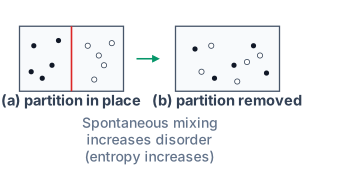
Fig. 5.11 is a simple two-panel sketch that captures the core idea of entropy as a measure of disorder. In panel (a), a box is divided by a removable partition. On the left side, black dots represent molecules of gas A; on the right side, white dots represent molecules of gas B. The two gases are completely separated — the system is ordered because you can say with certainty which gas occupies which half. In panel (b), the partition has been withdrawn. The black and white dots are now mixed uniformly throughout the whole box. You can no longer tell which gas a molecule belongs to just by its location; the system has become more chaotic, or disordered.
The physical idea is that this mixing happens spontaneously — no external work is needed — even though there is no change in enthalpy () for an ideal gas mixing at constant temperature. The driving force is the increase in disorder, which the textbook identifies with an increase in entropy, . The figure is used to argue that entropy, not just enthalpy, must be considered when judging spontaneity.
The key formula that the textbook develops from this conceptual foundation is the definition of entropy change for a reversible process:
Here:
- is the change in entropy of the system (in J K).
- is the heat absorbed by the system in a reversible process (in J).
- is the absolute temperature (in K).
The figure also leads directly to the second law of thermodynamics, which the textbook states in the context of an isolated system: the entropy of an isolated system increases in a spontaneous process. This is expressed mathematically as:
for a spontaneous process. The figure of the mixing gases is a classic example of a process where and (since the container is isolated), so , confirming spontaneity. …