Mathematics · Ch 6 — Permutations and Combinations
Combinations
Combinations
6.4 Combinations
When you pick a team, the order in which you name the players does not matter. A team of X and Y is the same as a team of Y and X. This is the core idea of combinations: you are selecting, not arranging.
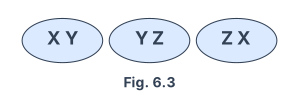
Consider three lawn tennis players: X, Y, Z. How many different teams of 2 players can you form? The possibilities are XY, YZ, and ZX — just three. Each of these is a combination of 3 different objects taken 2 at a time. In a combination, the order of selection is irrelevant.
The same idea appears in many situations. If twelve people meet and each shakes hands with every other person, how many handshakes occur? A handshake between X and Y is the same as between Y and X — order does not matter. So the number of handshakes equals the number of combinations of 12 different things taken 2 at a time. Similarly, if seven points lie on a circle, the number of chords you can draw by joining them pairwise is the number of combinations of 7 different things taken 2 at a time.
The formula for
We need a general formula for the number of combinations of different objects taken at a time. This number is denoted by (also written as ).
Take 4 different objects: A, B, C, D. The combinations taken 2 at a time are:
AB, AC, AD, BC, BD, CD
That is 6 combinations, so . Notice that AB and BA are the same combination — we did not list BA, CA, DA, etc.
Now, each combination of 2 objects can be rearranged in ways to give permutations. So the total number of permutations of 4 objects taken 2 at a time is:
But we already know that the number of permutations is . Therefore:
Since , we get:
Now try with 5 objects: A, B, C, D, E. The combinations taken 3 at a time are:
ABC, ABD, ABE, ACD, ACE, ADE, BCD, BCE, BDE, CDE
That is 10 combinations, so . Each combination gives permutations. So:
And since , we have:
These examples lead to the general relationship.
Proof: Corresponding to each combination of objects, there are permutations, because the objects in any combination can be rearranged in ways. So the total number of permutations of different things taken at a time is . But this total is also . Hence , for .
From this, we get the direct formula:
Remarks and properties
1. The case : When you select all objects, there is exactly one way to do it. The formula gives:
2. The case : Selecting nothing at all is the same as leaving behind all objects — there is exactly one way to do that. So we define . The formula also works for because :
3. Symmetry property: Selecting objects out of is the same as rejecting objects. Therefore:
Proof:
This symmetry is extremely useful. When is large (say out of ), it is easier to compute instead of .
4. Equality property: If , then either or (i.e., ).
This follows directly from the symmetry property. If , then the only way the two combinations can be equal is if .
Theorem 6: Pascal's identity
Proof:
Take a common factor :
This identity is the basis of Pascal's triangle and is extremely useful for simplifying sums of combinations.
Worked examples
Example 17: If , find .
Using the equality property, since , we have either (impossible) or . So .
Therefore .
Example 18: A committee of 3 persons is to be formed from 2 men and 3 women. How many committees can be formed? How many of these consist of 1 man and 2 women?
Since order does not matter, we count combinations. Total number of committees = number of ways to choose 3 persons from 5:
For committees with 1 man and 2 women: choose 1 man from 2 men ( ways) and 2 women from 3 women ( ways). By the multiplication principle:
Example 19: How many ways are there to choose 4 cards from a pack of 52 playing cards? Also find the number of ways in which:
- four cards are of the same suit
- four cards belong to four different suits
- four cards are face cards
- two are red and two are black
- all four are of the same colour Total ways to choose 4 cards from 52:
(i) There are 4 suits, each with 13 cards. Choose all 4 from one suit: ways per suit. Since there are 4 suits: …
Theorem 5: The Relation Between Permutations and Combinations
For any positive integers and with , the number of permutations of different things taken at a time is equal to the number of combinations of different things taken at a time multiplied by .
This theorem is the bridge between counting arrangements (where order matters) and counting selections (where order does not matter). It tells us that every combination of objects can be rearranged in different ways to produce distinct permutations.
The hypothesis is essential. When , the formula still holds if we define , giving , which matches the convention that there is exactly one way to arrange nothing.
›Proof
Proof of Theorem 5
Consider any one combination of different objects chosen from distinct objects. In this single combination, the objects can be rearranged among themselves in different ways (since order matters for permutations but not for combinations).
Therefore, corresponding to each combination counted by , we obtain exactly distinct permutations.
The total number of permutations obtained from all combinations is therefore:
But this total must equal the number of permutations of different things taken at a time, which is .
Hence:
This completes the proof.
When This Theorem Is Used …
Theorem 5: The Relation Between Permutations and Combinations
For any positive integers and with , the number of permutations of different things taken at a time is equal to the number of combinations of different things taken at a time multiplied by .
This theorem is the bridge between counting arrangements (where order matters) and counting selections (where order does not matter). It tells us that every combination of objects can be rearranged in different ways to produce distinct permutations.
The hypothesis is essential. When , the formula still holds if we define , giving , which matches the convention that there is exactly one way to arrange nothing.
›Proof
Proof of Theorem 5
Consider any one combination of different objects chosen from distinct objects. In this single combination, the objects can be rearranged among themselves in different ways (since order matters for permutations but not for combinations).
Therefore, corresponding to each combination counted by , we obtain exactly distinct permutations.
The total number of permutations obtained from all combinations is therefore:
But this total must equal the number of permutations of different things taken at a time, which is .
Hence:
This completes the proof.
When This Theorem Is Used …
Drawn by us to help you understand the concept clearly, and verified to make sure it's accurate. For exams, practice from your NCERT textbook's own diagram.
Fig. 6.3 is a simple but powerful visual. It shows three pale-blue ellipses, each outlined in slate, arranged side by side. Inside each ellipse is a bold two-player label: 'X Y', 'Y Z', 'Z X'. There are no axes, no curves, no grid — just these three labelled ovals.
The figure is teaching the core idea of a combination: a selection where the order of the chosen items does not matter. The three players are X, Y, and Z. A team of two players is to be formed. The figure lists every possible team: XY, YZ, ZX. Notice that XY and YX are the same team — the figure shows only XY, not both. That is the entire point. If order mattered, there would be six possibilities (XY, YX, XZ, ZX, YZ, ZY). Because order does not matter, there are only three.
This is the fundamental distinction between a permutation and a combination. A permutation counts arrangements where order matters; a combination counts selections where order is irrelevant. The figure makes this concrete: the three ellipses are the three combinations of three objects taken two at a time.
The textbook uses this example to develop the general formula for combinations. For distinct objects taken at a time, the number of combinations is denoted (or ). The reasoning is:
Here, (read "n factorial") is the product . The formula arises because each combination of objects can be rearranged in different orders to give permutations. Since the total number of permutations of objects taken at a time is , we have:
For the tennis players, and :
which matches the three ellipses in the figure.
A common mistake is to confuse with . If the problem says "select a team" or "choose a committee", order does not matter — use combinations. If it says "arrange" or "line up", order matters — use permutations. The figure's three ellipses are a visual anchor for this rule. …