Mathematics · Ch 1 — Sets
Complement of a Set
Complement of a Set
Complement of a Set
The idea of a complement arises naturally once we fix a universal set. If the universal set contains everything we care about in a given discussion, then the complement of a set is simply everything in that is not in .
Consider as the set of all prime numbers. Let be the subset of consisting of those primes that are not divisors of 42. The prime divisors of 42 are 2, 3, and 7. So contains every prime except 2, 3, and 7. The set — the three primes that are missing from — is called the complement of with respect to , denoted .
Formally, for a universal set and a subset , the complement of is the set of all elements of that are not in . In set-builder notation:
An equivalent way to see this is as a set difference: .
If is a subset of , then its complement is also a subset of . The complement operation always stays inside the universal set.
Example 20. Let and . Then .
Example 21. In a coeducational school, let be the set of all Class XI students and be the set of all girls in Class XI. Then is the set of all boys in Class XI.
Double Complementation
If you take the complement of a complement, you get back the original set. From Example 20, , so .
This is always true: for any subset of a universal set ,
This is called the law of double complementation.
De Morgan's Laws
The most powerful results about complements involve how they interact with union and intersection. These are named after the mathematician Augustus De Morgan.
De Morgan's Laws
In words: the complement of a union is the intersection of the complements, and the complement of an intersection is the union of the complements.
Example 22. Let , , and .
First, find the individual complements:
Then .
Now find , so .
Since , the first De Morgan law is verified for this example.
›Proof
Proof of De Morgan's First Law:
We prove set equality by showing each side is a subset of the other.
Part 1:
Let . Then and .
If , then is not in and is not in (because if were in either or , it would be in the union).
So and , which means and .
Therefore .
Part 2:
Let . Then and .
So and .
Since is in neither nor , .
And (because complements are defined within ), so .
Since both subset relations hold, the sets are equal.
›Proof
Proof of De Morgan's Second Law:
Part 1:
Let . Then and .
If is not in the intersection, then is missing from at least one of or . That is, or (or both).
So or , which means .
Part 2:
Let . Then or (or both).
So or .
If is missing from at least one of or , then cannot be in both, so .
Since , we have .
Properties of Complement Sets
The textbook lists four groups of properties. Each can be verified using Venn diagrams or element arguments.
1. Complement Laws
Every element of is either in or not in , so the union of and its complement covers the entire universal set. No element can be both in and not in , so the intersection is empty.
2. De Morgan's Laws
These have been proved above.
3. Law of Double Complementation
…
The complement of a set (written as or ) is the collection of all objects in the universal set that are not in . Formally, .
Intuition: It’s everything outside the boundary of inside the universe . …
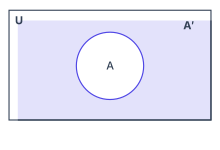
Drawn by us to help you understand the concept clearly, and verified to make sure it's accurate. For exams, practice from your NCERT textbook's own diagram.
Fig. 1.10 is a Venn diagram that shows the complement of a set. The universal set is drawn as a rectangle, and inside it is a single circle labelled . The circle itself is left unshaded. The entire region of the rectangle that lies outside the circle — that is, everything in that is not in — is shaded. That shaded region is labelled (read as "A complement" or "A prime").
The physical idea is simple: the complement is everything in the universe that the original set leaves out. If contains all the objects we care about, and picks out some of them, then picks out the rest. The diagram makes this "either inside or outside" relationship visually immediate — there is no overlap, no middle ground. An element of belongs either to or to , never to both.
The key definition the textbook builds from this figure is:
Here is the universal set, is any subset of , and is the set of all elements of that are not in . An equivalent way to write it is , the set difference of and .
From this definition, several important properties follow directly, and the textbook lists them after the figure:
- (every element is either in or in its complement)
- (no element can be in both)
- (the complement of the complement brings you back to the original set — the law of double complementation)
- and
The figure also sets the stage for De Morgan's laws, which the textbook proves using Venn diagrams shortly after. Those laws state:
In words: the complement of a union is the intersection of the complements, and the complement of an intersection is the union of the complements. …