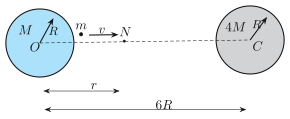
Q.Two uniform solid spheres of equal radii , but mass and have a centre to centre separation , as shown in Fig. 7.10. The two spheres are held fixed. A projectile of mass is projected from the surface of the sphere of mass directly towards the centre of the second sphere. Obtain an expression for the minimum speed of the projectile so that it reaches the surface of the second sphere.
You're viewing a preview — the full solution, concept, methods & PYQ mapping are locked.
Start your 14-day free trial to unlock the full solution →The projectile needs just enough speed to crest the gravitational potential 'hill' between the two spheres — the point where the pulls from the two spheres exactly balance — after which the second sphere's gravity carries it the rest of the way. Using conservation of energy between the launch point and that balance point gives a minimum speed of .
Setting up
Place the centre of the sphere of mass at and the centre of the sphere of mass at ; both spheres have radius , so their surfaces are at and . The projectile is launched from (the surface of the -sphere) toward the other sphere.
Finding the neutral point
Between the spheres, the projectile is pulled left by and right by . These pulls balance at the point where
This neutral point (at ) is where the projectile's gravitational potential energy is at its highest along the path — beyond it, the pull from the sphere dominates and pulls the projectile the rest of the way in.
The minimum-speed condition is that the projectile just reaches this neutral point with zero leftover speed — not that it reaches the far sphere's surface with zero speed. Once past the neutral point, the stronger sphere's gravity takes over and accelerates it the rest of the way, so no extra launch speed is needed for that part of the journey.
Applying conservation of energy
The potential energy of the projectile at position is
…
Unlock everything free for 14 days
- Full step-by-step solutions
- Concept-first explanations
- Methods, shortcuts & mistakes
- PYQ mapping + timed mock tests
Full access for 14 days. No credit card required.