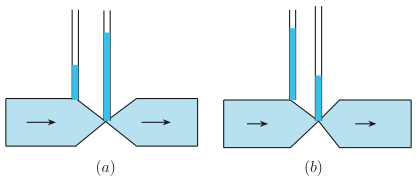
Q.Figures 9.20(a) and
🔒You're viewing a preview — the full solution, concept, methods & PYQ mapping are locked.
🔒 Start your 14-day free trial to unlock the full solution →Concept understanding — Bernoulli Principle
The Intuition: Why Does a Shower Curtain Bulge Inward?
Stand in a running shower, and you'll notice the curtain bulges toward you, not away. That seems backwards — the water is pushing air, so shouldn't the curtain be pushed out? What's actually happening is that the fast-moving water drags the air next to it, making that air move faster than the still air in the rest of the bathroom. And here's the key: faster moving fluid exerts less sideways pressure. The slower air outside the shower pushes harder, so the curtain moves into the low-pressure region.
That's the Bernoulli principle in action: where speed is high, pressure is low.
The Precise Statement
P+21ρv2+ρgh=constant along a streamline
This is Bernoulli's equation for an ideal fluid (incompressible, non-viscous, steady flow). The three terms are:
- P — static pressure (the usual pressure you feel)
- 21ρv2 — dynamic pressure (pressure due to motion)
- ρgh — gravitational pressure (height effect)
The principle says: if the speed of a fluid increases, its pressure decreases (assuming no change in height). That's the core idea.
Breaking It Down: Why Does This Happen?
Imagine a fluid particle moving along a streamline. As it enters a narrower section of a pipe, it must speed up to keep the same flow rate (continuity equation: A1v1=A2v2). To accelerate, a net force must act on it — that force comes from a pressure difference. The pressure behind the particle is higher than the pressure ahead, so the particle speeds up. Result: higher speed, lower pressure.
Bernoulli's equation is really just conservation of energy per unit volume for a fluid. The 21ρv2 term is kinetic energy density, ρgh is potential energy density, and P is the work done by pressure forces. Total energy per volume stays constant.
Common Misconception to Avoid
Many students think Bernoulli's principle means "fast air always has low pressure." That's not true — it's a relationship between speed and pressure along a single streamline. If you force air to move fast by blowing it, you're adding energy, not lowering pressure. The principle applies to a fluid moving on its own under conservation of energy, not to a jet from a fan.
Real-Life Examples (Exam Favourites)
| Situation | What happens | Why |
|---|---|---|
| Airplane wing | Air moves faster over the curved top surface, slower under the flat bottom. Lower pressure above, higher below → lift. | Bernoulli + angle of attack |
| Atomiser / spray bottle | Fast air stream over a vertical tube reduces pressure at the top, sucking liquid up. | Low pressure from high speed |
The narrow throat has the higher flow speed, so by Bernoulli's principle it must have the LOWER pressure and hence the SHORTER liquid column. Diagram (b) shows this correctly; diagram (a) shows a taller column at the throat, so (a) is incorrect.
By continuity, the smaller cross-section at the throat forces a larger speed there; by Bernoulli's principle a larger speed goes with a smaller pressure, so the vertical tube at the throat must show a shorter column. Diagram (a) shows the tallest column at the throat, implying the greatest pressure where the speed is …
For steady flow through a constriction, the equation of continuity makes the fluid speed largest at the narrow throat, and Bernoulli's principle then makes the pressure smallest there. A vertical side-tube rises to a height set by the local pressure, so the column at the throat must be the SHORTEST. Diagram (b) obeys this; diagram (a) shows the tallest column at the throat and is therefore incorrect.
Concept
Two ideas govern an ideal (non-viscous, incompressible) fluid in steady flow:
- Equation of continuity: A1v1=A2v2. Where the pipe is narrow (small A), the speed v is large.
- Bernoulli's principle (same height): P+21ρv2=constant. Where the speed v is large, the pressure P is small.
Why this fixes the tube heights
Each open vertical tube acts as a manometer: the liquid climbs until the static column balances the local pressure in the pipe, so a taller column means a higher local pressure.
Steps
- At the wide section: area large ⇒ speed small ⇒ pressure high ⇒ tall column.
- At the narrow throat: area small ⇒ speed large ⇒ pressure low ⇒ short column.
- Therefore the physically correct picture has the column over the throat SHORTER than the column over the wide part. …
Continuity: narrower throat -> higher speed. Bernoulli: higher speed -> lower pressure. Correct picture: shortest column over throat, taller over wide secti …
Showing the 12 most recent of 18 on this concept.
- MHT-CET 2026Set pcm-2026-04-16-E1 markMCQQ.A horizontal pipe carries water in a streamline flow. At point along the pipe, where the cross-sectional area is 𝐴1, the velocity of water is 𝑉1 and the pressure is 𝑃1. What is the pressure of water at another point where the cross-sectional area is 𝐴2? (A) 𝑃1−𝜚𝑉222𝐴21(𝐴22−𝐴21) (B) 𝑃1+𝜚𝑉212𝐴22(𝐴22−𝐴21) (C) 𝑃1𝜚𝑉21(𝐴21−𝐴22) (D) 𝑃/𝜚𝑉21𝐴22
›Reveal solutionSolution
P2=P1+2A22ϱV12(A22−A12). …
- MHT-CET 2026Set pcm-2026-04-16-M1 markMCQQ.A closed pipe containing liquid showed a pressure 𝑃1 by gauge. When the valve was opened, pressure was reduced to 𝑃2. The speed of water flowing out of the pipe is (𝜚=density of water) (A) [(𝑃1−𝑃2)𝜚]12 (B) [2(𝑃1−𝑃2)𝜚]12 (C) [(𝑃2−𝑃1)𝜚]12 (D) [2(𝑃2−𝑃1)𝜚]12
›Reveal solutionSolution
v = √[2(P1−P2)/ρ], from Bernoulli's equation applied between the closed and open states of the pipe.
Before the valve opens, the liquid is at rest with gauge pressure P1. After opening, pressure drops to P2 and the liquid accelerates to speed v as it flows out. By Bernoulli's principle (conservation of mechanical energy per unit vol …
- TG EAPCET 2025Set eng-2025-05-02-AN1 markMCQQ.For which of the following Reynold’s number, a flow is streamlined? (A) 900 (B) 2100 (C) 2900 (D) 4000
›Reveal solutionSolution
Streamlined (laminar) flow occurs when the Reynolds number is below a critical threshold, typically around 2000 for pipe flow. Among the given options, only 900 is below that threshold, so the correct choice is (A).
The key concept here is the Reynolds number (Re), a dimensionless quantity that predicts whether fluid flow will be laminar (streamlined) or turbulent. It compares inertial forces to viscous forces: low Re means viscous forces dominate, smoothing out disturbances and keeping the flow orderly; high Re means inertial forces dominate, causing chaotic eddies and turbulence.
For flow in a pipe, the critical Reynolds number is about 2000–2300. Below this, flow is typically laminar (streamlined); above it, flow becomes turbulent. This is a well-established experimental result, not a sharp boundary but a useful rule of thumb.
Now, let’s evaluate each option:
-
Option (A): 900
This is well below 2000. Viscous forces are strong enough to suppress any disturbances, so the flow remains smooth and layered — streamlined.
-
Option (B): 2100
This is just above the typical critical range. Flow here is often transitional — it may be laminar in very quiet conditions but is usually turbulent in practice. Not reliably streamlined.
-
Option (C): 2900 …
-
- MHT-CET 2025Set pcm-2025-04-19-E1 markMCQQ.Water is flowing steadily in a river. A and B are the two layers of water at heights 40 cm and 90 cm from the bottom. The velocity of the layer A is 12 cm/s. The velocity of the layer B is (A) 15 cm/s (B) 21 cm/s (C) 27 cm/s (D) 36 cm/s
›Reveal solutionSolution
Linear velocity profile from the bottom gives vB=27 cm/s.
For steady flow with a linear velocity profile (zero at the bottom), the speed is proportional to height h above the bed:
vAvB=hAhB=4090. …
- MHT-CET 2025Set pcm-2025-04-22-M1 markMCQQ.There are two identical small holes on the opposite side of a tank containing full of a liquid. The tank is open at the top. The difference in height between the two holes is ' h '. As the liquid comes out of the two holes, the tank will experience a net horizontal force proportional to (A) h3/2 (B) h2 (C) h (D) h
›Reveal solutionSolution
Each jet's reaction thrust is ρAv2=2ρgAy (proportional to the hole's depth y). The two jets leave in opposite directions, so the net horizontal force is their difference, 2ρgAh — proportional to h. Option (D).
Concept
Liquid leaving a small side hole carries momentum, and the tank feels an equal and opposite reaction (thrust). For a hole of area A at depth y below the free surface, Torricelli's law gives the efflux speed v=2gy, and the thrust equals the rate of momentum outflow, m˙v=(ρAv)v=ρAv2.
Step-by-step solution
- Thrust from one hole at depth y:
F=ρAv2=ρA(2gy)=2ρgAy.
So each hole's thrust is proportional to its depth. …
- MHT-CET 2025Set pcm-2025-05-05-E1 markMCQQ.A vessel completely filled with water has two holes ' P ' and ' Q ' at depths ' 2 h ' and ' 8 h ' from the top respectively. Hole ' P ' is square of side ' a ' and hole ' Q ' is a circle of radius ' r '. The water flowing out per second from both the holes is same, then side ' a ' of hole ' P ' is (A) 2πr (B) r2π (C) 2πr (D) 2πx
›Reveal solutionSolution
Equal efflux Av.
a2⋅2gh=πr2⋅4gh⇒a2=2πr2⇒a=r2π …
- MHT-CET 2024Set pcm-2024-05-16-M1 markMCQQ.A cylinder contains water upto a height ' H '. It has three orifices O1,O2,O3 as shown in the figure. Let V1,V2,V3 be the speed of efflux of water from the three orifices. Then (A) V1=V2=V3 (B) V1<V2<V3 (C) V1>V2>V3 (D) V1=V3>V2
›Reveal solutionSolution
Torricelli: v=2gh; greater depth ⇒ greater speed, so V1<V2<V3.
By Torricelli's theorem the speed of efflux is v=2gh, where h is the depth of the orifice below the free surface. …
- MHT-CET 2024Set pcb-2024-04-22-M1 markMCQQ.Water is flowing through a horizontal pipe in a streamline flow. At the narrowest part of the pipe (A) velocity is maximum and pressure is minimum. (B) pressure is maximum and velocity is minimum. (C) both the pressure and velocity are minimum. (D) both the pressure and velocity are maximum.
›Reveal solutionSolution
Narrow cross-section → high velocity (continuity) → low pressure (Bernoulli).
Equation of continuity Av= const means the smallest area has the largest velocity. Bernoulli's equation P+21ρv2= const (horizontal) then requi …
- TG EAPCET 2023Set ap-2023-05-11-FN1 markMCQQ.Match the following List - I A) Equation of continuity B) Bernoulli's theorem C) Turbulent flow D) Stream line flow List - II I) less than critical speed II) formation of whirlpool III) law of conservation of mass IV) law of conservation of energy (A) A-IV, B-II, C-I, D-III (B) A-I, B-IV, C-II, D-III (C) A-III, B-II, C-I, D-IV (D) A-III, B-IV, C-II, D-I
›Reveal solutionSolution
This question tests understanding of fundamental fluid dynamics concepts. The equation of continuity is based on mass conservation, Bernoulli's theorem on energy conservation, turbulent flow involves whirlpools, and streamline flow occurs below the critical speed. The correct match is (D).
The core idea behind understanding fluid flow involves two main aspects: the fundamental conservation laws that govern fluid motion and the different types of flow patterns fluids can exhibit. By understanding these principles, we can correctly associate each term in List-I with its defining characteristic or underlying law in List-II.
Here's a step-by-step breakdown of each concept and its match:
-
Equation of continuity (A):
The equation of continuity is a direct consequence of the law of conservation of mass. For an incompressible fluid flowing through a pipe, the mass of fluid entering any section of the pipe per unit time must be equal to the mass of fluid leaving that section per unit time. This implies that the product of the cross-sectional area (A) and the fluid velocity (v) remains constant along a streamline (Av=constant).
- Therefore, A matches with III) law of conservation of mass.
-
Bernoulli's theorem (B):
Bernoulli's theorem is a statement of the law of conservation of energy for an ideal fluid in steady, incompressible, and non-viscous flow. It states that the sum of pressure energy, kinetic energy, and potential energy per unit volume remains constant along a streamline. Mathematically, this is expressed as P+21ρv2+ρgh=constant, where P is pressure, ρ is fluid density, v is fluid velocity, g is acceleration due to gravity, and h is height.
- Therefore, B matches with IV) law of conservation of energy.
-
Turbulent flow (C): …
-
- MHT-CET 2023Set pcm-2023-05-09-M1 markMCQQ.Water is flowing through a horizontal pipe in stream line flow. At the narrowest part of the pipe (A) velocity is maximum and pressure minimum. (B) pressure is maximum and velocity minimum. (C) both pressure and velocity are minimum. (D) both pressure and velocity are maximum.
›Reveal solutionSolution
Continuity + Bernoulli.
Smaller area -> larger velocity (continuity); larger velocity -> lower pressure (Bernoulli). So velocity is maximum and p …
- MHT-CET 2023Set pcm-2023-05-13-M1 markMCQQ.Venturimeter is used to (A) measure liquid pressure. (B) measure liquid density. (C) measure rate of flow of liquids. (D) measure surface tension.
›Reveal solutionSolution
Venturimeter measures rate of flow of liquids.
A venturimeter uses the pressure difference across a constriction to determine the volum …
- WBJEE 2023Set phys-20231 markMCQQ.As shown in the figure, a pump is designed as horizontal cylinder with a piston having area A and an outlet orifice having an area 'a'. The piston moves with a constant velocity under the action of force F. If the density of the liquid is ρ, then the speed of the liquid emerging from the orifice is, (assume A≫a) (A) ρAF (B) AaρAF (C) ρA2F (D) aAρA2F
›Reveal solutionSolution
The force on the piston creates gauge pressure P=F/A inside. Apply Bernoulli between piston and orifice; with A≫a the piston speed is negligible.
Pressure produced by the piston:
P=AF.
Bernoulli from inside (piston) to the orifice (open to atmosphere), taking gauge pressures and vpiston≈0 since A≫a: …
🎓Unlock everything free for 14 days
- ✓Full step-by-step solutions
- ✓Concept-first explanations
- ✓Methods, shortcuts & mistakes
- ✓PYQ mapping + timed mock tests
Full access for 14 days. No credit card required.