Physics · Ch 8 — Mechanical Properties of Solids
Stress and Strain
Stress and Strain
Stress and Strain
When you apply a force to a solid object, the object does not remain completely unchanged. It deforms — its shape or size changes, at least a little. The study of how solids respond to such forces begins with two fundamental ideas: stress, which measures the intensity of the internal forces within the material, and strain, which measures the resulting deformation relative to the original dimensions.
The Concept of Stress
Imagine a solid rod being pulled from both ends. Inside the rod, the atoms are being pulled apart. To describe this internal condition, we consider an imaginary cross-section through the rod. The total force acting across that section is the same as the external force applied. But what matters for the material's response is not the total force — it is the force per unit area.
Stress is a vector quantity, but in most elementary treatments we work with its magnitude. Its SI unit is the pascal (Pa), where . Because solids can withstand very large forces, you will often see stress expressed in megapascals () or gigapascals ().
The direction of the force relative to the surface matters enormously. This gives us three distinct types of stress.
Normal stress occurs when the force is perpendicular to the surface. If the force pulls outward, stretching the object, it is called tensile stress. If the force pushes inward, compressing the object, it is called compressive stress. In both cases, the formula is the same: , where (sigma) is the usual symbol for normal stress.
Shear stress occurs when the force is parallel (tangential) to the surface. Imagine a book lying flat on a table; if you push the top cover sideways while holding the bottom cover still, the pages slide past each other. That sliding action is shear. The shear stress is , where (tau) denotes shear stress, and the area is the area of the surface being sheared.
Do not confuse stress with pressure. Pressure is always a normal force per unit area that acts inward (compressive). Stress can be tensile, compressive, or shear. Also, pressure in a fluid acts equally in all directions, while stress in a solid is directional.
The Concept of Strain
When a solid is under stress, it deforms. Strain is a measure of this deformation — it tells us how much the object has changed relative to its original size or shape. Because strain is a ratio of two lengths (or two angles), it is a dimensionless quantity.
Longitudinal strain describes the change in length of an object under normal stress. If a rod of original length stretches or compresses by an amount , then
This strain is positive for elongation (tensile) and negative for contraction (compressive).
Shear strain describes the angular deformation caused by shear stress. Consider a rectangular block whose top face is displaced sideways by a distance relative to the bottom face, while the height of the block is . The shear strain (gamma) is defined as
…
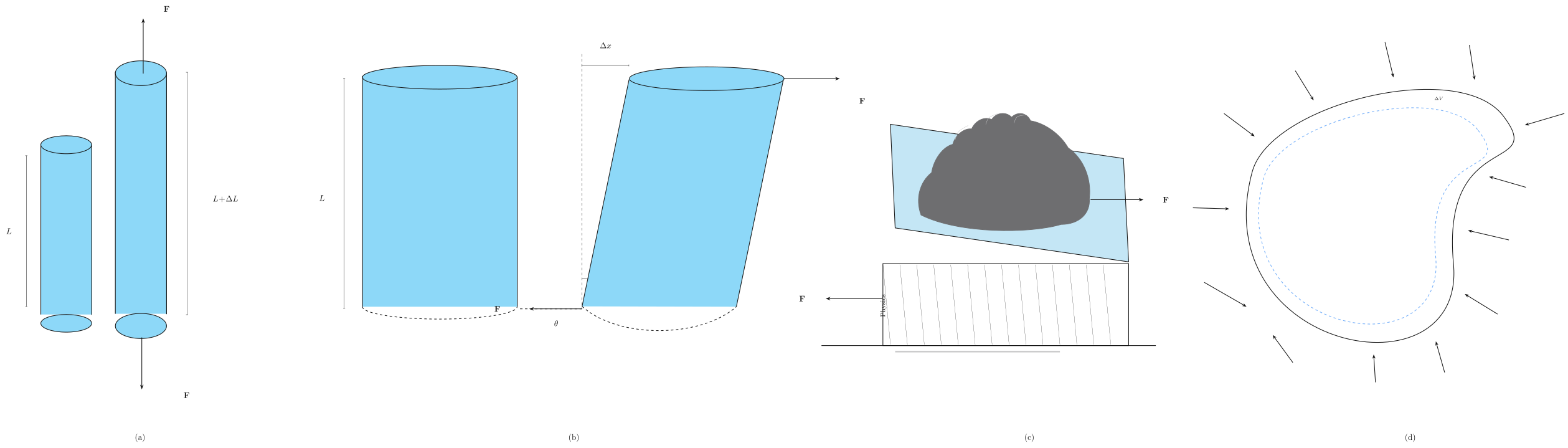
Drawn by us to help you understand the concept clearly, and verified to make sure it's accurate. For exams, practice from your NCERT textbook's own diagram.
Fig. 8.1 is a single composite diagram that introduces the three fundamental ways a solid body can be deformed. The textbook uses it to define stress and strain before stating Hooke’s law. Each panel isolates one type of deformation so you can see exactly what changes and what stays the same.
Panel (a) shows a tensile deformation. Two identical vertical cylinders are drawn side by side: one has original length , the other has been stretched to length . A pair of equal and opposite forces pull upward on the top face and downward on the bottom face. The key idea is that the force is perpendicular (normal) to the cross-section, and the body elongates along the direction of the force. The tensile stress is , where is the cross-sectional area, and the longitudinal strain is .
Panel (b) introduces shear deformation using a cylinder. The bottom face is fixed. A force acts parallel to the top face, displacing it sideways by . The cylinder tilts through a small angle , but its volume does not change. The shearing stress is (force parallel to the face divided by the area of that face), and the shearing strain is (for small angles, , where is the height of the cylinder).
Panel (c) is a second example of shear — a book pressed down by a hand and pushed horizontally. The top cover moves right relative to the fixed bottom cover. This reinforces that shear involves forces parallel to the surface, causing adjacent layers to slide past each other without changing volume.
Panel (d) shows hydraulic (or volume) stress. A solid sphere is squeezed by forces pointing inward from all directions — normal to the surface at every point. The dashed inner outline indicates the sphere shrinks uniformly, so its volume decreases by but its shape remains a sphere. The stress here is the pressure (force per unit area, same from all sides), and the volumetric strain is .
The figure teaches that stress is always defined as force per unit area, but the type of stress (tensile, shear, or hydraulic) depends on whether the force is perpendicular or parallel to the surface, and whether it acts in one direction or from all sides. Strain is always a dimensionless ratio describing the relative change — in length, angle, or volume. …