Q.Why is it detrimental for a nation to have negative balance of payments?
You're viewing a preview — the full solution, concept, methods & PYQ mapping are locked.
Start your 14-day free trial to unlock the full solution →A persistent negative balance of payments drains a country's foreign exchange reserves, weakens its currency, and can lead to economic instability by making it harder to pay for essential imports and service foreign debt.
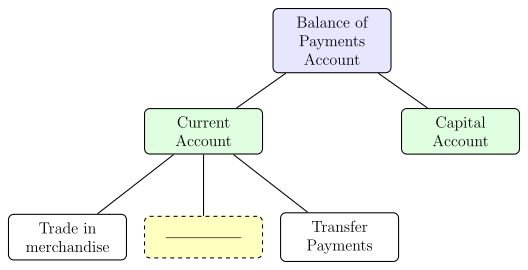
To understand why a negative balance of payments (BoP) is harmful, you first need to grasp what the BoP actually is. Think of it as a nation's financial report card with the rest of the world. It records every single transaction between residents of that country and residents of other countries — exports and imports of goods and services, money sent home by workers abroad, foreign investments, and loans. The BoP has two main parts: the current account (trade in goods and services plus income flows) and the capital account (financial flows like investments and loans). A negative BoP simply means more money is flowing out of the country than flowing in over a given period.
Now, why is this a problem? The immediate and most visible consequence is pressure on the country's currency. When a nation has a negative BoP, it means there is a higher demand for foreign currency (to pay for imports, for instance) than for its own currency. Basic supply and demand tells you what happens next: the domestic currency tends to depreciate or weaken. A weaker currency makes imports more expensive, which fuels inflation — especially in a country that relies heavily on imported oil, machinery, or raw materials. This hits ordinary citizens directly through higher prices for petrol, electronics, and even food.
A temporary negative BoP is not always disastrous. For example, a developing country might run a deficit because it is importing capital goods (machinery, technology) to build factories and infrastructure. If those investments later boost exports, the deficit can be self-correcting. The real danger is a persistent or structural deficit.
The second major problem is the drain on foreign exchange reserves. Every country keeps a stockpile of foreign currencies (mostly US dollars) to manage international payments and defend its currency in times of crisis. A prolonged negative BoP forces the central bank to dip into these reserves to finance the deficit. If reserves run low, the country becomes vulnerable to a balance of payments crisis — it may not have enough dollars to pay for essential imports like medicine, fuel, or food. This is exactly what happened in several emerging economies in the past, leading to sharp recessions and even defaults on foreign debt. …
Unlock everything free for 14 days
- Full step-by-step solutions
- Concept-first explanations
- Methods, shortcuts & mistakes
- PYQ mapping + timed mock tests
Full access for 14 days. No credit card required.