Geography · Ch 5 — Secondary Activities
Classification of Manufacturing Industries
Classification of Manufacturing Industries
Classification of Manufacturing Industries
Manufacturing industries are classified on the basis of four criteria: size, inputs/raw materials, output/products, and ownership. Each criterion gives us a different way of understanding how industries are organised and what they produce.
Industries Based on Size
The size of an industry is determined by three factors: the amount of capital invested, the number of workers employed, and the volume of production. On this basis, industries fall into three categories: household or cottage, small-scale, and large-scale.
Household Industries or Cottage Manufacturing
This is the smallest manufacturing unit. Artisans work in their own homes, using locally available raw materials and simple tools. They are helped by family members or part-time labour. The finished goods may be consumed within the household, sold in local village markets, or exchanged through barter.
Capital and transportation have little influence here because this type of manufacturing has low commercial significance. Most tools are devised locally. Common products include foodstuffs, fabrics, mats, containers, tools, furniture, shoes, and figurines from wood and forest products; leather items such as shoes and thongs; pottery and bricks from clay and stone; and jewellery made by goldsmiths from gold, silver, and bronze. Artefacts and crafts are also made from bamboo and locally sourced wood.
Small-Scale Manufacturing
Small-scale manufacturing differs from household industries in two key ways: its production techniques and its place of manufacture. The workshop is located outside the home or cottage of the producer. This type of manufacturing uses local raw materials, simple power-driven machines, and semi-skilled labour.
It provides employment and raises local purchasing power. For this reason, countries like India, China, Indonesia, and Brazil have developed labour-intensive small-scale manufacturing to provide jobs for their populations.
Large-Scale Manufacturing
Large-scale manufacturing involves a large market, a variety of raw materials, enormous energy, specialised workers, advanced technology, assembly-line mass production, and large capital. This kind of manufacturing developed over the last 200 years, first in the United Kingdom, north-eastern USA, and Europe. It has since spread to almost all over the world.
On the basis of the system of large-scale manufacturing, the world's major industrial regions can be grouped into two broad types:
- Traditional large-scale industrial regions — thickly clustered in a few more developed countries.
- High-technology large-scale industrial regions — which have diffused to less developed countries.
Industries Based on Inputs/Raw Materials
On the basis of raw materials used, industries are classified into five types: agro-based, mineral-based, chemical-based, forest-based, and animal-based.
Agro-Based Industries
Agro-processing involves turning raw materials from the field and the farm into finished products for rural and urban markets. Major agro-processing industries include food processing, sugar, pickles, fruit juices, beverages (tea, coffee, cocoa), spices, oils and fats, textiles (cotton, jute, silk), and rubber.
Food Processing — This includes canning, producing cream, fruit processing, and confectionery. Some preserving techniques such as drying, fermenting, and pickling have been known since ancient times, but they had limited applications before the Industrial Revolution.
Agri-business — This is commercial farming on an industrial scale, often financed by businesses whose main interests lie outside agriculture. For example, large corporations in the tea plantation business. Agri-business farms are mechanised, large in size, highly structured, and reliant on chemicals. They may be described as 'agro-factories'.
Mineral-Based Industries
These industries use minerals as raw material. Some use ferrous metallic minerals (containing iron), such as the iron and steel industry. Others use non-ferrous metallic minerals, such as aluminium, copper, and jewellery industries. Many industries use non-metallic minerals, such as the cement and pottery industries.
Chemical-Based Industries
Such industries use natural chemical minerals. For example, mineral oil (petroleum) is used in the petrochemical industry. Salts, sulphur, and potash industries also use natural minerals. Chemical industries are also based on raw materials obtained from wood and coal. Synthetic fibre and plastic are other examples of chemical-based industries.
Forest-Based Raw Material Using Industries …
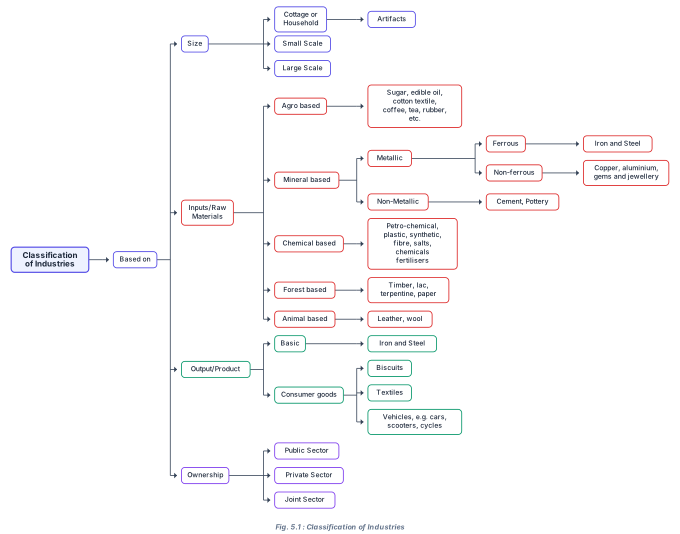
Drawn by us to help you understand the concept clearly, and verified to make sure it's accurate. For exams, practice from your NCERT textbook's own diagram.
Figure 5.1 is a hierarchical tree diagram that organises the entire classification of manufacturing industries into four parallel branches. The root node is simply labelled "Classification of Industries". From there, a single "Based on" node splits into four main categories: Size, Inputs/Raw Materials, Output/Product, and Ownership. Each branch then subdivides further, showing how industries are grouped under each criterion.
Under Size, the diagram shows three subcategories. "Cottage or Household" leads to "Artifacts" — this captures the smallest unit, where artisans work at home with family labour and local tools. "Small Scale" and "Large Scale" are the other two, with no further sub-branches shown. The key point here is that size is determined by capital, workers, and production volume, not by the type of product.
The Inputs/Raw Materials branch is the most detailed. It splits into five types: "Agro based", "Mineral based", "Chemical based", "Forest based", and "Animal based". Each has examples listed. Agro based leads to sugar, edible oil, cotton textile, coffee, tea, rubber, etc. Chemical based leads to petro-chemical, plastic, synthetic fibre, salts, and chemical fertilisers. Forest based leads to timber, lac, turpentine, and paper. Animal based leads to leather and wool.
Mineral based is further subdivided. It splits into "Metallic" and "Non-Metallic". Non-Metallic leads to cement and pottery. Metallic splits again into "Ferrous" (leading to iron and steel) and "Non-ferrous" (leading to copper, aluminium, gems and jewellery). This nested structure is important: it shows that mineral-based industries are not a single category but a hierarchy based on the type of mineral.
The Output/Product branch has two main arms: "Basic" and "Consumer goods". Basic leads to iron and steel — these are industries whose products become raw materials for other industries. Consumer goods splits into three examples: biscuits, textiles, and vehicles (e.g. cars, scooters, cycles). This branch teaches that industries can be classified by what they produce: either intermediate goods (basic) or final goods for direct consumption.
Finally, Ownership has three branches: "Public Sector", "Private Sector", and "Joint Sector". No further sub-branches are shown, but the textbook text clarifies that public sector industries are government-owned, private sector are individually owned, and joint sector are managed by joint stock companies or public-private partnerships.
The diagram is a pure classification tool — it does not show any geographic locations, factory images, or time periods. Every label is a category name or an example product. The arrows simply indicate "is a type of" or "leads to". The figure's purpose is to give you a single visual summary of the four ways industries are classified, which the chapter then explains in detail. …