Geography · Ch 6 — Tertiary and Quaternary Activities
Types of Tertiary Activities
Types of Tertiary Activities
Trade, transport, communication, and services form the backbone of tertiary activities. Every time you buy a notebook from a shop, travel by bus, send a letter, or visit a doctor, you are engaging with this sector. The textbook classifies these activities into a clear hierarchy, which we will unpack step by step.
Trade and Commerce
Trade is the buying and selling of items produced elsewhere. All services in retail and wholesale trading are intended for profit. The towns and cities where these activities concentrate are called trading centres. Trade has evolved from local barter to international money-exchange, giving rise to specialised centres that act as collection and distribution points.
Trading centres are divided into two broad types:
Rural marketing centres cater to nearby settlements. They are quasi-urban — the most rudimentary type of trading centre. Personal and professional services are not well-developed here. These centres serve as local collecting and distributing points. Most have mandis (wholesale markets) and retail areas. They are not urban centres per se, but they are vital for making frequently demanded goods and services available to rural folk.
Periodic markets appear in rural areas where regular markets are absent. They are organised at different temporal intervals — weekly or bi-weekly — so people from surrounding areas can meet their accumulated demand. These markets are held on specified dates and move from one place to another. This system keeps shopkeepers busy every day while serving a large area.
Urban marketing centres offer more widely specialised urban services. They provide ordinary goods as well as many specialised goods and services. Urban centres offer manufactured goods and specialised markets — for labour, housing, semi-finished or finished products. Services of educational institutions and professionals (teachers, lawyers, consultants, physicians, dentists, veterinary doctors) are available here.
Retail Trading
Retail trading is the business activity concerned with selling goods directly to consumers. Most retail trading takes place in fixed establishments or stores devoted solely to selling. However, non-store retail trading includes street peddling, handcarts, trucks, door-to-door sales, mail-order, telephone, automatic vending machines, and the internet.
The textbook discusses three important store innovations:
- Consumer cooperatives — the first large-scale retail innovation.
- Departmental stores — delegate responsibility and authority to departmental heads for purchasing and overseeing sales in different sections.
- Chain stores — purchase merchandise most economically, often directing goods to be manufactured to their specification. They employ highly skilled specialists and can experiment in one store and apply results to many.
Wholesale Trading
Wholesale trading constitutes bulk business through numerous intermediary merchants and supply houses — not through retail stores. Some large stores, including chain stores, can buy directly from manufacturers. However, most retail stores procure supplies from an intermediary source. Wholesalers often extend credit to retail stores to such an extent that the retailer operates very largely on the wholesaler's capital.
Transport
Transport is a service or facility by which people, materials, and manufactured goods are physically carried from one location to another. It is an organised industry created to satisfy man's basic need of mobility. Modern society requires speedy and efficient transport systems to assist in production, distribution, and consumption. At every stage in this complex system, the value of the material is significantly enhanced by transportation.
Transport distance can be measured in three ways:
- km distance — actual distance of route length
- time distance — the time taken to travel on a particular route
- cost distance — the expense of travelling on a route
In selecting the mode of transport, distance in terms of time or cost is the determining factor. Isochrone lines are drawn on a map to join places equal in terms of the time taken to reach them.
Network and Accessibility: As transport systems develop, different places are linked together to form a network. Networks are made up of nodes and links. A node is the meeting point of two or more routes — a point of origin, a point of destination, or any sizeable town along a route. Every road that joins two nodes is called a link. A developed network has many links, meaning places are well-connected.
Factors Affecting Transport: Demand for transport is influenced by the size of population — the larger the population, the greater the demand. Routes depend on:
- location of cities, towns, villages, industrial centres, and raw materials
- pattern of trade between them
- nature of the landscape between them
- type of climate
- funds available for overcoming obstacles along the length of the route
Communication
Communication services involve the transmission of words and messages, facts and ideas. The invention of writing preserved messages and made communication dependent on means of transport — messages were carried by hand, animals, boat, road, rail, and air. That is why all forms of transport are also referred to as lines of communication. Where the transport network is efficient, communications are easily disseminated.
Certain developments — such as mobile telephony and satellites — have made communications independent of transport. However, all forms are not fully disassociated because of the cheapness of older systems. Very large volumes of mail continue to be handled by post offices all over the world.
Telecommunications: The use of telecommunications is linked to modern technology. It has revolutionised communications because of the speed with which messages are sent — time reduced from weeks to minutes. Recent advancements like mobile telephony have made communications direct and instantaneous at any time and from anywhere. The telegraph, morse code, and telex have almost become things of the past.
Radio and television relay news, pictures, and telephone calls to vast audiences around the world — they are termed mass media. They are vital for advertising and entertainment. Newspapers are able to cover events in all corners of the world. Satellite communication relays information of the earth and from space. The internet has truly revolutionised the global communication system.
Services
Services occur at many different levels. Some are geared to industry, some to people, and some to both — for example, transport systems.
Low-order services (grocery shops, laundries) are more common and widespread than high-order services or more specialised ones (accountants, consultants, physicians). Services are provided to individual consumers who can afford to pay for them.
The textbook distinguishes between types of labour:
- Physical labour — gardener, launderer, barber …
Drawn by us to help you understand the concept clearly, and verified to make sure it's accurate. For exams, practice from your NCERT textbook's own diagram.
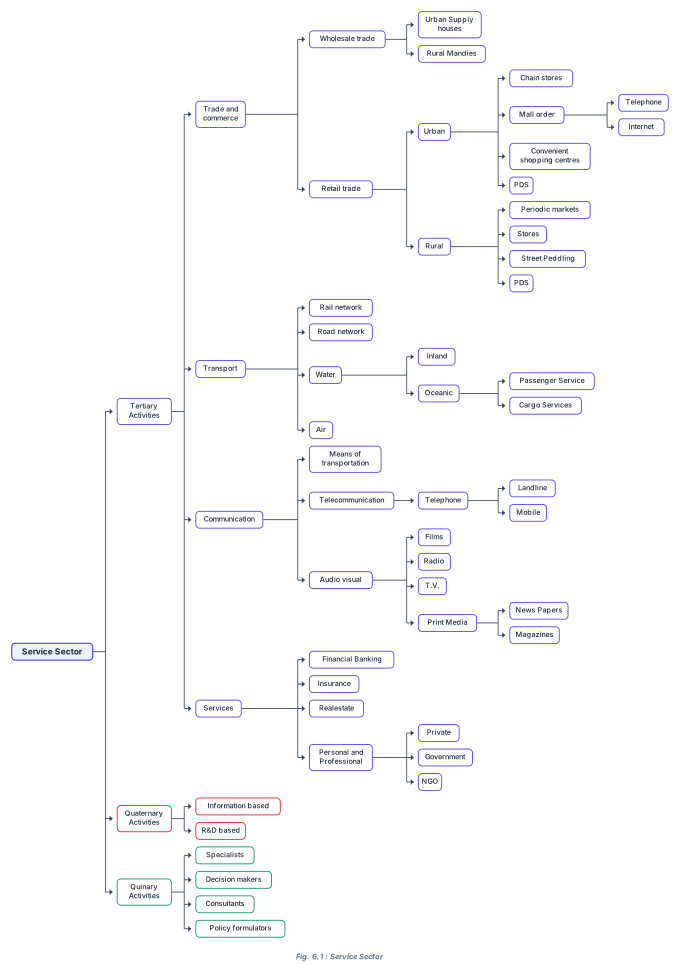
The figure is a full-page classification tree, with Service Sector as the single root at the top. From this root, three main branches spread out: Tertiary Activities, Quaternary Activities, and Quinary Activities. Each branch then splits further into subcategories, with boxes connected by single-line links and arrows to show the hierarchy.
Tertiary Activities is the largest branch, dividing into four main groups:
-
Trade and commerce → splits into Retail trade and Wholesale trade.
- Retail trade further divides into Rural and Urban.
- Rural retail includes: Periodic markets, Stores, Street Peddling, and PDS (Public Distribution System).
- Urban retail includes: Chain stores, Mall order, Convenient shopping centres, and PDS.
- Mall order itself branches into Telephone and Internet.
- Wholesale trade splits into Urban Supply houses and Rural Mandies.
- Retail trade further divides into Rural and Urban.
-
Transport → splits into Rail network, Road network, Water, and Air.
- Water further divides into Inland and Oceanic.
- Oceanic splits into Passenger Service and Cargo Services.
- Water further divides into Inland and Oceanic.
-
Communication → splits into Means of transportation and Telecommunication.
- Telecommunication divides into Telephone (with sub-branches Landline and Mobile) and Audio visual (with sub-branches Films, Radio, T.V., Print Media).
- Print Media further splits into News Papers and Magazines.
- Telecommunication divides into Telephone (with sub-branches Landline and Mobile) and Audio visual (with sub-branches Films, Radio, T.V., Print Media).
-
Services → splits into Financial Banking, Insurance, Realestate, and Personal and Professional.
- Personal and Professional divides into Private, Government, and NGO.
Quaternary Activities branch splits into two: Information based and R&D based.
Quinary Activities branch splits into three: Specialists Decision makers, Consultants, and Policy formulators.
The figure is a conceptual map, not a photograph or diagram of real places. It organises the entire service sector into three tiers of activity — tertiary (routine services like trade, transport, communication), quaternary (information and research), and quinary (high-level decision-making). The arrows show how each broad category breaks down into specific examples, helping you see the logical structure behind the textbook's discussion. …