History · Ch 3 — Kinship, Caste and Class — Early Societies
The ideal of patriliny
The ideal of patriliny
The ideal of patriliny
The Mahabharata is not just a story of a war — it is a text that reveals how kinship relations were understood and how they changed. At its core, the epic describes a feud over land and power between two groups of cousins, the Kauravas and the Pandavas, who belonged to a single ruling family: the Kurus. The Kurus were a lineage that dominated one of the janapadas (the early states or territorial units of the Vedic period). The conflict ended in a battle, and after the Pandavas won, patrilineal succession was proclaimed.
Patriliny means tracing descent from father to son, grandson, and so on. This system had existed before the epic was composed, but the central story of the Mahabharata reinforced the idea that patriliny was valuable. Under patriliny, sons could claim the resources of their fathers when the latter died — including the throne in the case of kings.
Most ruling dynasties from roughly the sixth century BCE onwards claimed to follow this system. But in practice, there were many variations:
- Sometimes there were no sons, so brothers succeeded one another.
- In other situations, other kinsmen claimed the throne.
- In very exceptional circumstances, women such as Prabhavati Gupta (discussed in Chapter 2) exercised power.
The concern with patriliny was not limited to ruling families. It is also evident in mantras from ritual texts such as the Rigveda. One such mantra, probably inserted into the text around 1000 BCE, was chanted by a priest during a marriage ritual. It is still used in many Hindu weddings today:
I free her from here, but not from there. I have bound her firmly there, so that through the grace of Indra she will have fine sons and be fortunate in her husband’s love.
In this mantra, “here” refers to the father’s house, and “there” refers to the husband’s house. The bride is released from her father’s household but bound to her husband’s. The implications for the bride and groom are not identical: the bride is expected to leave her natal home and produce sons for her husband’s lineage, while the groom gains a wife who will continue his patriline. The mantra explicitly links marriage to the production of “fine sons” — a clear expression of the value placed on patrilineal continuity.
These attitudes were likely shared by wealthy men and those who claimed high status, including Brahmanas.
Sanskrit texts use the term kula to designate families, jnati for the larger network of kinfolk, and vamsha for lineage. Matriliny, by contrast, is the term used when descent is traced through the mother.
Why kinfolk quarrelled
The Adi Parvan (the first section) of the Sanskrit Mahabharata describes why conflicts arose among the Kauravas and Pandavas. The Kauravas were the sons of Dhritarashtra, and the Pandavas were their cousins. Because Dhritarashtra was blind, his younger brother Pandu ascended the throne of Hastinapura. After Pandu’s premature death, Dhritarashtra became king, as the royal princes were still very young.
As the princes grew up together, the citizens of Hastinapura began to express a preference for the Pandavas, who were more capable and virtuous. This made Duryodhana, the eldest of the Kauravas, jealous. He approached his father and said: …
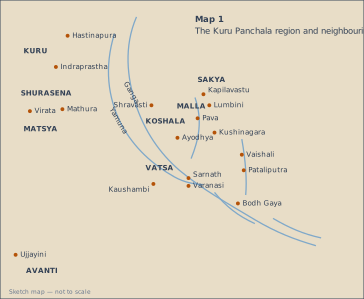
Map 1 is a schematic sketch map of the northern part of the Indian subcontinent, centred on the Ganga-Yamuna doab. It is not drawn to scale. The map’s primary purpose is to show the location of the Kuru region and the neighbouring janapadas (territorial states or tribal settlements) that are mentioned in the Mahabharata and other early texts.
The map marks the following janapadas by name, each placed roughly in its geographical position: KURU (the central region around modern Delhi and western Uttar Pradesh), SHURASENA (south of Kuru, around Mathura), MATSYA (west of Kuru, around Virata), VATSA (south-east of Kuru, around Kaushambi), KOSHALA (east of Kuru, along the Ganga), MALLA (further east, in the region of Kushinagara and Pava), SAKYA (north-east, around Kapilavastu and Lumbini), and AVANTI (far south-west, around Ujjayini). The map also shows the Panchala region (not labelled separately in the description, but implied by the title “Kuru-Panchala region”).
Within these janapadas, the map marks towns and cities that are significant in the Mahabharata story and in early Indian history. These include: Indraprastha (the Pandava capital, in Kuru), Hastinapura (the Kaurava capital, also in Kuru), Mathura (in Shurasena), Virata (in Matsya), Kaushambi (in Vatsa), Shravasti and Ayodhya (in Koshala), Varanasi and Sarnath (on the Ganga, in Koshala or nearby), Bodh Gaya (south of the Ganga), Kushinagara and Pava (in Malla), Vaishali (north of the Ganga, in the region of the Licchavis), Pataliputra (at the confluence of the Ganga and Son, later the Mauryan capital), Kapilavastu and Lumbini (in Sakya), and Ujjayini (in Avanti).
The map shows the Ganga and Yamuna rivers flowing roughly east-west, with the Ganga forming the northern boundary of the Kuru region and the Yamuna flowing south of it. The towns are placed along these rivers or near them, reflecting the importance of riverine routes and fertile plains. …
Terms for family and kin. Sanskrit texts use the term kula to designate families and jnati for the larger network of kinfolk. The term vamsha is used for lineage. Patriliny means tracing descent from father to son, grandson and so on. Matriliny is the ter …
Source 1 — Producing "fine sons." An excerpt of a mantra from the Rigveda (probably inserted c. 1000 BCE), chanted by the priest during the marriage ritual and used in many Hindu weddings even today:
I free her from here, but not from there. I have bound her firmly there, so that through the grace of Indra she will have fine sons and be fortunate in her husband's love.
(Indra was one of the principal deities, a god of valour, warfare and rain. "Here" and "there" refer to the father's and husband's house respectively.) …
Source 2 — Why kinfolk quarrelled. An excerpt from the Adi Parvan (the first section) of the Sanskrit Mahabharata, on why conflict arose between the Kauravas and Pandavas:
The Kauravas were the … sons of Dhritarashtra, and the Pandavas … were their cousins. Since Dhritarashtra was blind, his younger brother Pandu ascended the throne of Hastinapura … However, after the premature death of Pandu, Dhritarashtra became king … As the princes grew up together, the citizens of Hastinapura began to express their preference for the Pandavas, for they were more capable and virtuous than the Kauravas. This made Duryodhana, the eldest of the Kauravas, jealous. …