History · Ch 5 — Through the Eyes of Travellers — Perceptions of Society
The “enjoyment of curiosities”
The “enjoyment of curiosities”
The “enjoyment of curiosities”
Ibn Battuta was not just a traveller — he was an inveterate one, meaning he travelled compulsively and over vast distances. Over several years, he journeyed through north Africa, West Asia, parts of Central Asia (possibly even Russia), the Indian subcontinent, and China, before finally returning to his native Morocco. When he came back, the local ruler ordered that his stories be recorded. This was not a casual request: the ruler wanted a permanent account of the cities Ibn Battuta had seen, the interesting events he remembered, and the people he had met — rulers, scholars, and pious saints.
The task of writing down Ibn Battuta’s dictated account was given to a scholar named Ibn Juzayy. In his introduction, Ibn Juzayy explained the purpose of the work. He said the narrative was meant to give entertainment to the mind and delight to the ears and eyes. It was filled with a variety of curious particulars — things that were strange, unusual, or marvellous. By exposing these wonders, the account was supposed to both edify (teach or instruct) and arouse interest. In other words, the travelogue was meant to be both educational and entertaining — a blend of learning and pleasure.
The phrase “enjoyment of curiosities” captures this dual purpose: the reader was expected to enjoy the strange and wonderful things described, while also learning from them.
In the footsteps of Ibn Battuta
Ibn Battuta was not the last traveller to write about India. Between 1400 and 1800, many visitors to India wrote travelogues in Persian. At the same time, Indians who travelled to Central Asia, Iran, and the Ottoman Empire also sometimes recorded their experiences. These writers were consciously following in the footsteps of earlier authors like Al-Biruni and Ibn Battuta — some had even read their works.
Among the best-known of these later travellers were:
- Abdur Razzaq Samarqandi — visited south India in the 1440s.
- Mahmud Wali Balkhi — travelled very widely in the 1620s. He was so fascinated by India that he even became a sort of sanyasi (a Hindu ascetic) for a time.
- Shaikh Ali Hazin — came to north India in the 1740s. Unlike Balkhi, he was disappointed and even disgusted with India, because he had expected to receive a red-carpet welcome. …
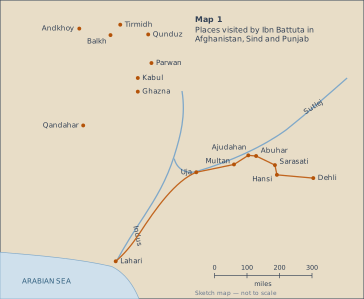
Map 1 is a sketch map — not drawn to scale, though it does include a scale bar — that traces the route Ibn Battuta took through Afghanistan, Sind, and Punjab on his way to Delhi. The place-names are spelled as Ibn Battuta himself would have known them, which gives the map a historical rather than a modern geographical feel.
The route begins in the northwest, in Central Asia, at Andkhoy (in present-day northern Afghanistan), then moves east to Tirmidh (Termez, on the Amu Darya), Balkh, Qunduz, and Parwan. From there it goes south to Kabul, then southeast to Ghazna (Ghazni) and Qandahar (Kandahar). After crossing into the Indian subcontinent, the path continues through Ajudahan (possibly a medieval name for a settlement in Punjab), Multan, Uja (likely Uch, at the confluence of the Indus and Chenab), Sarasati (on the Saraswati river, now dry), Abuhar (Abohar), and Hansi, before finally reaching Dehli (Delhi). The map also shows the Indus and Sutlej rivers, which Ibn Battuta would have crossed or followed.
The map is not a modern political map — it is a schematic reconstruction of the traveller's own mental geography. The scale bar (marked 0, 100, 200, 300 miles) allows a rough calculation: the textbook asks students to use it to find the distance between Multan and Delhi. That exercise is the map's main pedagogical purpose — to make the reader engage with the actual scale of Ibn Battuta's journey, not just memorise names. …
Source 3 — Education and entertainment. Ibn Juzayy, deputed to write down what Ibn Battuta dictated, explains the commission:
A gracious direction was transmitted (by the ruler) that he should dictate an account of the cities which he had seen in his travel, and of the interesting events which had clung to his memory … Accordingly he dictated … a narrative which gave entertainment to the mind and delight to the ears and eyes, with a variety of curious particulars … and of marvellous things, by referring to which he aroused interest. …
In the footsteps of Ibn Battuta. Between 1400 and 1800 many visitors wrote travelogues in Persian, and Indian visitors to Central Asia, Iran and the Ottoman empire also recorded their experiences. Among the best known were Abdur Razzaq Samarqandi (south India, 1440s), Mahmud Wali Balkhi (1620s — who briefly became a kind of sanyasi) and Shaikh Ali H …
The painting shows a group of travellers seated around a campfire at night. The scene is set in the open, with no buildings or city walls visible — the road itself is the setting. Several men are gathered in a rough circle near the flames, some sitting cross-legged, others leaning forward. A few appear to be talking or listening; one may be warming his hands. In the background, a couple of pack animals (likely horses or mules) stand tethered, with baggage still strapped on. The fire casts light on the faces and clothes of the travellers, while the edges of the painting are dark, suggesting the surrounding wilderness.
This image captures the sociable yet hazardous reality of long-distance travel in the pre-modern world. Travellers like Ibn Battuta, Abdur Razzaq Samarqandi, or Mahmud Wali Balkhi would have spent many nights exactly like this — strangers thrown together by the road, sharing food, news, and stories around a fire. The campfire is both a practical necessity (for warmth, cooking, and keeping wild animals at bay) and a social centre: it is where travellers exchanged information about routes, rulers, and dangers ahead.
At the same time, the painting hints at the risks. There is no inn, no wall, no guard — just a small group of people in an open landscape, vulnerable to bandits, wild animals, or bad weather. The travellers are alert, not relaxed. The world of the road was one of constant uncertainty, where a traveller’s safety depended on the goodwill of strangers and the luck of the journey. …