Economics · Ch 11 — Market Equilibrium
Price Floor
Price Floor
5.2.2 Price Floor
Governments sometimes decide that the market price for a particular good or service is too low — that allowing it to fall below a certain level would be harmful to producers or workers. In such cases, the government steps in and sets a minimum legal price, called a price floor. A price floor is a lower limit on the price that may be charged for a good or service. No one is allowed to sell below this floor.
The two most familiar examples of price floors are agricultural price support programmes and minimum wage legislation.
In an agricultural price support programme, the government sets a minimum purchase price for certain crops (like wheat, rice, or cotton). This floor is typically set above the market-determined equilibrium price. The goal is to protect farmers' incomes from the volatility of agricultural markets, where a bumper harvest could drive prices very low.
Similarly, a minimum wage law sets a floor on the wage rate that employers can pay their workers. The minimum wage is also set above the equilibrium wage that would prevail in an unregulated labour market. The purpose is to ensure that workers earn a living wage and do not fall into poverty.
A price floor is only effective — meaning it actually changes the market outcome — if it is set above the equilibrium price. If the floor is set below the equilibrium, the market price will simply stay at equilibrium, and the floor has no effect. All textbook analysis of price floors assumes the floor is set above equilibrium.
How a Price Floor Creates Excess Supply
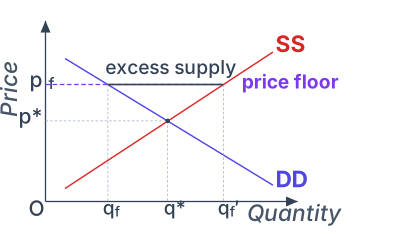
Consider a market for a commodity on which the government imposes a price floor. Figure 5.8 in the textbook illustrates this situation. The diagram has the standard axes: price on the vertical axis and quantity on the horizontal axis. The market demand curve slopes downward, and the market supply curve slopes upward.
Without government intervention, the market would reach equilibrium at price and quantity , where the demand and supply curves intersect.
Now the government imposes a price floor at , which is higher than . At this higher price, two things happen:
- Buyers reduce their quantity demanded. At price , the market demand is only units.
- Sellers increase their quantity supplied. At the attractive higher price , firms want to supply units.
Since is greater than , there is an excess supply (also called a surplus) in the market. The size of this surplus is the horizontal distance between the quantity supplied and the quantity demanded at the floor price:
This surplus is a direct consequence of the price floor. The market cannot clear on its own because the price is not allowed to fall to the equilibrium level.
Drawn by us to help you understand the concept clearly, and verified to make sure it's accurate. For exams, practice from your NCERT textbook's own diagram.
Figure 5.8 is a standard supply-and-demand diagram. The vertical axis is labelled Price and the horizontal axis is Quantity. Two curves are drawn: an upward-sloping SS curve (supply, shown in red) and a downward-sloping DD curve (demand, shown in indigo). These two curves intersect at a single point, which is the market equilibrium. That intersection is labelled with coordinates (p*, q*) — the equilibrium price and quantity.
Above this equilibrium, a horizontal dashed line is drawn in purple at a price labelled p_f. This is the price floor — a legally imposed minimum price that is set above the market-clearing price p*. The line extends across the entire width of the diagram, indicating that the floor applies to all transactions.
Now look at where this price floor line meets the demand and supply curves. On the demand curve (DD), at price p_f, the quantity demanded is labelled q_f. On the supply curve (SS), at the same price p_f, the quantity supplied is labelled q_f' (read as "q_f prime"). Because the supply curve slopes upward and the demand curve slopes downward, q_f' is clearly larger than q_f. The horizontal distance between these two points — from q_f to q_f' — is marked as excess supply (a surplus). This gap is the key visual takeaway: at the floor price, sellers want to sell more than buyers want to buy. …
In a normal, unregulated market, a surplus would push the price down until equilibrium is restored. But a price floor legally prevents that adjustment. The surplus therefore persists as long as the floor is in place.
The Government's Role: Buying the Surplus
The textbook specifically discusses the case of agricultural price support. When a price floor creates a surplus of agricultural goods, the government cannot simply leave the surplus in the market. If it did, the excess supply would cause the market price to fall below the floor, defeating the purpose of the policy.
To prevent this, the government must step in and buy the entire surplus at the predetermined floor price . The government purchases the quantity from producers. This purchase removes the excess supply from the market, allowing the price to stay at the floor level.
The government then stores this surplus grain, or disposes of it through other means (such as export subsidies, food aid, or selling it at a loss in other markets). The cost of this programme is borne by taxpayers.
The key result of a price floor set above equilibrium is a persistent excess supply. In agricultural markets, the government must buy this surplus to maintain the floor price. In labour markets (minimum wage), the surplus takes the form of unemployment — more workers want jobs at the higher wage than firms are willing to hire. …