Computer Science · Ch 11 — Data Communication
Full-duplex Communication
Full-duplex Communication
Full-duplex Communication
Full-duplex communication is two-way, bidirectional data transfer where both devices can send and receive data at the same time. Think of a two-lane road where vehicles travel in opposite directions simultaneously — there is no waiting for one direction to clear before the other starts.
This is the most advanced and efficient mode of data transmission. The key feature is simultaneity: neither device has to pause its transmission to receive data from the other end. Both channels of communication remain open and active throughout the session.
How it works technically: The capacity of the transmission link is shared between the signals travelling in opposite directions. This can be achieved in two ways:
- Using two physically separate simplex lines — one dedicated for sending data, the other for receiving. Each direction gets its own private path.
- Sharing the capacity of a single channel between signals going in different directions. The same wire or frequency band is split (through techniques like frequency division or echo cancellation) so that both directions can use it at once without interfering.
Real-world examples given in the textbook are:
- Mobile phones — you can speak and hear the other person at the same time during a call.
- Landline telephones — the same simultaneous two-way conversation is possible.
Full-duplex is the standard for modern voice communication. Without it, phone calls would feel unnatural — you would have to take turns speaking, like a walkie-talkie.
Comparison with other modes (implied by the textbook): …
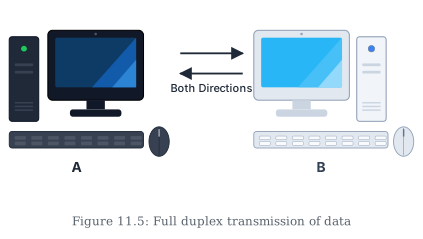
Drawn by us to help you understand the concept clearly, and verified to make sure it's accurate. For exams, practice from your NCERT textbook's own diagram.
Full-duplex is the most flexible mode: both directions work AT THE SAME TIME. Computer A can send data to B while, simultaneously, B is sending data to A — neither has to wait for the other to finish.
This is like a two-way road with lanes going in both directions at once, or an ordinary phone call, where both people can technically talk (and be heard) at the same time. Full-duplex needs more capability than …