Computer Science · Ch 11 — Data Communication
Half-duplex Communication
Half-duplex Communication
Half-duplex communication is a two-way or bidirectional mode of data transmission between two devices. Both devices can send and receive data or control signals, but not at the same time. While one device is transmitting, the other must receive, and vice versa.
Think of it like a narrow one-way bridge shared by vehicles moving in opposite directions. Vehicles cannot cross the bridge simultaneously — one must wait until the other has passed. In technical terms, half-duplex is essentially a simplex channel whose direction of transmission can be switched.
A classic real-world example is a walkie-talkie. To speak, you press the push-to-talk button. This action enables the transmitter and turns off the receiver in your device. Others can only listen while you are talking. Once you release the button, the roles reverse.
The textbook refers to Figure 11.4, which illustrates that communication occurs in two different moments — one moment data flows from device A to B, and the next moment from B to A.
Key characteristics of half-duplex communication:
- Both devices can send and receive, but only one direction at a time.
- The transmission channel is shared, requiring a turn-taking mechanism. …
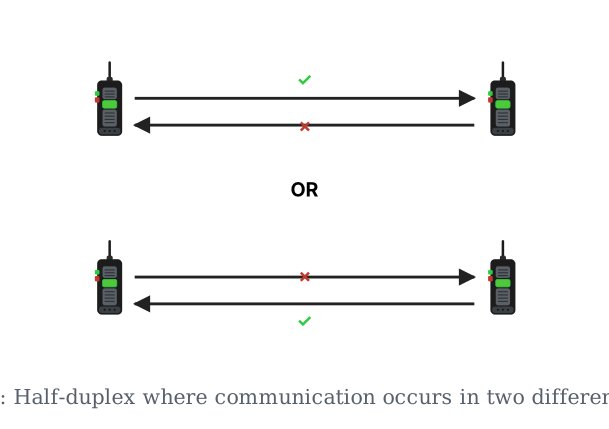
Drawn by us to help you understand the concept clearly, and verified to make sure it's accurate. For exams, practice from your NCERT textbook's own diagram.
Half-duplex allows communication in BOTH directions, but only ONE direction at a time — never simultaneously. Think of two walkie-talkies: while one person is holding down the button and talking, the other person can only listen; they have to wait for their turn before they can reply. …