Physical Education · Ch 1 — Management of Sporting Events
Functions of Sports Events Management
Functions of Sports Events Management
1.1 Functions of Sports Events Management
Running a sporting event, whether it is a one-day inter-house tournament or a national championship, follows the same set of management functions that guide any organised activity. In sport, these functions turn a rough idea — "let us hold a tournament" — into a well-run competition with clear objectives, a proper schedule, the right people in the right roles, and a way to check that everything is going to plan.
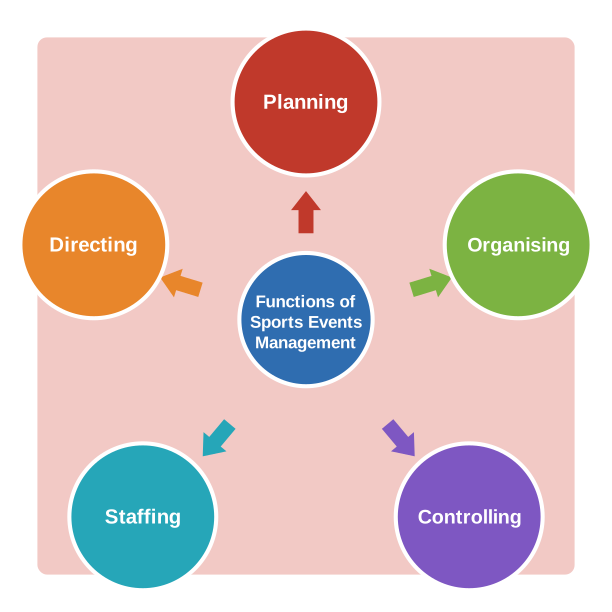
There are five functions of sports events management: Planning, Organising, Staffing, Directing and Controlling. They are not a one-time checklist but a cycle — each function leads into the next, and what you learn while controlling one event feeds back into the planning of the next. Explaining all five is a favourite CBSE Class 12 Physical Education board question, so learn them with a sports example for each.
Drawn by us to help you understand the concept clearly, and verified to make sure it's accurate. For exams, practice from your NCERT textbook's own diagram.
A central circle labelled 'Functions of Sports Events Management' with five coloured circles around it — Planning, Organising, Staffing, Directing and Controlling — each linked to the centre by an arrow, showing that the five functio …
Planning
Planning is the foremost function, because it gives a view of the future course of action. To be effective, a plan should be specific, logical, flexible and complete in all respects, and it should make the later controlling of the event easier. A good plan also comprehends all the other functions — organising, staffing, directing and controlling — so that the predetermined goals are actually reached.
In a sporting event, planning is what makes the event run smoothly and stay free of conflict. It clearly defines the aims, goals and objectives of the event and explains, in simple and easy language, the method by which those targets will be achieved. Practical planning decisions include the type and scale of the event, the fixtures, the dates and timings, the budget, and the rules and regulations, as well as contingencies for problems such as bad weather or a team withdrawing. A sports plan should be prepared in a professional manner, carrying the elements of commitment, enjoyment and voluntary effort.
Organising
Organising is the next step after planning — it is the process of executing the plan. It involves distributing the available resources and arranging personnel so that the goals set during the planning stage are achieved. The organising stage decides the type of jobs to be done and the responsibility attached to each, and it is at this stage that the organisation chart — showing the various positions and who reports to whom — is prepared. In short, if planning is the blueprint, organising is the construction that turns that blueprint into a working structure.
Staffing
Staffing means identifying the key staff positions and ensuring that proper talent is serving in each role to achieve the aims and objectives of the organisation. This is where recruitment and selection of qualified people take place, followed by orientation, training and professional development. During orientation, new members are introduced to the nature, goals and policies of the event so that they are tuned in to what the organisation wants; training programmes then build the professional skills they need.
In a sporting event, staff are recruited according to the organisation's needs. For example, the apex post may be a Director of the event, with a Deputy Director in the second line and an Assistant Director of the sports event below that — along with officials such as referees, umpires, judges, timekeepers, scorers, medical staff and volunteers.
Directing
Directing is a leadership function. It means letting the staff know what needs to be done, by whom, and by when, and then supervising them while keeping them motivated. Directing guides, inspires and instructs people so that they work towards the common organisational goal. Without directing, planning and organising have no meaning — the structure exists, but nothing moves. On the day of the event this is the most visible function: the organiser who is "running the show", giving clear instructions and making quick, fair decisions, is directing.