Question
Q.(a) Development of recombinant DNA technology has opened gates to many breakthroughs in the fields of medicine and agriculture. This has enabled scientists to isolate, sequence and manipulate individual genes obtained from diverse living or dead cells. Given below is a diagram showing the basic steps involved in genetically modifying an organism. Study the given diagram and answer the questions that follow : [Diagram:
(1) Restriction Enzyme → (Gene of Interest);
(2) Restriction Enzyme → Plasmid (Vector); (X) →
(3) rDNA (vector) →
(4) E. coli → (5)/(Y)]
(i) Are two different types of restriction endonucleases used, one to cut the vector DNA and another to cut the desired DNA to be cloned ? Support your answer, giving reason.
(ii) Which enzyme is used at step (X) to integrate the foreign DNA with the vector DNA ?
(iii) What is the term used for step (Y) showing multiple copies of the foreign DNA being formed in transformed E. coli ?
(iv) Draw a diagram of E. coli cloning vector pBR322 to show the following : (I) Any one restriction endonuclease site in tetracycline resistance gene (II) Any one restriction endonuclease site in ampicillin resistance gene (III) ‘ori’ site
(v) What does “rop” code for in plasmid pBR322 ?
(OR)
(b) RNA interference (RNAi) holds great potential as a therapeutic agent for the treatment of human diseases and as a bicontrol agent for controlling pests in the agricultural fields. An experiment was conducted to study the use of ‘RNAi’ for the potential treatment of disorders of cholesterol metabolism. Some people possess genetic mutations with elevated levels of ‘ApoB’ gene which predisposes them to coronary artery diseases. Lowering the amount of ‘ApoB’ can reduce the number of lipoproteins and lower the blood cholesterol. Tracy Zimmerman and her colleagues used RNAi in 2006 to reduce the level of ‘ApoB’ in non-human primates Cynomolgus monkeys.
(i) One group of monkeys were given RNAi treatment (Small interfering RNAs, SiRNAs) (doses 1 mg/kg SiRNAs),
(ii) Second group of monkeys were given RNAi treatment (doses 2·5 mg/kg SiRNAs), and
(iii) Third group of monkeys were injected saline as control. The results of the experiments are illustrated in the graph given below : [Graph: Relative serum cholesterol (% per dose) vs Time (hours) 24, 48, 144, 264; bars: Saline X, 1 mg/kg Y, 2·5 mg/kg Z]
(i) What do you interpret from the bars (X and Z) obtained after 264 hours of treatment of monkeys with saline and 2·5 mg/kg SiRNAs treatment ?
(ii) Name the category of organisms in the living world, where RNA interference (RNAi) takes place. Why ?
(iii) What is the basic principle involved in RNA interference (RNAi) in silencing the preferred genes ?
CBSECBSE Class XII Board 2022Subjective· 5mImportance★★★★★
You're viewing a preview — the full solution, concept, methods & PYQ mapping are locked.
Start your 14-day free trial to unlock the full solution →Part (a): one restriction enzyme is used for both vector and insert; DNA ligase joins them; the multiplication step is cloning; pBR322 carries tetR (BamHI/SalI site), ampR (PstI site), ori and rop (copy-number control).
Part (b): saline shows no change while 2.5 mg/kg siRNA sharply lowers cholesterol; RNAi occurs in eukaryotes (they have Dicer/RISC); dsRNA is cut to siRNA, which with RISC degrades the complementary mRNA.
Part (a)
- One enzyme or two? No — the same restriction endonuclease is used to cut both the vector DNA and the foreign (gene-of-interest) DNA. A given restriction enzyme cuts its palindromic site to leave characteristic single-stranded sticky (cohesive) ends. Only DNA cut by the same enzyme has complementary sticky ends, so the vector and the insert can pair up by hydrogen bonding; if two different enzymes were used, the ends would not be complementary and could not join.
- Enzyme at step (X). DNA ligase integrates the foreign DNA with the vector DNA. After the complementary sticky ends anneal, ligase seals the nicks by forming phosphodiester bonds, giving the recombinant DNA (rDNA).
- Term for step (Y). The formation of many copies of the foreign DNA inside the transformed E. coli is called cloning (gene amplification) — as the host multiplies and the plasmid replicates, the inserted gene is copied along with it.
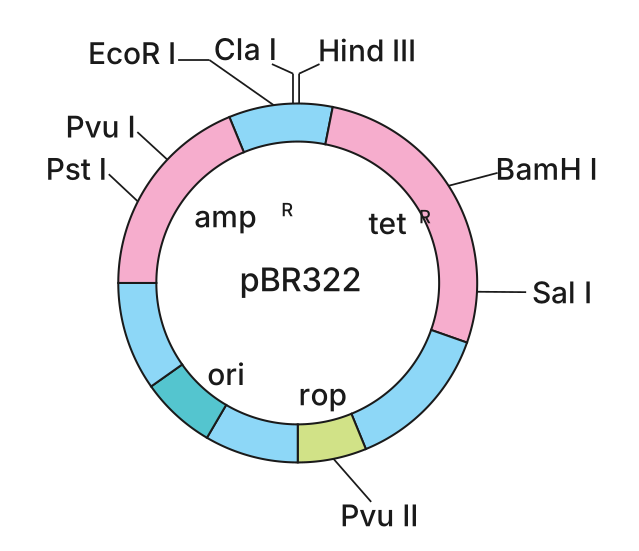
Circular map of the E. coli cloning vector pBR322 showing its restriction sites (Hind III, EcoR I, BamH I, Sal I, Pvu II, Pst I, Cla I), the ori site, and the antibiotic-resistance genes ampR and tetR. - Diagram of pBR322. Draw a circular plasmid and mark:
- (I) a restriction site within the tetracycline-resistance gene (tetR) — e.g. BamHI (or SalI);
- (II) a restriction site within the ampicillin-resistance gene (ampR) — e.g. PstI;
- (III) the ori (origin of replication). (Note: the EcoRI site of pBR322 lies outside both resistance genes, so it is not used for insertional inactivation; BamHI/SalI in tetR and PstI in ampR are the sites used as selectable markers.) …
Unlock everything free for 14 days
- Full step-by-step solutions
- Concept-first explanations
- Methods, shortcuts & mistakes
- PYQ mapping + timed mock tests
Full access for 14 days. No credit card required.