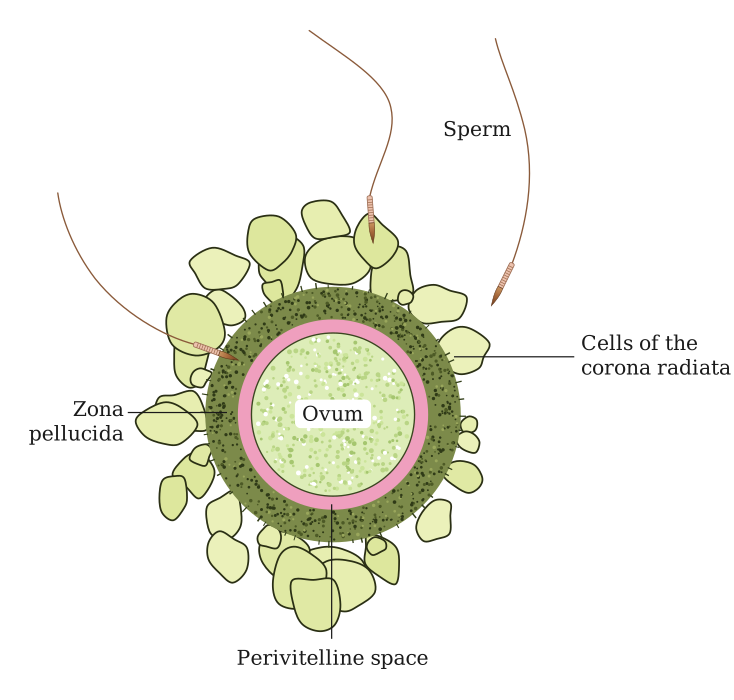
Q.(a) Given below is a diagrammatic representation of a human ovum. [Figure: human ovum with labels a, b, c, d]
🔒You're viewing a preview — the full solution, concept, methods & PYQ mapping are locked.
🔒 Start your 14-day free trial to unlock the full solution →Part (a)Concept understanding — Human Reproduction
Human Reproduction: A First Look
Think about what makes you you. You have your mother's eyes, your father's laugh, a mix of traits from two people you may never have met — your grandparents. That chain of life, stretching back thousands of years, runs through one process: human reproduction. It is not a topic for biology students alone. It is the story of how every single person on this planet came to be here.
The Big Picture: Why Does Reproduction Exist?
Every living thing has one fundamental drive: to continue its kind. A mango tree grows fruit so its seeds can sprout elsewhere. A bacterium splits in two. For humans, reproduction is more complex — and more personal. It is the reason families exist, why you have siblings or cousins, and why populations grow or shrink.
At its simplest, human reproduction is the biological process by which a new human individual is created. It requires two parents — a male and a female — each contributing a special cell that fuses to form a single, new cell. That single cell then grows, divides, and develops into a baby over about nine months.
Reproduction is not the same as sex. Sex is an act; reproduction is the entire sequence from cell fusion to birth. Not every act of sex leads to reproduction, and reproduction can sometimes happen with medical help (like IVF) without sex.
The Two Key Players: Male and Female Reproductive Systems
Your body, whether male or female, has a set of organs designed specifically for reproduction. These are not the same as the organs that keep you alive — they are the "spare set" dedicated to creating the next generation.
The Male System: Production and Delivery
The male reproductive system has one main job: to produce male sex cells (sperm) and deliver them to the female body. The key parts are:
- Testes (two oval organs in a pouch called the scrotum): These are the factories. They produce sperm continuously from puberty onwards — millions every day. They also produce testosterone, the hormone that drives male physical changes at puberty.
- Duct system (a series of tubes): Sperm travel from the testes through a long coiled tube (epididymis) where they mature, then through a muscular tube (vas deferens) that carries them toward the urethra.
- Accessory glands (seminal vesicles, prostate gland, bulbourethral glands): These add fluids to the sperm to nourish them and help them swim. The mixture of sperm and these fluids is called semen.
- Penis: The organ that delivers semen into the female reproductive tract.
The Female System: Production, Reception, and Nurturing
The female system has a bigger job: it produces female sex cells (eggs), receives sperm, and if fertilization occurs, houses and nourishes the developing baby for nine months. The key parts are:
- Ovaries (two almond-sized organs): These produce eggs — but unlike sperm, eggs are not made continuously. A female is born with all the eggs she will ever have (about 1–2 million at birth, reducing to around 300,000–400,000 by puberty). Each month, one egg matures and is released.
- Fallopian tubes (also called oviducts): These are not connected directly to the ovaries. When an egg is released, the finger-like ends of the tube sweep it inside. Fertilization — the meeting of sperm and egg — happens here, in the tube.
- Uterus (womb): A hollow, pear-shaped muscular organ. If fertilization happens, the embryo implants in the lining of the uterus and grows here. If not, the lining is shed — that is menstruation.
- Cervix: The lower, narrow part of the uterus that opens into the vagina. It produces mucus that changes consistency during the month to help or hinder sperm.
- Vagina: A muscular canal that receives the penis during intercourse and serves as the birth canal during delivery.
The female reproductive system has a monthly cycle (the menstrual cycle) that prepares the body for a possible pregnancy. This cycle is controlled by hormones and typically lasts about 28 days. The release of the egg (ovulation) happens around day 14. If no pregnancy occurs, the uterine lining is shed as menstrual blood — this is a normal, healthy process, not a "curse" or something to be ashamed of.
The Moment of Creation: Fertilization
When sperm from the male meet the egg from the female inside a fallopian tube, one sperm may penetrate the egg's outer layer. That single moment — fertilization — creates a new cell called a zygote. This zygote contains 23 chromosomes from the mother and 23 from the father, making 46 in total. That is the complete genetic blueprint for a new human being.
The zygote immediately begins to divide as it travels down the fallopian tube toward the uterus. By the time it reaches the uterus (about 5–7 days later), it has become a ball of about 100 cells called a blastocyst. This blastocyst burrows into the soft, thick lining of the uterus — a process called implantation. That is when pregnancy truly begins.
The Nine-Month Journey: Development
Once implanted, the developing human is called an embryo for the first eight weeks, and then a fetus from the ninth week until birth. During these months:
- A special organ called the placenta develops, connecting the mother's blood supply to the fetus. It delivers oxygen and nutrients and removes waste — without the mother's and baby's blood ever mixing directly.
- The umbilical cord links the baby to the placenta.
- The baby is protected by a fluid-filled sac (amniotic sac) that cushions it.
- All major organs form in the first three months (first trimester). The next three months (second trimester) are about growth and refinement. The final three months (third trimester) are about rapid weight gain and preparation for life outside the womb. …
Part (b)Concept understanding — Triple Fusion Process
Triple Fusion Process – A First Look
Imagine you are baking a cake. You have three separate ingredients: flour, eggs, and sugar. On their own, each is useful but incomplete. When you mix them together and bake, they fuse into something entirely new — a cake that has properties none of the individual ingredients had. That is the spirit of triple fusion, though in biology the ingredients are far more specific.
What Triple Fusion Actually Means
In the context of plant reproduction — specifically in flowering plants — triple fusion is a fertilisation event that happens inside the ovule (the part that becomes the seed). It involves the fusion of three nuclei: one sperm cell from the pollen grain fuses with two polar nuclei present in the central cell of the embryo sac. The result is a triploid (3n) nucleus, which then develops into the endosperm — the nutritive tissue that feeds the developing embryo.
This is not a random event. It is a carefully orchestrated step that occurs simultaneously with the fusion of another sperm cell with the egg cell (which forms the zygote). Because two fertilisation events happen together — one forming the zygote, the other forming the endosperm — the entire process is called double fertilisation. Triple fusion is the name given specifically to the second of these two events.
Triple fusion is not a separate process from double fertilisation. It is the second half of it. Double fertilisation = fusion of sperm with egg (syngamy) + fusion of sperm with two polar nuclei (triple fusion). The "triple" refers to the three nuclei that come together.
Why Does Triple Fusion Matter?
The endosperm produced by triple fusion is triploid — a condition unique to flowering plants. This triploid tissue is rich in nutrients (starch, proteins, oils) and serves as the food supply for the developing embryo. In many seeds we eat — like wheat, rice, maize, and coconut — the endosperm is the edible part.
Without triple fusion, the embryo would have no built-in food source. The seed would either fail to develop or would be too small to survive. This is why triple fusion is considered a key evolutionary innovation of angiosperms (flowering plants). It gave them a reproductive advantage over gymnosperms (like pines and cycads), whose endosperm is haploid and formed before fertilisation.
What the NCERT Textbook Says
The NCERT Class 12 Biology textbook (Chapter 2: Sexual Reproduction in Flowering Plants) describes triple fusion as follows:
- One of the two male gametes (sperm cells) moves towards the egg cell and fuses with it to form the zygote (2n).
- The other male gamete moves towards the central cell of the embryo sac, where it fuses with two polar nuclei (both haploid, 1n each). This fusion of three haploid nuclei produces a triploid primary endosperm nucleus (PEN).
- The PEN then divides repeatedly to form the endosperm, which nourishes the embryo.
The textbook emphasises that this is a unique feature of angiosperms — no other plant group does this.
Triple fusion is not the fusion of three cells. It is the fusion of three nuclei — one sperm nucleus + two polar nuclei. The result is a triploid nucleus, not a triploid cell. The cell that contains this nucleus is called the central cell, and it becomes the endosperm mother cell.
A Simple Way to Remember
Think of it as a three-way handshake inside the ovule:
- Player 1: Sperm nucleus (from pollen)
- Player 2: First polar nucleus (in the central cell)
- Player 3: Second polar nucleus (also in the central cell) …
Part (a)
- Identifying the parts. The figure of the ovum is not available, so the exact letter-to-part mapping cannot be confirmed; in the standard NCERT diagram the layers, from outside inwards, are: corona radiata (outer follicle cells), zona pellucida (thick glycoprotein coat), the plasma membrane of the ovum, and inside it the cytoplasm with the nucleus (arrested in metaphase-II). So the three outer labels a, b, c correspond to corona radiata, zona pellucida and plasma membrane respectively.
- Completion of meiosis. The ovum is shed at ovulation as a secondary oocyte arrested in metaphase of meiosis-II. It completes meiosis-II only after a sperm enters it, i.e. at fertilisation, which occurs in the ampulla / ampullary–isthmic junction of the fallopian tube. Sperm entry activates the oocyte to finish the division, extruding the second polar body and leaving the mature ovum. …
Part (a): the ovum's layers from outside in are corona radiata, zona pellucida and plasma membrane (nucleus/cytoplasm within); the secondary oocyte completes meiosis-II only after sperm entry in the fallopian tube, and the cortical/zona reaction prevents polyspermy.
Part (b): double fertilisation gives a 2n zygote (syngamy) and a 3n primary endosperm nucleus (triple fusion); orange has many embryos through nucellar polyembryony, cashew is a false fruit (thalamus) and guava a true fruit (ovary).
Part (a)
(i) The parts of the ovum. The figure is not supplied, so the precise letters cannot be matched with certainty; however, the human ovum in the NCERT diagram is surrounded, from outside inwards, by:
- corona radiata — the outermost layer of follicle cells,
- zona pellucida — a thick transparent glycoprotein coat,
- the plasma membrane (oolemma) of the egg,
- and within it the cytoplasm (ooplasm) containing the nucleus. Thus the outer labels a, b and c represent the corona radiata, the zona pellucida and the plasma membrane respectively.
(ii) Completion of the meiotic division. The structure released at ovulation is a secondary oocyte, arrested in metaphase of meiosis-II — division is suspended, awaiting a trigger.
- When: meiosis-II is completed only after a sperm penetrates the oocyte, i.e. during fertilisation.
- Where: at the ampullary–isthmic junction (ampulla) of the fallopian tube, the usual site of fertilisation.
- How: sperm entry activates the oocyte; it finishes meiosis-II and throws off the second polar body, leaving a mature, haploid ovum whose nucleus can fuse with the sperm nucleus. …
Showing the 12 most recent of 37 on this concept.
- CBSE 2026Set A1 markMCQQ.Which cell of the embryo sac becomes primary endosperm cell after triple fusion?(a) Central cell(b) Synergids(c) Antipodals(d) Egg cell
›Reveal solutionSolution
One male gamete fuses with the two polar nuclei of the central cell (triple fusion), turning the central cell into the primary endosperm cell.
In double fertilisation, one male gamete fuses with the egg (syngamy) to form the zygote. The second male gamete fuses with the two polar nuclei present in the central cell — this is triple fusion, producing a triploid primary endosperm nucleus (PEN). Because this fusion occurs in the central cel …
- CBSE 2026Set ANNUAL1 markMCQQ.The cells of endosperm of a plant have 27 chromosomes. What will be the number of chromosomes in its gametes?(a) 18(b) 9(c) 36(d) 27
›Reveal solutionSolution
Endosperm in angiosperms is triploid (3n); dividing its chromosome number by 3 gives the haploid number found in the plant's gametes.
In flowering plants, double fertilisation produces two products: the diploid (2n) zygote from fusion of the egg and one male gamete, and the triploid (3n) primary endosperm nucleus from fusion of the two polar nuclei (which together are 2n) with the second male gamete (n).
Given the endosperm has 27 chromosomes: 3n = 27, so n = 27 / 3 = 9.
…
- CBSE 2025Set ANNUAL1 markMCQQ.What is the ploidy of endosperm in flowering plants ?(a) 2n(b) 3n(c) 4n(d) 6n
›Reveal solutionSolution
Triple fusion during double fertilisation makes the endosperm 3n.
In flowering plants, double fertilisation involves two fusion events inside the embryo sac. One male gamete (n) fuses with the egg cell (n) to form the diploid (2n) zygote (syngamy). The second male gamete (n) fuses with the diploid (2n) secondary nucleus — itself formed by fusion of the two polar nuclei — to form the primary endosperm nucleus (PEN). Since this event involves the fusion of three haploid nuclei (one male gamete + two …
- CBSE 2024Set 57/2/11 markMCQQ.In humans, the secondary oocyte completes meiotic division when : (A) it gets implanted in the uterine endometrium. (B) it is released from the matured Graafian follicle. (C) it is penetrated by the sperm cell. (D) acrosomal enzymes break down the zona pellucida.
›Reveal solutionSolution
The secondary oocyte arrests in metaphase II and completes meiosis II only upon fertilization—specifically when a sperm penetrates it. The answer is (C).
Why the secondary oocyte waits
Human oogenesis is a carefully timed process. Unlike spermatogenesis, which runs to completion once started, oogenesis has two built-in arrest points. The first is in prophase I (during fetal development), and the second is in metaphase II—right after the first meiotic division produces the secondary oocyte.
This second arrest exists because completing meiosis is metabolically expensive and produces a second polar body that will be discarded. Evolution has optimized this: why finish the division if no sperm arrives? The secondary oocyte therefore remains frozen at metaphase II, chromosomes aligned on the spindle, waiting for a signal that fertilization has begun.
That signal is sperm entry.
Walking through the oocyte's journey
-
Ovulation releases a metaphase II cell
When the Graafian follicle ruptures during ovulation, what is released is a secondary oocyte, not a mature ovum. This cell has already completed meiosis I (producing the first polar body) but is arrested in metaphase II. So option (B) describes the release, but meiosis II is not yet complete at this moment.
-
Sperm penetration triggers completion
When a sperm successfully penetrates the secondary oocyte—after the acrosome reaction has allowed it to breach the zona pellucida and the sperm head fuses with the oocyte membrane—the oocyte receives a calcium signal. This calcium wave is the trigger that releases the metaphase II arrest. The cell now completes meiosis II, extruding the second polar body and forming the mature ovum with a haploid nucleus.
-
What about the other options? …
-
- CBSE 2024Set D1 markMCQQ.How many chromosomes are present in endosperm (Angiosperm)?(a) n (Haploid)(b) 2n (Diploid)(c) 3n (Triploid)(d) 4n (Tetraploid)
›Reveal solutionSolution
The endosperm of angiosperms is triploid (3n), formed by the fusion of one male gamete with the two haploid polar nuclei of the central cell.
In angiosperms, double fertilisation occurs inside the embryo sac. One of the two male gametes (n) delivered by the pollen tube fuses with the egg cell (n) to form the diploid zygote (2n), which develops into the embryo. This is called syngamy.
…
- CBSE 2024Set D1 markQ.Write True or False: Humans are oviparous.
›Reveal solutionSolution
The statement is False — humans give birth to live young (viviparous), they are not egg-laying (oviparous) organisms.
Animals can be classified by their mode of reproduction/birth as oviparous (egg-laying, where the embryo develops outside the mother's body inside an egg, e.g., birds, reptiles, most fish) or viviparous (where the embryo develops inside the mother's body and she gives birth to live young, e.g., most mammals).
…
- CBSE 2024Set BOTANY1 markQ.Correct the statement, if necessary, by changing the underlined word(s) only: Primary endosperm nucleus is produced by double fertilization.
›Reveal solutionSolution
Strictly, the PEN arises from triple fusion, not from double fertilization as a whole.
In angiosperms, one pollen tube delivers two male gametes into the embryo sac. One male gamete fuses with the egg cell (syngamy) to form the diploid zygote. The other male gamete fuses with the two polar nuclei (or the secondary nucleus formed by their fusion) located in the central cell — this second event is called triple fusion because three haploid nuclei (one male gamete + two polar nuclei) are involved, and it produces the triploid (3n) Primary Endosperm Nucleus (PEN), which develops into the endosperm. Since both syngamy and …
- CBSE 2024Set ANNUAL1 markMCQQ.Choose the correct sequence of processes in human reproduction:(a) Gametogenesis → Gamete fusion → Zygote → Embryonic development(b) Zygote → Gametogenesis → Gamete fusion → Embryonic development(c) Embryonic development → Gametogenesis → Zygote → Gamete fusion(d) Gamete fusion → Embryonic development → Gametogenesis → Zygote
›Reveal solutionSolution
Human (and most sexual) reproduction proceeds through gamete formation, their fusion, zygote formation, and then development of the embryo.
Sexual reproduction follows a fixed logical order: first, the parents produce haploid gametes through gametogenesis (spermatogenesis in the male, oogenesis in the female). Next, during fertilisation, a male and a female gamete undergo gamete fusion (syngamy) to restore the diploid number. This fusion produces a diploid zygote. T …
- CBSE 2024Set ANNUAL1 markQ.The central cell after triple fusion becomes the ________.
›Reveal solutionSolution
The central cell after triple fusion becomes the primary endosperm cell (PEC); the triploid nucleus inside it is the primary endosperm nucleus (PEN).
During double fertilisation in flowering plants, one male gamete fuses with the egg to form the diploid zygote (syngamy), while the second male gamete fuses with the two polar nuclei of the central cell — this is triple fusion, involving three haploid nuclei (one male gamete + two polar nuclei). The triploid (3n) nucleus produced is the primary endosperm nucleus (PEN). The central cell that contained the polar nuclei is now called the **primary endosperm cell ( …
- CBSE 2023Set ANNUAL1 markMCQQ.Double fertilization occurs in -(a) Algae(b) Bryophytes(c) Gymnosperms(d) Angiosperms
›Reveal solutionSolution
Double fertilization — a defining feature of flowering plants — occurs only in angiosperms.
Double fertilization involves two fusion events inside the embryo sac: syngamy, in which one male gamete fuses with the egg cell to form the diploid zygote, and triple fusion, in which the second male gamete fuses with the two polar nuclei to form the triploid primary endosperm nucleus (PEN). Both …
- CBSE 2023Set ANNUAL1 markMCQQ.The primary endosperm nucleus formed in angiosperms is(a) haploid(b) diploid(c) triploid(d) tetraploid
›Reveal solutionSolution
Triple fusion (one sperm + two polar nuclei) produces the primary endosperm nucleus, which is triploid — this is unique to angiosperms.
In angiosperms, double fertilisation occurs inside the embryo sac: one male gamete (n) fuses with the egg cell (n) to form the diploid (2n) zygote (syngamy), and the second male gamete (n) fuses with the two polar nuclei (each n) located in the central cell, in a process called triple fusion. This produces the …
- CBSE 2023Set ANNUAL1 markMCQQ.The animals in which embryonic development completes inside the female body are called(a) oviparous(b) viviparous(c) both(1) and(2)(d) none of these
›Reveal solutionSolution
Viviparity means the embryo develops completely inside the mother's body, nourished directly by her, and is born alive — as opposed to oviparity, where development happens outside, inside a laid egg.
Animals are classified by where embryonic development occurs: oviparous animals (e.g., birds, reptiles, most fish) lay fertilised eggs, and the embryo develops OUTSIDE the mother's body, drawing on the egg's stored nutrients, hatching later; viviparous animals (most mammals, including humans) retain the developing embryo inside the mother's body (uterus), whe …
🎓Unlock everything free for 14 days
- ✓Full step-by-step solutions
- ✓Concept-first explanations
- ✓Methods, shortcuts & mistakes
- ✓PYQ mapping + timed mock tests
Full access for 14 days. No credit card required.