Q.How will you convert 4-nitrotoluene to 2-bromobenzoic acid?
🔒You're viewing a preview — the full solution, concept, methods & PYQ mapping are locked.
🔒 Start your 14-day free trial to unlock the full solution →Concept understanding — Aromatic Synthesis Route
Aromatic Synthesis Route – First Principles
Imagine you are a chef who has been given a plain wooden board and told to carve a specific shape out of it. You can cut away wood, but you cannot add wood back. That is exactly the problem in aromatic synthesis: you start with a simple, cheap aromatic ring (like benzene) and you need to attach specific groups at specific positions. The ring itself is already there — you cannot rearrange its carbon skeleton. So the entire challenge is where to put the next group, and how to get it there.
The "route" is the sequence of reactions you choose. The order matters enormously because the groups already on the ring control where the next group will go. A wrong order can give you the wrong isomer, or force you into a dead end.
The Core Idea: The Ring Directs
Every substituent already on a benzene ring has a directing effect — it tells the next incoming group to go to certain positions. There are two families:
- Ortho/para directors (e.g., –OH, –NH₂, –CH₃, –Cl) — they push the next group to positions 2 and 4 (ortho and para).
- Meta directors (e.g., –NO₂, –CN, –CHO, –SO₃H) — they push the next group to position 3 (meta).
A common mistake is to think you can just "add any group in any order." The ring is not passive — it has a memory of what is already attached. If you ignore directing effects, you will get a mixture of products, often with the wrong isomer as the major one.
The Precise Statement
An aromatic synthesis route is a planned sequence of electrophilic aromatic substitution (EAS) reactions, chosen so that each new substituent is introduced at the correct position relative to the existing ones. The route must account for:
- Directing effects of all current substituents.
- Activation/deactivation — some groups make the ring more reactive (activators), some make it less reactive (deactivators). You cannot do a reaction on a strongly deactivated ring without special conditions.
- Order of introduction — sometimes you must introduce a meta director first, then an ortho/para director, or vice versa, to get the desired final pattern.
A Concrete Example: Making 4-Nitrobenzoic Acid
You want a benzene ring with –COOH at position 1 and –NO₂ at position 4 (para to each other).
–COOH is a meta director. –NO₂ is also a meta director. If you put –COOH first and then nitrate, the –COOH will send the –NO₂ to the meta position (3), not para (4). That gives the wrong isomer.
Correct route:
- Nitrate benzene first → nitrobenzene ( –NO₂ is meta directing).
- Then oxidise the methyl group (if you started with toluene) or use a different method to introduce –COOH. But wait — –NO₂ deactivates the ring strongly. So you cannot easily do Friedel-Crafts acylation on nitrobenzene.
So the actual correct route is different:
- Start with toluene (methylbenzene). The –CH₃ is an ortho/para director and an activator.
- Nitrate toluene → you get a mixture of ortho and para nitrotoluene. Separate the para isomer.
- Oxidise the –CH₃ to –COOH using KMnO₄. The –NO₂ survives this oxidation.
The order here is: introduce the ortho/para director first ( –CH₃ ), then nitrate to get para, then convert the –CH₃ to –COOH. If you had tried to put –COOH first, you would have a meta director that would send –NO₂ to the wrong place.
The General Strategy
When planning a route, ask yourself in order:
- What is the final substitution pattern? (1,2- ; 1,3- ; 1,4- ; etc.)
- Which groups are ortho/para directors and which are meta directors?
- Can I introduce the meta director first, then the ortho/para director? (Often yes, because meta directors deactivate the ring, making further substitution harder — so you want to do the deactivating step last if possible.)
- If I need a 1,3 pattern, I usually put a meta director first, then an ortho/para director. If I need a 1,4 pattern, I usually put an ortho/para director first, then a meta director (because the ortho/para director will send the next group to para, and the meta director will then be at the correct position). …
Why this formula?
Aromatic Synthesis Route: Understanding the Why Behind the Key Principles
In organic chemistry, an aromatic synthesis route refers to a sequence of reactions designed to construct or modify an aromatic ring (typically benzene or its derivatives). The "key formulas" here are not single equations but rather rules and principles that govern reactivity and orientation. Let's break down the reasoning behind the most critical ones.
1. The 4n+2 Hückel Rule — Why Aromaticity Exists
Formula: A planar, cyclic, conjugated molecule is aromatic if it has (4n+2) π electrons, where n=0,1,2,…
Why this holds (the derivation):
- In a cyclic conjugated system, the π electrons occupy molecular orbitals (MOs) that form a ring.
- The energy levels of these MOs are given by the Frost circle (or polygon rule):
- For a regular polygon with N vertices (atoms), inscribe it in a circle with one vertex at the bottom.
- The energy of each MO corresponds to the vertical coordinate of each vertex.
- For benzene (N=6), the MOs split into:
- 1 low-energy bonding orbital
- 2 degenerate bonding orbitals
- 2 degenerate antibonding orbitals
- 1 high-energy antibonding orbital
- Key insight: The 6 π electrons fill the 3 bonding MOs completely. This gives a closed-shell, highly stable configuration — the aromatic stabilization energy (~150 kJ/mol for benzene).
- For N=4 (cyclobutadiene), the MO pattern gives 2 degenerate non-bonding orbitals — filling with 4 electrons creates an open-shell, antiaromatic (unstable) system.
Takeaway: The (4n+2) rule is not arbitrary — it emerges from the symmetry of cyclic π systems and the filling of bonding MOs.
2. Electrophilic Aromatic Substitution (EAS) — The Reactivity Formula
General reaction:
Ar-H+E+catalystAr-E+H+
Why this is the only viable route for aromatic rings:
- Aromatic rings are electron-rich (due to the π cloud) but resistant to addition — addition would break aromaticity.
- Mechanism reasoning:
- The electrophile E+ attacks the ring, forming a σ-complex (arenium ion) — this step is slow (rate-determining).
- The σ-complex is non-aromatic (4 π electrons in the ring) — it is high-energy and unstable.
- To regain aromaticity, the complex loses a proton (H+) — this step is fast and thermodynamically driven.
- Why substitution, not addition: Addition would permanently destroy aromaticity; substitution restores it.
Key formula: The rate law is Rate=k[Ar-H][E+] — first order in both, because the slow step involves both reactants.
3. Orientation Rules — Why Substituents Direct Where the Next Group Goes
Rule:
- Activating groups (e.g., −OH,−NH2,−OCH3) direct to ortho/para positions.
- Deactivating groups (e.g., −NO2,−CN,−CHO) direct to meta positions.
Why this happens (resonance + inductive reasoning):
For ortho/para directors:
- The substituent has a lone pair or π bond that can donate electrons into the ring via resonance.
- Draw the resonance structures of the σ-complex for attack at ortho, meta, and para:
- Ortho attack: The positive charge can be delocalized onto the substituent (e.g., −OH becomes =OH+). This stabilizes the intermediate.
- Para attack: Similar stabilization — charge delocalized to the substituent.
- Meta attack: The positive charge cannot reach the substituent — less stable.
- Result: Ortho/para intermediates are lower in energy → faster reaction.
For meta directors:
- The substituent is electron-withdrawing (by induction or resonance, e.g., −NO2).
- Draw resonance for ortho attack: The positive charge is placed directly on the carbon bearing the withdrawing group — this is highly destabilizing (like putting a + charge next to a + pole).
- For meta attack: The positive charge is never on the carbon with the withdrawing group — relatively more stable.
- Result: Meta attack is the least destabilized → preferred. …
Concept: Aromatic Synthesis Route — the trick is to brominate first, while both original substituents are still on the ring. In 4-nitrotoluene the position ortho to −CH3 (an ortho/para director) is the very same position that is meta to −NO2 (a meta director), so both groups direct the incoming bromine to the same carbon.
The textbook's Solution, step by step:
- Brominate 4-nitrotoluene with Br2. Bromine enters ortho to the methyl group (which is simultaneously meta to the nitro group), giving 2-bromo-4-nitrotoluene.
- Reduce −NO2 to −NH2 with Sn/HCl: 2-bromo-4-methylaniline.
- Diazotise with NaNO2/HCl at 273–278 K, then treat the diazonium salt with H2O/H3PO2 to replace −N2+Cl− by −H: 2-bromotoluene. …
Brominate first: in 4-nitrotoluene, −CH3 (ortho/para director) and −NO2 (meta director) both point the incoming bromine to the same carbon — the position ortho to methyl is the position meta to nitro. That gives 2-bromo-4-nitrotoluene. Then reduce the nitro group, remove the resulting amino group via diazotisation/H3PO2, and only at the end oxidise −CH3 to −COOH. Final product: 2-bromobenzoic acid.
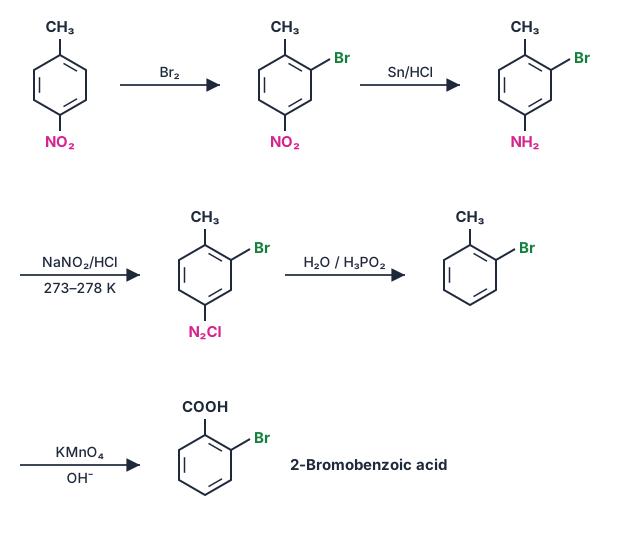
The target, 2-bromobenzoic acid, needs bromine ortho to a carboxylic acid — but −COOH is a meta director, so it can never direct bromine to its own ortho position. The insight of the textbook's Solution is that in the starting material the two substituents already present agree on exactly the right position, so the bromination should be done before anything else is changed.
1. Brominate while both original groups are on the ring.
Number the ring with −CH3 at C-1 and −NO2 at C-4. The methyl group (ortho/para director) favours C-2/C-6; the nitro group (meta director) favours the positions meta to itself, which are the same C-2/C-6. Both effects reinforce, so bromination gives 2-bromo-4-nitrotoluene cleanly:
4-O2N-C6H4-CH3Br22-Br-4-O2N-C6H3-CH3
2. Reduce the nitro group to an amine.
2-bromo-4-nitrotolueneSn/HCl2-bromo-4-methylaniline
3. Remove the amino group via the diazonium salt.
Diazotise with NaNO2/HCl at 273–278 K, then treat with H2O/H3PO2 (hypophosphorous acid), which replaces −N2+ by −H:
2-bromo-4-methylanilineNaNO2/HCl273–278 Kdiazonium saltH2O/H3PO22-bromotoluene
4. Oxidise the methyl group last.
2-bromotolueneKMnO4, OH− (then H3O+)2-bromobenzoic acid …
Method: Directing-Effect Audit Before Any Step
For a multi-step aromatic synthesis, list every substituent's directing effect in the starting material first, and ask whether the groups already present can place the new substituent where the target needs it. Only if they cannot do you start interconverting groups.
Step 1: Map the target onto the starting material
- Target: 2-bromobenzoic acid — −COOH at C-1, −Br at C-2 (ortho).
- Start: 4-nitrotoluene — −CH3 at C-1 (future −COOH, by oxidation), −NO2 at C-4.
- Needed: bromine at C-2, i.e. ortho to the methyl group.
Step 2: Audit the directors in 4-nitrotoluene
- −CH3: ortho/para director → favours C-2/C-6.
- −NO2: meta director → its meta positions are also C-2/C-6.
- Both groups direct to the same carbon. So bromination should be done immediately, before either group is touched.
Step 3: Forward synthesis (the textbook's Solution)
- Brominate: Br2 on 4-nitrotoluene → 2-bromo-4-nitrotoluene (Br enters ortho to −CH3, meta to −NO2).
- Reduce: Sn/HCl converts −NO2 to −NH2 → 2-bromo-4-methylaniline.
- Diazotise: NaNO2/HCl, 273–278 K → the diazonium salt.
- Deaminate: H2O/H3PO2 replaces −N2+ by −H → 2-bromotoluene. …
These mistakes all come from re-ordering the steps of the synthesis without checking the ring geometry at each stage.
✓ The correct route (the textbook's Solution)
4-nitrotolueneBr22-bromo-4-nitrotolueneSn/HCl2-bromo-4-methylanilineNaNO2/HCl273–278 Kdiazonium saltH2O/H3PO22-bromotolueneKMnO4, OH−2-bromobenzoic acid
Bromination comes first because −CH3 (ortho/para director) and −NO2 (meta director) both point to the same carbon — the position ortho to methyl is the position meta to nitro.
✗ Mistake 1: Reduce the nitro group first, protect, and brominate ortho to the acetamido group
- The wrong route: −NO2→−NH2 (Sn/HCl), acetylate to −NHCOCH3, brominate "ortho to the director", deprotect, deaminate.
- Why it's wrong — check the geometry: the acetamido group sits at C-4 and the methyl at C-1. Bromine ortho to −NHCOCH3 means C-3, and C-3 is meta to the methyl group. After deamination this gives 3-bromotoluene, and oxidation gives 3-bromobenzoic acid — the wrong isomer.
- How to avoid: before swapping any group, ask what the existing groups already direct to. Here they already agree on C-2, so no protection strategy is needed at all.
✗ Mistake 2: Oxidising the methyl group before brominating
- Why it's wrong: once −CH3 becomes −COOH, the ring carries two meta directors that disagree — −COOH at C-1 favours C-3/C-5 while −NO2 at C-4 favours C-2/C-6 — on a doubly deactivated ring. There is no longer any position both groups favour, so you cannot rely on getting the 2-bromo product cleanly. The textbook avoids the conflict entirely by brominating while −CH3 and −NO2 still reinforce each other.
✗ Mistake 3: Oxidising with KMnO4 while the free amine is on the ring
- Why it's wrong: KMnO4 attacks aromatic amines as well as side chains — a free −NH2 would be destroyed. The amino group must be removed (diazotisation, then H3PO2) before the oxidation step.
✗ Mistake 4: Letting the diazonium salt warm up …
- CBSE 2025Set 56/4/11 markMCQQ.Hoffmann Bromamide degradation reaction is given by : (A) ArNO2 (B) ArNH2 (C) ArCONH2 (D) ArCH2NH2
›Reveal solutionSolution
The Hoffmann bromamide degradation converts a primary amide (RCONHX2) into a primary amine with one fewer carbon atom using bromine and base. The starting material is ArCONHX2, option (C).
The Hoffmann bromamide degradation is one of the most elegant reactions in organic chemistry for shortening a carbon chain while introducing an amino group. Understanding what it does—and what it requires—makes the answer obvious.
The Core Concept
The reaction takes a primary amide (RCONHX2) and, through treatment with bromine in aqueous or alcoholic alkali (typically NaOH or KOH), removes the carbonyl carbon entirely. The product is a primary amine (RNHX2) with one carbon atom less than the starting amide.
The key transformation:
RCONHX2BrX2/NaOH−COX2RNHX2
The carbonyl carbon is lost as carbonate, and the nitrogen that was part of the amide becomes the amino group of the amine. This is why it's called a "degradation"—you're stepping down the carbon skeleton.
Why This Mechanism Matters
The reaction proceeds through several intermediates:
-
N-bromoamide formation: Bromine in base first converts the amide to an N-bromoamide (RCONHBr).
-
Isocyanate intermediate: Base abstracts the remaining N–H proton, and the resulting anion loses bromide to form an isocyanate (R−N=C=O). This is the crucial rearrangement step—the alkyl/aryl group migrates from carbon to nitrogen.
-
Hydrolysis: The isocyanate is rapidly hydrolyzed by the aqueous base to give a carbamic acid (RNHCOOH), which immediately decarboxylates to yield the primary amine (RNHX2).
ImportantThe starting material must be a primary amide (RCONHX2). Secondary or tertiary amides do not undergo this reaction because the mechanism requires an N–H hydrogen for the rearrangement.
Analyzing the Options
Now let's see which option fits:
(A) ArNOX2 — This is a nitro compound (nitrobenzene and derivatives). It has no amide group and cannot undergo Hoffmann degradation. Nitro groups are reduced to amines by other methods (catalytic hydrogenation, metal/acid reduction). …
-
- CBSE 2023Set 56/3/11 markMCQQ.Aspirin is obtained by the acetylation of which of the following compounds? (A) Salicylaldehyde (B) Salicylic acid (C) Acetyl salicylic acid (D) Phenol
›Reveal solutionSolution
Aspirin is synthesized by acetylating the hydroxyl group of salicylic acid with acetic anhydride or acetyl chloride, producing acetylsalicylic acid. The answer is (B).
Understanding Aspirin Synthesis
Aspirin, chemically known as acetylsalicylic acid, is one of the most widely used analgesic and anti-inflammatory drugs. The key to answering this question lies in understanding what acetylation means and recognizing the structural relationship between aspirin and its precursor.
Acetylation is the process of introducing an acetyl group (−COCHX3) into a molecule, typically by replacing an active hydrogen (usually on a hydroxyl or amino group) with −COCHX3.
When we say aspirin is "obtained by acetylation," we're looking for the compound that, when treated with an acetylating agent, gives us aspirin.
Step-by-Step Analysis
-
Identify aspirin's structure
Aspirin is acetylsalicylic acid, which has:
- A benzene ring
- A carboxylic acid group (−COOH) at position 1
- An acetyl ester group (−OCOCHX3) at position 2 (ortho to the carboxyl)
-
Work backwards from the product
If aspirin has an ester linkage (−OCOCHX3), then before acetylation, that position must have had a free hydroxyl group (−OH). The acetylation reaction converts −OH to −OCOCHX3.
-
Examine each option
(A) Salicylaldehyde has a benzene ring with −CHO (aldehyde) and −OH groups. Acetylating this would give an acetylated aldehyde derivative, not aspirin (which has a carboxylic acid group).
(B) Salicylic acid has:
- A carboxylic acid group (−COOH)
- A hydroxyl group (−OH) at the ortho position
When the −OH is acetylated, we get exactly aspirin's structure.
(C) Acetyl salicylic acid is aspirin itself. You can't obtain aspirin by acetylating aspirin. …
-
🎓Unlock everything free for 14 days
- ✓Full step-by-step solutions
- ✓Concept-first explanations
- ✓Methods, shortcuts & mistakes
- ✓PYQ mapping + timed mock tests
Full access for 14 days. No credit card required.