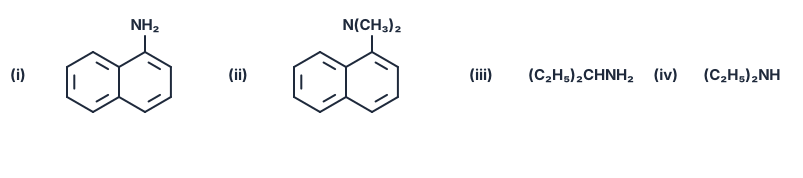
Q.Classify the following amines as primary, secondary or tertiary:
Concept understanding — Basicity Order Amines
Basicity of Amines: From Intuition to Precision
Imagine you have a nitrogen atom with a lone pair of electrons — that pair is like a key that can grab a proton (H+). The more willing the nitrogen is to share that pair, the stronger the base. That's the core idea.
The Intuition: What Makes a Nitrogen "Want" a Proton?
Amines are organic derivatives of ammonia (NH3), where one or more hydrogen atoms are replaced by alkyl groups (R). Alkyl groups are electron-donating — they push electron density toward the nitrogen. More alkyl groups = more electron density on nitrogen = stronger base.
So you'd expect: tertiary > secondary > primary > ammonia. That's the inductive effect argument.
But reality is more interesting. In water (the usual solvent for basicity measurements), the order is:
Secondary > Primary > Tertiary > Ammonia
Why the reversal for tertiary amines? Because basicity isn't just about the free amine — it's about the stability of the conjugate acid (the ammonium ion RNH3+) once the proton is grabbed.
The Precise Explanation: Three Factors at Play
1. Inductive Effect (pushes electron density)
Alkyl groups donate electrons through sigma bonds. More alkyl groups = more electron density on N = stronger base. This favours: tertiary > secondary > primary > ammonia.
2. Solvation Effect (stabilises the conjugate acid)
Once the amine grabs a proton, the resulting ammonium ion is positively charged. Water molecules surround it, stabilising the charge through hydrogen bonding. The more hydrogens on the nitrogen, the more H-bonds can form.
Primary ammonium (RNH3+) has 3 H's → best solvation.
Secondary (R2NH2+) has 2 H's → good solvation.
Tertiary (R3NH+) has 1 H → poor solvation.
This favours: primary > secondary > tertiary.
3. Steric Hindrance (blocks solvation)
Bulkier alkyl groups physically block water molecules from approaching the charged nitrogen. This further reduces solvation in tertiary amines.
The Net Result: The Actual Order in Water
| Amine Type | Inductive Effect | Solvation | Steric Hindrance | Net Basicity (pKb) |
|---|---|---|---|---|
| Ammonia (NH3) | Weakest | Best (3 H's) | None | 4.75 |
| Primary (RNH2) | Moderate | Good (2 H's) | Minimal | ~3.4 |
| Secondary (R2NH) | Strong | Moderate (1 H) | Some | ~3.2 |
| Tertiary (R3N) | Strongest | Poor (0 H's) | Significant | ~4.2 |
pKb is the negative log of the base dissociation constant. Lower pKb = stronger base. So secondary (pKb ≈ 3.2) is the strongest, then primary (≈3.4), then tertiary (≈4.2), then ammonia (4.75).
The Final Answer
The basicity order of amines in aqueous solution is:
Secondary > Primary > Tertiary > Ammonia
This is the standard order for simple alkyl amines (methyl, ethyl, etc.). The inductive effect dominates from ammonia to secondary, but the loss of solvation and steric hindrance in tertiary amines drops them below primary.
A Quick Check: Why Not Tertiary?
If you only considered electron donation, tertiary would win. But the ammonium ion R3NH+ has only one hydrogen to hydrogen-bond with water, and the three bulky alkyl groups physically block water molecules. The conjugate acid is poorly stabilised, so the equilibrium shifts back toward the free amine — making it a weaker base than expected.
This order applies to aliphatic amines in water. Aromatic amines (like aniline) are much weaker bases because the lone pair is delocalised into the benzene ring. Also, in the gas phase (no solvent), the order reverts to tertiary > secondary > primary > ammonia — confirming that solvation is the key reason for the reversal.
The Takeaway
Basicity is a tug-of-war between:
- Inductive effect (wants tertiary to win)
- Solvation + sterics (wants primary to win)
Secondary amines hit the sweet spot — strong inductive donation and decent solvation — making them the strongest bases in water.
The basicity order of amines in aqueous solution is one of the most frequently asked comparison-type questions in the NCERT Class 12 Chemistry chapter on amines, regularly appearing in CBSE boards, JEE Main and NEET. Anyone searching "basicity order of amines class 12 chemistry" or trying to understand why secondary amines outrank primary and tertiary amines will find the inductive-versus-solvation trade-off above is the standard NCERT-aligned explanation.
Why this formula?
Basicity Order of Amines: Why It Holds
Let's build this from first principles — understanding why amines have different basicities is essential for exams and for deeper chemistry.
1. What Does "Basicity" Mean Here?
Basicity of an amine is its ability to accept a proton (H+).
The stronger the base, the more readily it grabs H+.
The equilibrium is:
R3N+H2O⇌R3NH++OH−
The base dissociation constant Kb measures this:
Kb=[R3N][R3NH+][OH−]
A larger Kb means a stronger base.
2. The Key Factor: Electron Density on Nitrogen
The lone pair on nitrogen is what accepts H+.
More electron density on nitrogen → stronger base.
Why? Because a proton (H+) is attracted to negative charge. If the nitrogen's lone pair is more "available" (less tightly held), it binds H+ more easily.
3. The Two Competing Effects
✓ Inductive Effect (Electron-Donating)
Alkyl groups (−CH3, −C2H5, etc.) are electron-donating via the inductive effect.
They push electron density toward nitrogen.
- More alkyl groups → more electron density on N → stronger base.
This suggests:
3∘>2∘>1∘>NH3
✗ Solvation Effect (Hydration of the Conjugate Acid)
When the amine accepts H+, it forms R3NH+ (a positively charged ion).
This ion is stabilized by water molecules (hydration).
- More H atoms on the NH+ group → more hydrogen bonding with water → better stabilization of the conjugate acid.
- Better stabilization of R3NH+ → stronger base (because the equilibrium shifts toward protonation).
This suggests:
1∘>2∘>3∘ (since 1∘ has 3 H's, 2∘ has 2, 3∘ has 1)
4. The Actual Order (Aqueous Solution)
In water, the observed order for aliphatic amines is:
2° > 1° > 3° > NH3
Wait — that's not simply "more alkyl = stronger". Why?
The Reasoning (Step by Step)
-
From NH3 to 1∘: Adding one alkyl group increases electron density (inductive effect) → stronger base.
So 1∘>NH3.
-
From 1∘ to 2∘: Adding a second alkyl group further increases electron density → even stronger base.
So 2∘>1∘.
-
From 2∘ to 3∘: Here, the solvation effect becomes dominant.
The 3∘ amine has only one H on the NH+ group → poor hydration of the conjugate acid.
The inductive effect is still present, but the loss of solvation outweighs the gain in electron density.
So 3∘ is weaker than 2∘.
Thus, the net order is:
2° > 1° > 3° > NH3
5. The Key Formula(e) to Remember
For gas phase (no solvent):
Only inductive effect matters:
3° > 2° > 1° > NH3
For aqueous solution (common in exams):
Both effects matter — solvation dominates for 3∘:
2° > 1° > 3° > NH3
For aromatic amines (e.g., aniline):
The lone pair is delocalized into the benzene ring → much weaker base.
Aliphatic amines > Aromatic amines
6. Quick Exam Tip
If a question asks "basicity order of amines in water", always write:
2° > 1° > 3° > NH3
And explain:
- Inductive effect increases from NH3 to 3∘
- But solvation of the conjugate acid decreases from 1∘ to 3∘
- The balance gives the above order.
7. Summary Table
| Amine Type | Inductive Effect | Solvation of R3NH+ | Net Basicity (aq) |
|---|---|---|---|
| NH3 | Weakest | Best (3 H's) | Weakest |
| 1∘ | Moderate | Good (2 H's) | Moderate |
| 2∘ | Strong | Moderate (1 H) | Strongest |
| 3∘ | Strongest | Poor (0 H's) | Weaker than 2∘ |
Final takeaway:
Basicity is not just about "more alkyl = stronger". The solvation of the conjugate acid is the deciding factor in water. Always reason from both effects.
Count how many carbon atoms are attached to the nitrogen: one C = primary, two C = secondary, three C = tertiary.
- naphthalen-1-amine: N bonded to one aryl carbon (plus two H) → primary.
- N,N-dimethylnaphthalen-1-amine: N bonded to one aryl C and two CH3 carbons → tertiary.
- (C2H5)2CHNH2: N bonded to the single CH carbon (plus two H) → primary.
- (C2H5)2NH: N bonded to two ethyl carbons (plus one H) → secondary.
✓Final answer
- primary,
- tertiary,
- primary,
- secondary.
An amine is classed by how many carbon atoms are joined directly to its nitrogen: one → primary (1°), two → secondary (2°), three → tertiary (3°). The number of hydrogens on nitrogen (2, 1, 0) mirrors this. Applying the rule gives (i) 1°,
(ii) 3°,
(iii) 1°,
(iv) 2°.
Concept
Amines are viewed as derivatives of ammonia, NH3, in which one, two or three of the N–H bonds are replaced by N–C bonds. The classification depends only on how many carbon atoms are bonded to nitrogen, not on whether those carbons are part of a ring or a chain, and not on the size of the group:
- Primary (1°): R–NH2 (one C on N)
- Secondary (2°): R2NH (two C on N)
- Tertiary (3°): R3N (three C on N)
Applying the rule to each compound
- naphthalen-1-amine, C10H7–NH2. The nitrogen is joined to a single carbon — the C-1 of the naphthalene ring — and still carries two hydrogens (–NH2). One carbon on nitrogen ⇒ primary amine (an aromatic/aryl amine).
- N,N-dimethylnaphthalen-1-amine, C10H7–N(CH3)2. Here the nitrogen is bonded to the aryl carbon of the naphthalene ring and to the two carbons of the two methyl groups. Three carbons on nitrogen, no N–H left ⇒ tertiary amine.
- (C2H5)2CHNH2 (pentan-3-amine). The –NH2 is attached to the central methine carbon (the CH), which itself bears two ethyl groups. Nitrogen sees only that one carbon and keeps two hydrogens; the ethyl groups are further out on the carbon skeleton, not on nitrogen ⇒ primary amine. (This part tests whether you count carbons on N, not carbons in the molecule.)
- (C2H5)2NH (diethylamine). Nitrogen is bonded to the two carbons of two ethyl groups and retains one hydrogen ⇒ secondary amine.
✓Final answer
- naphthalen-1-amine — primary (1°);
- N,N-dimethylnaphthalen-1-amine — tertiary (3°);
- (C2H5)2CHNH2 (pentan-3-amine) — primary (1°);
- (C2H5)2NH (diethylamine) — secondary (2°).
Method: Classifying Amines (Primary/Secondary/Tertiary) by Counting C-N Bonds
Core Concept
An amine's class depends ONLY on how many carbon atoms are bonded directly to the nitrogen atom - one carbon on N gives a primary amine, two gives secondary, three gives tertiary - regardless of whether those carbons belong to a ring, a chain, or how large the attached groups are.
Steps
- Locate the nitrogen atom in the given structure.
- Count only the bonds going from N directly to a carbon atom (ignore N-H bonds and ignore carbons further away in the molecule that are not bonded to N itself).
- Map the count to a class: 1 carbon on N gives primary (1 degree); 2 carbons give secondary (2 degree); 3 carbons give tertiary (3 degree).
- Repeat independently for every compound in the set - classification never depends on comparing compounds to each other.
Applying the Method to Each Sub-Part
- naphthalen-1-amine, C10H7-NH2: N is bonded to exactly one carbon (the aryl C-1 of naphthalene) and keeps two H -> primary.
- N,N-dimethylnaphthalen-1-amine, C10H7-N(CH3)2: N is bonded to the aryl C-1 AND to the two methyl carbons - three C-N bonds, no N-H left -> tertiary.
- (C2H5)2CHNH2: the -NH2 is bonded only to the single central CH carbon; the two ethyl groups are attached to THAT carbon, not to nitrogen, so N still sees only one carbon -> primary (the trap here is counting the ethyl carbons as if they were on N).
- (C2H5)2NH: N is bonded to the two ethyl carbons and keeps one H -> secondary.
Key Exam Point
Sub-part (iii) is specifically designed to catch students who classify by "how many carbons are in the molecule" instead of "how many carbons are bonded to N" - always trace only the bonds directly touching the nitrogen atom.
Here are the common mistakes students make when classifying amines from drawn structures and condensed formulas, along with how to avoid each.
Mistake 1: Counting all the carbons in the molecule instead of the carbons bonded to nitrogen
Students see a big structure (like the naphthalene ring in part (i)) or a heavily branched formula and assume "many carbons = higher class."
- The Error: Calling naphthalen-1-amine "tertiary" because the ring has ten carbons.
- How to Avoid: The classification rule looks at one atom only — the nitrogen. Count the carbon atoms bonded directly to N:
- one C on N → primary (1°)
- two C on N → secondary (2°)
- three C on N → tertiary (3°)
- Example: In part (i), the nitrogen is bonded to a single ring carbon (C-1 of naphthalene) and two hydrogens → primary, no matter how large the ring system is.
Mistake 2: Classifying by the carbon skeleton next to the amine carbon (the "alcohol/haloalkane habit")
Students carry over the alkyl-halide/alcohol convention — where 1°/2°/3° describes the carbon bearing the functional group — and apply it to the amine.
- The Error: Calling (C2H5)2CHNH2 (part (iii)) a "secondary amine" because the CH carbon bearing the NH2 carries two ethyl groups (it is a secondary carbon).
- How to Avoid: For amines, the degree is a property of the nitrogen, not of the carbon it sits on. In (C2H5)2CHNH2, nitrogen sees only one carbon (the CH) and keeps two hydrogens → primary amine. The two ethyl groups are further out on the skeleton, not on nitrogen.
Mistake 3: Misreading −N(CH3)2 as "two substituents, so secondary"
- The Error: For part (ii), counting the two methyl groups of −N(CH3)2 and stopping there → "secondary."
- How to Avoid: Count every C–N bond, including the bond to the ring/parent chain. In N,N-dimethylnaphthalen-1-amine the nitrogen is bonded to the aryl carbon and to two methyl carbons — three C–N bonds, no N–H left → tertiary (3°). The "N,N-" prefix in a name is itself a signal that nitrogen carries two extra groups besides the parent.
Mistake 4: Thinking aryl amines classify differently from alkyl amines
- The Error: Treating a ring carbon on N as "not counting" (or counting it differently) because it is aromatic.
- How to Avoid: An aryl carbon bonded to nitrogen counts exactly like an alkyl carbon. Aniline (C6H5NH2) and naphthalen-1-amine are both primary amines — one C on N, two H on N — just aromatic ones.
Mistake 5: Not using the N–H count as a cross-check
- The Error: Deciding the class from the drawing alone and never verifying.
- How to Avoid: The hydrogens on nitrogen mirror the classification: 2 H → 1°, 1 H → 2°, 0 H → 3°. In part (iv), (C2H5)2NH has exactly one N–H → secondary, consistent with its two C–N bonds. If your carbon count and hydrogen count disagree, you have misread the structure — recount.
Quick Reference Table
| Part | Compound | C atoms on N | H atoms on N | Class |
|---|---|---|---|---|
| (i) | naphthalen-1-amine | 1 (aryl C) | 2 | Primary (1°) |
| (ii) | N,N-dimethylnaphthalen-1-amine | 3 (aryl C + 2 CH₃) | 0 | Tertiary (3°) |
| (iii) | (C2H5)2CHNH2 | 1 (the CH carbon) | 2 | Primary (1°) |
| (iv) | (C2H5)2NH | 2 (two ethyl C) | 1 | Secondary (2°) |
Final tip: Circle the nitrogen atom and draw only its four bonds before classifying. Everything outside those bonds — ring size, branching, chain length — is irrelevant to whether the amine is 1°, 2° or 3°.
Showing the 12 most recent of 27 on this concept.
- CBSE 2026Set 56/3/11 markMCQQ.Among the following, which is the strongest base ? (A) 4-nitroaniline [O2N−C6H4−NH2] (B) Benzylamine [C6H5CH2NH2] (C) 4-methylaniline [CH3−C6H4−NH2] (D) Aniline [C6H5NH2]
›Reveal solutionSolution
Basicity of amines depends on electron density on nitrogen. Benzylamine has an alkyl group (electron-donating) attached to the amino group, making it the strongest base among the given aromatic amines. The correct option is (B).
Why Basicity Order Matters Here
The question asks you to compare the basic strength of four amines. In organic chemistry, basicity is directly linked to how readily the nitrogen atom can donate its lone pair. The more electron-rich the nitrogen, the stronger the base. For aromatic amines, the key factor is resonance and substituent effects — electron-donating groups increase basicity, while electron-withdrawing groups decrease it.
Let’s break down each compound.
-
Aniline (D) — C6H5NH2
The lone pair on nitrogen is delocalised into the benzene ring through resonance. This makes the nitrogen less available to accept a proton, so aniline is a weaker base than aliphatic amines.
-
4-nitroaniline (A) — O2N−C6H4−NH2
The nitro group (−NO2) is a strong electron-withdrawing group. It pulls electron density away from the nitrogen via both inductive and resonance effects. This drastically reduces the electron density on nitrogen, making it the weakest base among the four.
-
4-methylaniline (C) — CH3−C6H4−NH2
The methyl group is electron-donating (hyperconjugation + inductive effect). It pushes electron density toward the ring, which slightly increases electron density on nitrogen compared to aniline. So 4-methylaniline is a stronger base than aniline, but still weaker than benzylamine.
-
Benzylamine (B) — C6H5CH2NH2
Here, the amino group is attached to a CH2 group, not directly to the benzene ring. The benzene ring is separated by a methylene spacer. This means the lone pair on nitrogen cannot participate in resonance with the ring. The nitrogen behaves like an aliphatic amine — its lone pair is fully available for protonation. The benzene ring still exerts a weak inductive electron-withdrawing effect through the CH2 group, but this is much weaker than resonance. Hence, benzylamine is the strongest base.
Watch outA common mistake is to think that because benzylamine has a benzene ring, it will be similar to aniline. But the CH2 group breaks conjugation — the lone pair is not delocalised into the ring. That changes everything.
TipFor quick comparison: any amine where the nitrogen is directly attached to an aromatic ring (aniline derivatives) will be weaker than an amine where the nitrogen is separated by at least one sp3 carbon (benzylamine). The only exception is if the ring has very strong electron-donating groups.
Basicity order for these compounds:
Benzylamine>4-methylaniline>Aniline>4-nitroaniline
✓Final answerThe strongest base is benzylamine, option (B).
-
- CBSE 2026Set ANNUAL1 markQ.Why is methanamine a stronger base than ammonia?
›Reveal solutionSolution
Basicity of an amine depends on how available its nitrogen lone pair is to accept a proton; an alkyl group's electron-donating (+I) inductive effect increases that availability compared with plain ammonia.
In ammonia, NH3, the nitrogen is bonded only to three hydrogens, which contribute no electron-donating effect of their own. In methanamine, CH3−NH2, the methyl group is electron-releasing (+I effect): it pushes electron density through the C−N sigma bond onto the nitrogen atom, increasing the electron density available in its lone pair.
A more electron-rich lone pair is a better proton acceptor (Lewis base), so protonation is favoured more strongly for methanamine than for ammonia:
CH3NH2+H+⇌CH3NH3+(favoured more than)NH3+H+⇌NH4+
This is reflected in their base-dissociation behaviour: CH3NH2 is a noticeably stronger base than NH3, consistent with the inductive argument (in aqueous solution, solvation of the resulting ammonium ion also plays a secondary role, but the +I effect of the methyl group is the primary reason taught at this level).
✓Final answerMethanamine (CH3NH2) is a stronger base than ammonia because the electron-donating (+I) methyl group raises the electron density on nitrogen, making its lone pair more available to bind a proton.
- CBSE 2026Set ANNUAL1 markQ.Arrange the following in decreasing order of their basic strength: C2H5NH2, (C2H5)2NH, (C2H5)3N, C6H5NH2
›Reveal solutionSolution
Aqueous basicity of amines balances +I electron release (favours more alkyl groups), steric hindrance to solvation of the protonated ion (disfavours bulky/3° amines), and resonance delocalisation of the lone pair (drastically weakens aniline).
Factors at play
- +I effect: each ethyl group pushes electron density onto N, making the lone pair more available and increasing basicity — this alone would predict 3∘>2∘>1∘.
- Steric hindrance to solvation: basicity in water is effectively measured by how well the protonated (R3NH+) ion is stabilised by H-bonding with water. A bulky, highly alkyl-substituted ammonium ion like (C2H5)3NH+ is harder to solvate, which lowers its effective basicity in water — this pulls 3∘ amines down.
- Aromatic ring delocalisation: in aniline, C6H5NH2, the lone pair on N is delocalised into the benzene ring by resonance, making it far less available for protonation — anilines are always much weaker bases than aliphatic amines.
Balancing (1) and (2) for the simple ethylamines in water gives the well-established order 2∘>1∘>3∘ (the +I effect of a second ethyl group boosts basicity more than the added steric/solvation penalty, but a third group tips the balance the other way), with aniline last because of (3):
(C2H5)2NH>C2H5NH2>(C2H5)3N>C6H5NH2
✓Final answer(C2H5)2NH>C2H5NH2>(C2H5)3N>C6H5NH2
- CBSE 2025Set ANNUAL1 markMCQQ.Which of the following is most basic?(a) C6H5NH2(b) NH3(c) C2H5NH2(d) (C2H5)2NH
›Reveal solutionSolution
In aqueous solution, basicity of these amines follows secondary > primary > NH3 > aniline — aniline is weakest because its nitrogen lone pair is delocalised into the benzene ring, while a secondary alkylamine's two electron-donating ethyl groups make it the strongest base here.
Electron-donating alkyl (+I) groups on nitrogen increase electron density on N, making the lone pair more available to accept a proton, so alkyl-substituted amines are more basic than NH3. Between primary and secondary alkylamines in water, the extra +I contribution from the second ethyl group in (C2H5)2NH outweighs its slightly greater steric hindrance/solvation penalty, making it the strongest base of this set: (C2H5)2NH > C2H5NH2 > NH3 > C6H5NH2.
Aniline, C6H5NH2, is the weakest base here because the nitrogen lone pair conjugates into the aromatic ring (delocalisation lowers its availability to a proton), and further the resulting anilinium ion is destabilised relative to alkylammonium ions.
✓Final answer(d) (C2H5)2NH.
- CBSE 2025Set ANNUAL1 markQ.Arrange the following in decreasing order of their basic strength: C6H5NH2, C2H5NH2, (C2H5)2NH, NH3
›Reveal solutionSolution
Diethylamine is the strongest base (two electron-donating ethyl groups, still well solvated), followed by ethylamine, then unsubstituted ammonia, with aniline the weakest because the ring delocalises the nitrogen lone pair by resonance.
Basicity of an amine depends on how available the nitrogen lone pair is to accept a proton, which in aqueous solution is governed by three competing effects: (i) the +I (electron-donating) effect of alkyl groups, which pushes electron density onto N and increases basicity; (ii) steric hindrance and the extent of solvation (H-bonding) of the resulting ammonium cation, which is reduced by bulky/more numerous alkyl groups and lowers basicity; and (iii) resonance delocalisation of the lone pair, which sharply lowers basicity when N is attached to an aromatic ring.
-
(C2H5)2NH (diethylamine, 2°): two ethyl groups give a strong +I effect, and being only disubstituted it is still reasonably well solvated in water — the strongest base of the set.
-
C2H5NH2 (ethylamine, 1°): one +I-donating ethyl group, well solvated — a stronger base than plain ammonia but weaker than the disubstituted amine above.
-
NH3 (ammonia): no alkyl substituent at all, so no +I effect enhancement, but also no steric hindrance — intermediate.
-
C6H5NH2 (aniline): the nitrogen lone pair is conjugated into the aromatic ring (resonance delocalisation over the ortho/para carbons), making it far less available to bind H+; additionally the ring is electron-withdrawing by induction. This makes aniline much less basic than even ammonia.
✓Final answerDecreasing basic strength: (C2H5)2NH>C2H5NH2>NH3>C6H5NH2
-
- CBSE 2024Set 56/3/11 markMCQQ.The order of increasing basicities of CH3NH2 (I), (CH3)2NH (II), (CH3)3N (III) and C6H5NH2 (IV) in aqueous media is : (A) IV < III < I < II (B) II < I < IV < III (C) I < II < III < IV (D) II < III < I < IV
›Reveal solutionSolution
In aqueous solution, basicity of amines depends on a balance between the inductive effect (which increases electron density on nitrogen) and solvation of the conjugate acid (which stabilises it). For methyl-substituted amines, the order is (CH3)2NH>CH3NH2>(CH3)3N>C6H5NH2, so the correct option is (A).
The question asks for the increasing order of basicity in aqueous media — that’s the key. In water, basicity is not just about how much the nitrogen “wants” to donate its lone pair; it’s also about how stable the resulting ammonium ion is once it forms. Two effects compete here: the inductive effect of alkyl groups (which push electrons toward nitrogen, making it more basic) and the solvation effect (water molecules stabilise the charged ammonium ion by hydrogen bonding — more hydrogens on the nitrogen mean better solvation).
For aniline (C6H5NH2), the lone pair on nitrogen is delocalised into the aromatic ring, making it far less available for protonation. That’s why it’s always the weakest base among these four — no contest.
Now, among the methylamines, the trend in the gas phase (no solvent) is clear: more methyl groups → more electron donation → stronger base. So gas-phase order would be (CH3)3N>(CH3)2NH>CH3NH2>NH3. But in water, the story changes because the conjugate acid of trimethylamine, (CH3)3NH+, has only one N–H bond — it can form only one strong hydrogen bond with water. The conjugate acid of dimethylamine, (CH3)2NH2+, has two N–H bonds, so it’s better solvated and more stabilised. This extra stabilisation outweighs the extra inductive effect of the third methyl group, making dimethylamine the strongest base in water.
Let’s walk through the reasoning step by step.
-
Identify the weakest base first.
Aniline (IV) has its lone pair conjugated with the benzene ring — resonance delocalisation reduces electron density on nitrogen drastically. It is by far the least basic. So IV must come first in the increasing order. That eliminates options (B) and (C), which place aniline later.
-
Compare the three methylamines in water.
The inductive effect of methyl groups increases electron density on nitrogen, favouring basicity: more methyl groups → stronger base, all else equal. But “all else” is not equal in water. The conjugate acid’s ability to be stabilised by solvation depends on the number of N–H bonds: each N–H can hydrogen-bond with water.
- (CH3)3NH+ has one N–H.
- (CH3)2NH2+ has two N–Hs.
- CH3NH3+ has three N–Hs.
More N–H bonds mean better solvation, which lowers the energy of the conjugate acid and thus makes the base stronger. So solvation favours the opposite order: more hydrogens → stronger base.
-
The net effect in water is a compromise.
The inductive effect and solvation effect pull in opposite directions as you add methyl groups. Experimentally, the order of basicity in water for methylamines is:
(CH3)2NH>CH3NH2>(CH3)3N>NH3.
Dimethylamine (II) wins because it has two methyl groups (good inductive effect) and two N–Hs (good solvation). Trimethylamine (III) loses to methylamine (I) because its solvation disadvantage (only one N–H) outweighs its extra inductive push.
-
Arrange in increasing order.
Weakest: aniline (IV).
Next: trimethylamine (III) — weaker than methylamine due to poor solvation.
Then: methylamine (I).
Strongest: dimethylamine (II).
So increasing order: IV < III < I < II.
Watch outA common mistake is to assume that more alkyl groups always mean stronger base, even in water. That would give III > II > I, which is wrong. Always check solvation of the conjugate acid — the number of N–H bonds matters.
TipA quick memory aid for aqueous basicity of methylamines: “2 > 1 > 3 > 0” — dimethylamine > methylamine > trimethylamine > ammonia. Aniline is always weaker than ammonia, so it goes at the very end.
✓Final answerThe correct option is (A) IV < III < I < II.
-
- CBSE 2024Set D1 markMCQQ.Which of the following is the most basic?(a) C6H5NH2(b) (C6H5)2NH(c) C2H5NH2(d) (C2H5)2NH
›Reveal solutionSolution
Aliphatic amines > aromatic; secondary diethylamine is most basic here.
Basicity depends on availability of the nitrogen lone pair:
-
Aromatic amines C6H5NH2 (aniline) and (C6H5)2NH (diphenylamine) are weak bases because the lone pair is delocalised into the benzene ring(s); diphenylamine is the weakest.
-
Aliphatic amines are stronger bases due to the electron-releasing (+I) alkyl groups.
-
Among the two aliphatic amines, (C2H5)2NH (secondary) has more +I donation than C2H5NH2 (primary), so in aqueous solution diethylamine is the most basic of the four.
✓Final answer(d) (C2H5)2NH — diethylamine is the most basic.
-
- CBSE 2024Set B1 markQ.Fill in the blank: Methyl amine is ______ acidic than ethyl amine.
›Reveal solutionSolution
Ethyl amine is a stronger base than methyl amine because the larger ethyl group has a greater +I (electron-releasing) effect than methyl, so relative to ethylamine, methylamine is more acidic/less basic.
Basicity of simple aliphatic amines increases as the alkyl group attached to nitrogen becomes a better electron donor (+I effect), because this raises electron density on nitrogen and better stabilises the positive charge on the protonated ammonium ion formed.
Ethyl (-C2H5) has a slightly stronger +I effect than methyl (-CH3), so ethylamine donates electron density to nitrogen more effectively than methylamine, making ethylamine the stronger base of the two. Correspondingly, methylamine, being the weaker base, is relatively more acidic (its conjugate acid is comparatively a stronger acid) than ethylamine.
✓Final answerMore (methylamine is more acidic / less basic than ethylamine).
- CBSE 2024Set ANNUAL1 markQ.Why is ethyl amine more basic than ammonia?
›Reveal solutionSolution
An alkyl group's +I (electron-releasing inductive) effect pushes extra electron density onto nitrogen, strengthening its ability to accept a proton compared to plain ammonia.
Basicity of an amine depends on how readily the nitrogen's lone pair of electrons is available to accept a proton (H⁺) — the more available/electron-rich the lone pair, the stronger the base.
In ethylamine (CH3CH2-NH2), the ethyl group is an alkyl group with a +I (positive inductive) effect — it pushes electron density TOWARD the nitrogen atom through the sigma-bond framework. This makes the nitrogen's lone pair MORE electron-rich and more readily available to accept (bond to) an incoming proton, compared to ammonia (NH3), which has no alkyl group to donate electron density.
Additionally, in aqueous solution the resulting ethylammonium ion is stabilised somewhat by the alkyl group and by solvation, further favouring protonation.
✓Final answerThe ethyl group's electron-donating (+I) inductive effect increases the electron density on nitrogen in ethylamine, making its lone pair more available for protonation than ammonia's — so ethylamine is the stronger base.
- CBSE 2023Set 56/1/11 markMCQQ.Which of the following is least basic ? (A) (CH3)2NH (B) NH3 (C) Aniline, C6H5NH2 (benzene ring bearing −NH2, drawn as a structure in the paper) (D) (CH3)3N
›Reveal solutionSolution
Basicity of amines depends on the availability of the lone pair on nitrogen for protonation. Alkyl groups are electron-donating (inductive effect), increasing basicity, while the phenyl ring in aniline is electron-withdrawing (resonance effect), drastically reducing basicity. Therefore, aniline is the least basic among the given options.
-
The core concept: what makes an amine basic?
An amine is basic because the nitrogen atom has a lone pair of electrons that can accept a proton (H+). The more available this lone pair is, the stronger the base. Two main factors affect this availability in the compounds listed:
- Inductive effect: Alkyl groups (−CH3) push electron density toward nitrogen, making the lone pair more available.
- Resonance effect: In aniline, the lone pair on nitrogen is delocalized into the benzene ring, making it much less available for protonation.
-
Comparing the alkyl amines: (CH3)2NH and (CH3)3N
In the gas phase, basicity increases with the number of alkyl groups: (CH3)3N>(CH3)2NH>CH3NH2>NH3. However, in aqueous solution (the usual context for such questions), a different order emerges due to solvation effects.
- (CH3)2NH (dimethylamine) has two methyl groups donating electron density, and its conjugate acid is well-stabilized by hydrogen bonding with water.
- (CH3)3N (trimethylamine) has three methyl groups, but the bulky alkyl groups hinder solvation of the protonated form, slightly reducing its basicity in water. The typical order in water is: (CH3)2NH>CH3NH2>(CH3)3N>NH3. So both (CH3)2NH and (CH3)3N are more basic than NH3.
-
Where does NH3 stand?
Ammonia has no alkyl groups to donate electron density, so its lone pair is less available than in the alkyl amines. It is more basic than aniline but less basic than the alkyl amines listed.
-
Why aniline is the least basic
In aniline, the nitrogen’s lone pair is conjugated with the π-electron system of the benzene ring. This resonance delocalization spreads the lone pair over the ring, making it much less available for protonation.
Resonance structures of aniline:
C6H5−NH2↔C6H5=NH2+ (with negative charge on ortho/para positions)
This delocalization stabilizes the neutral amine, but the conjugate acid (anilinium ion) does not benefit from such resonance. Hence, the equilibrium shifts toward the neutral form, making aniline a weak base.
The pKb values confirm this:
- (CH3)2NH: pKb≈3.27
- (CH3)3N: pKb≈4.20
- NH3: pKb≈4.75
- Aniline: pKb≈9.38
A higher pKb means a weaker base. Aniline’s pKb is far higher than the others.
Watch outA common mistake is to think that more alkyl groups always mean higher basicity in water. While true in the gas phase, solvation effects reverse the order for tertiary amines in solution. However, this nuance does not affect the ranking here — aniline is still the weakest by a large margin.
- Final ranking From most basic to least basic: (CH3)2NH>(CH3)3N>NH3>C6H5NH2 So aniline is the least basic.
✓Final answerThe least basic compound is aniline, option (C).
-
- CBSE 2023Set 56/2/11 markMCQQ.Among the following, which is the strongest base ? (A) C6H5NH2 (aniline, drawn as a structure) (B) H3C−C6H4−NH2 (para-toluidine — benzene ring with −CH3 and −NH2 at para positions, drawn as a structure) (C) C6H5−CH2−NH2 (benzylamine — benzene ring with a −CH2−NH2 side chain, drawn as a structure) (D) O2N−C6H4−NH2 (para-nitroaniline — benzene ring with −NO2 and −NH2 at para positions, drawn as a structure)
›Reveal solutionSolution
Basicity of amines depends on the availability of the lone pair on nitrogen. Electron-donating groups increase basicity; electron-withdrawing groups (especially through resonance) decrease it. Benzylamine is the strongest base because its lone pair is insulated from the ring by a −CH2− spacer, while aniline and its derivatives lose electron density through resonance. The answer is (C).
The basicity of an amine hinges on one simple question: how available is the lone pair on nitrogen to accept a proton? The more electron-rich the nitrogen, the more readily it bonds with H+, and the stronger the base.
In aromatic amines like aniline, the lone pair on nitrogen can delocalize into the benzene ring through resonance. This delocalization spreads the electron density away from nitrogen, making it less available for protonation. Any substituent on the ring will either amplify or dampen this effect depending on whether it donates or withdraws electrons.
Let's examine each compound systematically.
Step-by-step comparison
1. Aniline (C6H5NH2) — the reference point
The amino group is directly attached to the benzene ring. The lone pair on nitrogen participates in resonance with the π-system of the ring, delocalizing into the aromatic cloud. This makes nitrogen less basic than aliphatic amines. The pKb of aniline is around 9.4 (or pKa of its conjugate acid ≈4.6), which is significantly weaker than methylamine (pKb≈3.4).
2. Para-toluidine (H3C−C6H4−NH2) — electron donation helps
The methyl group at the para position is an electron-donating group (through hyperconjugation and weak inductive effect, often called the +I effect). It pushes electron density into the ring, which in turn makes the nitrogen slightly more electron-rich. This partially counteracts the resonance withdrawal, so para-toluidine is a slightly stronger base than aniline. The pKb drops to around 8.9 (conjugate acid pKa≈5.1).
3. Benzylamine (C6H5−CH2−NH2) — insulation is key
Here the amino group is separated from the benzene ring by a −CH2− spacer. This is crucial: the lone pair on nitrogen cannot participate in resonance with the aromatic ring because it's not directly conjugated. The nitrogen behaves almost like an aliphatic amine. The benzene ring exerts only a weak inductive effect (slightly electron-withdrawing through the σ-bond), but this is far less significant than resonance delocalization. Benzylamine has a pKb≈4.7 (conjugate acid pKa≈9.3), making it much more basic than aniline.
TipWhenever you see a −CH2− group between nitrogen and an aromatic ring, treat the amine as essentially aliphatic. The insulating methylene group blocks resonance.
4. Para-nitroaniline (O2N−C6H4−NH2) — strong withdrawal
The nitro group is a powerful electron-withdrawing group, both through resonance (−R effect) and induction (−I effect). It pulls electron density away from the ring and, by extension, from the nitrogen atom. This makes the lone pair on nitrogen even less available for protonation. Para-nitroaniline is the weakest base in this set, with pKb≈13 (conjugate acid pKa≈1).
Watch outA common mistake is to think that because the nitro group is at the para position (not ortho), its effect is negligible. In fact, resonance operates through the entire conjugated system, and para-substitution allows direct resonance interaction with the amino group.
Ranking the basicity
Putting it all together, the order from strongest to weakest base is:
Benzylamine>para-Toluidine>Aniline>para-Nitroaniline
or in symbols:
C6H5CH2NH2>CH3−C6H4−NH2>C6H5NH2>O2N−C6H4−NH2
Compound Key Feature Relative Basicity Benzylamine −CH2− insulates N from ring Strongest para-Toluidine −CH3 donates electrons Moderate Aniline Direct resonance withdrawal Weak para-Nitroaniline −NO2 withdraws strongly Weakest ✓Final answerThe correct option is (C) C6H5−CH2−NH2 (benzylamine).
- CBSE 2023Set 56/3/11 markMCQQ.Among the following, which is the strongest base ? (A) H3C−C6H4−NH2 (para-toluidine — benzene ring with −CH3 and −NH2 at para positions, drawn as a structure) (B) O2N−C6H4−NH2 (para-nitroaniline — benzene ring with −NO2 and −NH2 at para positions, drawn as a structure) (C) C6H5NH2 (aniline, drawn as a structure) (D) C6H5−CH2−NH2 (benzylamine — benzene ring with a −CH2−NH2 side chain, drawn as a structure)
›Reveal solutionSolution
Basicity of amines depends on the availability of the lone pair on nitrogen for protonation. Electron-donating groups increase basicity; electron-withdrawing groups decrease it. Benzylamine is the strongest base here because its amino group is separated from the aromatic ring by a methylene group, preventing resonance delocalisation of the lone pair into the ring.
The question asks you to compare the basic strength of four aromatic amines. The key idea is simple: a base is stronger if its lone pair is more available to accept a proton. In aromatic systems, the lone pair on nitrogen can be delocalised into the benzene ring through resonance, which reduces its availability. Any substituent that either enhances or reduces this delocalisation will affect basicity.
Let’s examine each compound step by step.
-
Aniline (C) — C6H5NH2
The lone pair on nitrogen is conjugated with the aromatic π-system. This resonance delocalisation makes the lone pair less available for protonation. Aniline is a weaker base than aliphatic amines (like benzylamine) because of this effect. Its pKb is about 9.4.
-
para-Toluidine (A) — H3C−C6H4−NH2
The methyl group at the para position is an electron-donating group (EDG) by hyperconjugation and inductive effect. It pushes electron density toward the ring, which slightly increases the electron density on nitrogen. This makes the lone pair more available than in aniline. So para-toluidine is a stronger base than aniline, but still weaker than an aliphatic amine because the resonance delocalisation is still present.
-
para-Nitroaniline (B) — O2N−C6H4−NH2
The nitro group is a strong electron-withdrawing group (EWG) by both inductive and resonance effects. It pulls electron density away from the ring, and through resonance, it further delocalises the lone pair on nitrogen into the ring and onto the nitro group. This drastically reduces the availability of the lone pair. para-Nitroaniline is the weakest base among the four.
-
Benzylamine (D) — C6H5−CH2−NH2
Here, the amino group is attached to a carbon that is one bond away from the ring. The lone pair on nitrogen cannot conjugate with the aromatic π-system because the methylene (−CH2−) group breaks the conjugation. The ring can still exert an inductive effect (slightly electron-withdrawing due to the sp² carbons), but this is weak and over a longer distance. The lone pair is essentially as available as in a simple aliphatic amine. Benzylamine is therefore the strongest base among the four.
Watch outA common mistake is to think that because benzylamine has an aromatic ring, it behaves like aniline. But the key difference is the methylene spacer — it isolates the amino group from the ring’s π-system, so resonance delocalisation of the lone pair does not occur. Always check whether the nitrogen lone pair is directly attached to the aromatic ring.
TipFor quick comparison in such problems:
- Direct attachment to an aromatic ring → weaker base (resonance effect dominates).
- Electron-donating substituents on the ring → slightly stronger base than aniline.
- Electron-withdrawing substituents → much weaker base.
- A methylene spacer between ring and amino group → aliphatic-like, strong base.
So the order of basic strength is:
para-nitroaniline (B) < aniline (C) < para-toluidine (A) < benzylamine (D).
✓Final answerThe strongest base is benzylamine, option (D).
-
🎓Unlock everything free for 14 days
- ✓Full step-by-step solutions
- ✓Concept-first explanations
- ✓Methods, shortcuts & mistakes
- ✓PYQ mapping + timed mock tests
Full access for 14 days. No credit card required.