Chemistry · Ch 9 — Amines
Reactions Involving Retention of Diazo Group
Reactions Involving Retention of Diazo Group
Instead of being displaced, the diazonium group can also stay fully intact in the product. Here the diazonium ion behaves as a weak electrophile, and it attacks a second, electron-rich aromatic ring in an electrophilic aromatic substitution — the new bond formed is the (azo) linkage joining the two rings. Because this reaction stitches two aromatic rings together through nitrogen rather than swapping a substituent, it is called a coupling reaction, and the products are known as azo compounds.
Azo compounds carry an extended, cross-conjugated system spanning both rings and the bridge. This extended conjugation pushes their absorption into the visible region, which is why azo compounds are intensely coloured — a property that makes them the basis of a large class of synthetic azo dyes.
For coupling to happen at all, the second ring must be strongly activated toward electrophilic attack — phenols and aromatic amines, both bearing a powerful electron-donating group ( or ), are the typical coupling partners. The diazonium ion attacks predominantly at the position para to the activating group, since that is where the ring's electron density (reinforced by resonance donation from /) is greatest and least hindered.
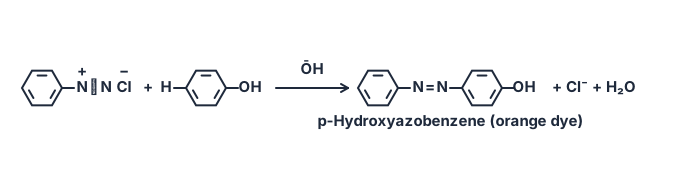
Coupling with phenol: benzenediazonium chloride reacts with phenol under mildly alkaline conditions (the phenol is first converted to the more strongly activating phenoxide ion). Coupling occurs at the carbon para to the group, giving -hydroxyazobenzene, an orange dye:
Drawn by us to help you understand the concept clearly, and verified to make sure it's accurate. For exams, practice from your NCERT textbook's own diagram.
Redrawn from the NCERT page with the structures, printed labels (Cl, OH, ŌH, + Cl⁻ + H2O, p-Hydroxyazobenzene (orange dye)) and reagent placement exactly as the textbook prints them. Every element of this display was checked against the printed page during the sweep's blind-judge verification pass, …
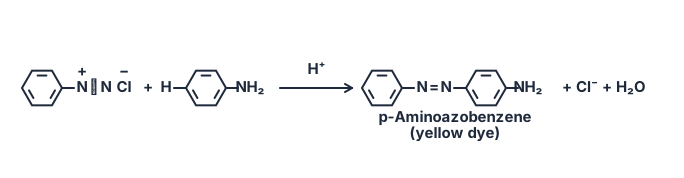
Coupling with aniline: the analogous reaction of benzenediazonium chloride with aniline is carried out under mildly acidic conditions and couples para to the group, giving -aminoazobenzene, a yellow dye:
Drawn by us to help you understand the concept clearly, and verified to make sure it's accurate. For exams, practice from your NCERT textbook's own diagram.
Redrawn from the NCERT page with the structures, printed labels (Cl, NH2, H⁺, + Cl⁻ + H2O, p-Aminoazobenzene, (yellow dye)) and reagent placement exactly as the textbook prints them. Every element of this display was checked against the printed page during the sweep's blind-judge verification pass, …
In both cases the diazonium-bearing ring itself is unchanged — it is the second ring (the phenol or the amine) that undergoes electrophilic substitution, with the diazonium ion playing the role of the attacking electrophile. …