Chemistry · Ch 3 — Chemical Kinetics
Effect of Catalyst
Effect of Catalyst
What a Catalyst Does
A catalyst is a substance that speeds up a reaction without itself undergoing any permanent chemical change in the process. A familiar example is the decomposition of potassium chlorate, which proceeds far faster in the presence of manganese dioxide:
The term "catalyst" is reserved for a substance that speeds a reaction up. When an added substance instead slows a reaction down, it is called an inhibitor, not a catalyst.
How a Catalyst Works — Intermediate Complex Theory
The action of a catalyst is explained through the intermediate complex theory. On this view, the catalyst takes part in the reaction by forming temporary bonds with the reactants, producing an intermediate complex. This complex has only a fleeting existence — it soon breaks down to release the products, regenerating the catalyst unchanged in the process.
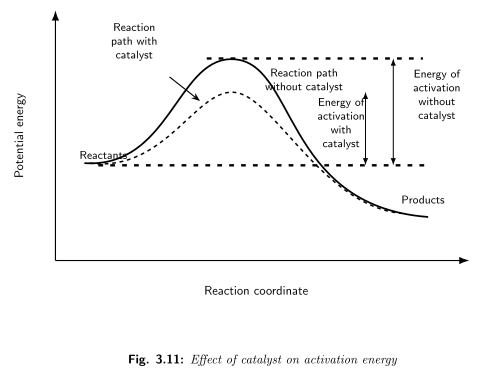
The reason this speeds up the reaction is that the catalyst opens up an alternative reaction pathway, one whose activation-energy barrier is lower than that of the uncatalysed route (fig-3-11 compares the potential-energy profile of the reaction with and without a catalyst present, showing the lowered barrier).
Drawn by us to help you understand the concept clearly, and verified to make sure it's accurate. For exams, practice from your NCERT textbook's own diagram.
The figure is an energy profile diagram that compares the reaction pathway with and without a catalyst.
- Axes: The vertical axis represents potential energy (or enthalpy, ) of the system. The horizontal axis is the reaction coordinate (or progress of reaction), which shows the transformation from reactants to products.
- Curves: Two curves start at the same Reactants energy level on the left and end at the same lower Products energy level on the right.
- The solid curve (higher peak) is labelled "reaction path without catalyst".
- The dashed curve (lower peak) is labelled "reaction path with catalyst".
- Labels: Vertical double arrows indicate:
- A large arrow from the reactants level to the top of the solid curve — this is the activation energy without catalyst, .
- A smaller arrow from the reactants level to the top of the dashed curve — this is the activation energy with catalyst, .
Physical idea: A catalyst provides an alternative pathway (a different reaction mechanism) that has a lower activation energy. The reactants and products remain the same (same initial and final energy levels), so the overall enthalpy change is unchanged. The catalyst does not affect the equilibrium constant or the thermodynamics — it only speeds up the rate by making it easier for the reaction to occur.
Key formula developed from this figure is the Arrhenius equation:
where:
- = rate constant
- = pre-exponential factor (frequency factor)
- = activation energy (in J/mol or kJ/mol)
- = gas constant ()
- = absolute temperature (in Kelvin) …
Since the Arrhenius equation shows that a smaller activation energy corresponds to a larger rate constant, this lowered barrier translates directly into a faster reaction.
Because only a small quantity of catalyst is needed to bring about this alternate lower-energy pathway, a small amount of catalyst is able to process a large amount of reactant — consistent with the catalyst itself not being consumed.
What a Catalyst Does NOT Change
A catalyst's effect is confined strictly to speeding up how fast a reaction reaches its natural endpoint — it does not change where that endpoint lies: …