Q.Write the structures of the following organic halogen compounds.
Concept understanding — Structural Isomerism
Structural Isomerism: The First Meeting
Imagine you have a box of identical Lego bricks — four red, ten blue, and six yellow. You build two different models: a car and a house. Both use exactly the same number of each colour brick, but the structures are completely different. That is the core idea of isomerism: same atoms, different arrangement.
In chemistry, molecules are not just a list of atoms. How those atoms are connected matters enormously. Two molecules can have the exact same molecular formula (same number of each atom) but be connected in different ways. Those are structural isomers (also called constitutional isomers).
The Precise Statement
Structural isomers are compounds that have the same molecular formula but different connectivity of atoms — that is, different structural formulas.
The key word is connectivity. Which atom is bonded to which? If you change that, you get a different substance with different physical and chemical properties.
A Concrete Example: C₄H₁₀
Take butane, C₄H₁₀. There are exactly two ways to connect four carbon atoms and ten hydrogen atoms:
- n-Butane — a straight chain: C–C–C–C
- Isobutane (2-methylpropane) — a branched chain: a central carbon bonded to three methyl groups
Both have formula C₄H₁₀. But n-butane boils at –0.5 °C, while isobutane boils at –11.7 °C. Same atoms, different connectivity → different substance.
Structural isomers are not the same molecule. They are distinct compounds that happen to share a molecular formula. You cannot rotate or flip one to get the other — you must break and reform bonds.
The Three Main Types
Structural isomerism comes in three flavours:
| Type | What changes | Example (C₃H₆O) |
|---|---|---|
| Chain isomerism | The carbon skeleton (straight vs. branched) | Butane vs. isobutane |
| Position isomerism | The location of a functional group or substituent | Propan-1-ol vs. propan-2-ol (OH on carbon 1 vs. carbon 2) |
| Functional group isomerism | The atoms are rearranged into a different functional group | Propanal (aldehyde) vs. propanone (ketone) — both C₃H₆O |
Do not confuse structural isomers with stereoisomers. Stereoisomers have the same connectivity but differ in spatial arrangement (like left and right hands). That is a completely different chapter. For now: structural isomers = different bond connections.
Why This Matters
Structural isomers can have wildly different properties. Ethanol (C₂H₆O) is a drinkable alcohol; its isomer dimethyl ether is a gas used as a refrigerant. Same atoms, but one is a liquid you can consume, the other is a gas that would kill you. That is why chemists care so much about connectivity — it determines everything.
Quick Check
Question: Are these structural isomers?
Molecule A: CH₃–CH₂–CH₂–CH₃
Molecule B: CH₃–CH(CH₃)–CH₃
Answer: Yes. Both are C₄H₁₀. A is n-butane (straight chain), B is isobutane (branched). Different connectivity → structural isomers.
The molecular formula must be identical. If the formulas differ, they are not isomers at all — just different compounds.
Structural isomerism is introduced in the NCERT/CBSE Class 11 Chemistry chapter on Organic Chemistry: Some Basic Principles and Techniques, and ‘structural isomerism examples class 11’ is a frequently searched important-question topic for board exams, JEE Main and NEET. Correctly distinguishing structural isomers by connectivity, rather than just matching molecular formulas, is a skill tested throughout competitive organic chemistry exams.
Why this formula?
Structural Isomerism: Why the Key Ideas Hold
Structural isomerism arises when molecules share the same molecular formula but differ in the connectivity of atoms. There is no single "formula" for structural isomerism — instead, the key is understanding why different arrangements are possible.
The Core Principle: Connectivity ≠ Composition
A molecular formula tells you how many of each atom are present, but not how they are joined. Structural isomers exist because atoms can form bonds in multiple distinct sequences while satisfying valency rules.
Why This Happens: The Valency Constraint
Each atom has a fixed bonding capacity (valency):
- Carbon: 4 bonds
- Hydrogen: 1 bond
- Oxygen: 2 bonds
- Nitrogen: 3 bonds
Example: For C4H10, the formula satisfies 4(4)+10(1)=26 valence electrons. But the carbon atoms can be arranged as:
- A straight chain: CH3−CH2−CH2−CH3 (n-butane)
- A branched chain: CH3−CH(CH3)−CH3 (isobutane)
Both satisfy valency, but the connectivity differs.
The "Formula" for Counting Isomers: Why It's Not Simple
There is no closed-form formula to count structural isomers for a given molecular formula. The number grows rapidly and depends on:
- Carbon skeleton branching possibilities
- Functional group positions
- Ring formation possibilities
Why No Simple Formula Exists
The problem is combinatorial — the number of possible trees (acyclic graphs) with n carbon atoms grows exponentially. For example:
- C4H10: 2 structural isomers
- C5H12: 3 structural isomers
- C6H14: 5 structural isomers
- C10H22: 75 structural isomers
The pattern follows Cayley's formula for trees, but even that counts only carbon skeletons — not functional group positions.
Key Reasoning: The Branching Principle
The fundamental reason structural isomers exist is that carbon chains can branch. Consider C5H12:
- Straight chain: C−C−C−C−C (n-pentane)
- One branch: C−C−C(C)−C (isopentane) — the branch can be at position 2 or 3, but these are identical due to symmetry
- Two branches: C−C(C)(C)−C (neopentane) — a quaternary carbon
Why position matters: The branch location changes the carbon's environment, altering physical and chemical properties.
The Functional Group Position Rule
For compounds with functional groups (e.g., alcohols CnH2n+2O), the position of the -OH group creates isomers:
- CH3CH2CH2OH (propan-1-ol) — OH at end
- CH3CH(OH)CH3 (propan-2-ol) — OH in middle
Why these are distinct: The OH group's position changes the carbon's hybridization environment and the molecule's polarity.
The Ring-Chain Isomerism Reason
For unsaturated formulas like C4H8, the same formula can represent:
- A straight alkene: CH2=CH−CH2−CH3
- A branched alkene: CH3−C(=CH2)−CH3
- A cycloalkane: cyclobutane (ring)
Why rings form: Carbon atoms can bond to form closed loops, reducing the number of hydrogen atoms needed. The formula CnH2n can be either an alkene (one double bond) or a cycloalkane (one ring).
Summary: The Takeaway
| Aspect | Why It Holds |
|---|---|
| Different connectivity | Atoms can bond in multiple sequences while satisfying valency |
| No simple counting formula | The number of possible trees grows combinatorially |
| Branching creates isomers | Carbon chains can have branches at different positions |
| Position matters | Functional groups at different locations change properties |
| Rings vs. chains | Same formula can represent open chains or closed rings |
The key insight: Structural isomerism exists because molecular formula is a constraint, not a blueprint — it tells you the ingredients, not the recipe.
Concept: Structural Isomerism & IUPAC Nomenclature
The key is to translate each IUPAC name into a correct structural formula by identifying the parent chain, substituents, and their positions.
Reasoning steps:
- Identify the parent chain (alkane, cycloalkane, or benzene ring) and number it according to the locants given.
- Attach the substituents (halogens, alkyl groups) at the specified carbon numbers.
- Check for stereochemistry where relevant (e.g., cis/trans in cyclohexane, E/Z in alkenes) — draw the most stable or unambiguous form.
- Write the condensed or bond-line structure clearly.
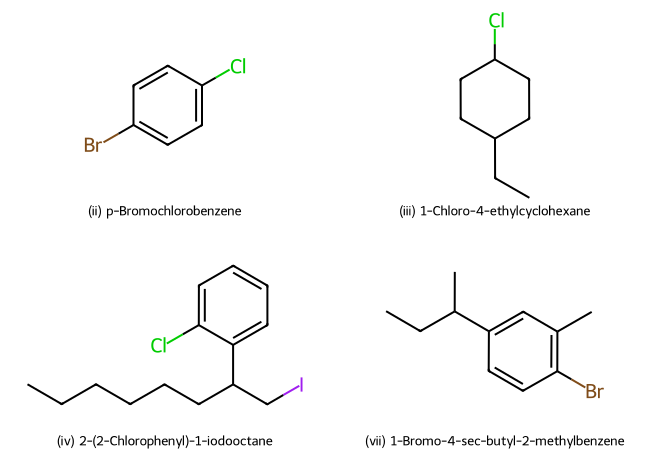
The structures are drawn below.
- 2-Chloro-3-methylpentane Parent: pentane (5 C chain). Cl at C2, CH3 at C3. CH3−CHCl−CH(CH3)−CH2−CH3
- p-Bromochlorobenzene Benzene ring with Br and Cl at para positions (1,4-). Br at C1, Cl at C4.
- 1-Chloro-4-ethylcyclohexane Cyclohexane ring. Cl at C1, ethyl (−CH2CH3) at C4. cis/trans not specified; draw one (e.g., trans).
- 2-(2-Chlorophenyl)-1-iodooctane Parent: octane (8 C chain). I at C1. At C2, a 2-chlorophenyl group (benzene ring with Cl at ortho position).
- 2-Bromobutane Parent: butane (4 C chain). Br at C2. CH3−CHBr−CH2−CH3
- 4-tert-Butyl-3-iodoheptane Parent: heptane (7 C chain). I at C3. tert-Butyl (−C(CH3)3) at C4.
- 1-Bromo-4-sec-butyl-2-methylbenzene Benzene ring. Br at C1, CH3 at C2, sec-butyl (−CH(CH3)CH2CH3) at C4.
- 1,4-Dibromobut-2-ene Parent: but-2-ene (4 C chain with double bond between C2 and C3). Br at C1 and C4. E/Z not specified; draw trans (more stable). BrCH2−CH=CH−CH2Br
The key idea is to translate each IUPAC name into a structural formula by identifying the parent chain, locating substituents with locants, and drawing the correct connectivity — including stereochemistry where implied. The final structures are given below.
Why this approach works
Drawing organic structures from IUPAC names is like following a set of building instructions. The name tells you three things: the parent chain (the longest carbon skeleton), the functional groups or substituents attached to it, and their positions (locants). The trick is to work systematically — start with the backbone, number it correctly, then attach each substituent at the right carbon. For cyclic compounds, the ring is the parent. For aromatic compounds, the benzene ring is the parent, and substituents are numbered to give the lowest locants.
Let’s go through each one.
-
2-Chloro-3-methylpentane
Parent chain: pentane (5 carbons).
Number from the end nearest the first substituent. Here, chloro is at C-2 and methyl at C-3.
Draw a 5-carbon straight chain:
C1−C2−C3−C4−C5
Attach Cl at C-2 and a methyl group (CH3) at C-3.
The structure:
CH3−CHCl−CH(CH3)−CH2−CH3
-
p-Bromochlorobenzene
“p-” means para — the two substituents are opposite each other on the benzene ring.
Benzene ring with Br at position 1 and Cl at position 4 (or vice versa — it’s the same compound).
Draw a hexagon with alternating double bonds. Attach Br to one carbon and Cl to the carbon directly opposite.
-
1-Chloro-4-ethylcyclohexane
Parent: cyclohexane (6-carbon ring).
Number the ring carbons so that the substituents get the lowest locants. Chloro at C-1, ethyl at C-4.
Draw a hexagon. At one carbon, attach Cl. At the carbon three steps away (counting around), attach an ethyl group (CH2CH3).
NoteIn cyclohexane, the ring is usually drawn as a regular hexagon. The exact stereochemistry (cis/trans) is not specified here, so just show the connectivity.
-
2-(2-Chlorophenyl)-1-iodooctane
Parent chain: octane (8 carbons).
Substituents: an iodine at C-1, and a 2-chlorophenyl group at C-2.
“2-Chlorophenyl” means a benzene ring with a chlorine at the 2-position (ortho to the point of attachment).
Draw an 8-carbon chain:
C1−C2−C3−C4−C5−C6−C7−C8
Attach I at C-1. At C-2, attach a benzene ring that has a Cl at the ortho position relative to the bond to C-2.
So the benzene ring is drawn with the attachment point at C-1 of the ring, and Cl at C-2 of the ring.
-
2-Bromobutane
Parent: butane (4 carbons).
Bromine at C-2.
CH3−CHBr−CH2−CH3
-
4-tert-Butyl-3-iodoheptane
Parent: heptane (7 carbons).
Substituents: iodine at C-3, and a tert-butyl group at C-4.
“tert-Butyl” is −C(CH3)3.
Draw a 7-carbon chain:
C1−C2−C3−C4−C5−C6−C7
Attach I at C-3. At C-4, attach a carbon that has three methyl groups:
C4−C(CH3)3
The full structure:
CH3−CH2−CHI−CH(C(CH3)3)−CH2−CH2−CH3
-
1-Bromo-4-sec-butyl-2-methylbenzene
Parent: benzene.
Substituents: Br at C-1, methyl at C-2, and a sec-butyl group at C-4.
“sec-Butyl” is −CH(CH3)CH2CH3.
Number the benzene ring so that the substituents get the lowest locants. Here, 1,2,4-trisubstituted.
Draw the benzene ring. At position 1, attach Br. At position 2 (adjacent), attach a methyl group. At position 4 (directly opposite C-1), attach the sec-butyl group:
−CH(CH3)CH2CH3
-
1,4-Dibromobut-2-ene
Parent: but-2-ene (4-carbon chain with a double bond between C-2 and C-3).
Bromines at C-1 and C-4.
The double bond is between C-2 and C-3.
Structure:
BrCH2−CH=CH−CH2Br
Watch outA common mistake is to put the double bond at the end. The name “but-2-ene” explicitly places the double bond between carbons 2 and 3. Also, the bromines are on the terminal carbons.
The structural formulas are: (i) CH3−CHCl−CH(CH3)−CH2−CH3 (ii) A benzene ring with Br and Cl para to each other (iii) A cyclohexane ring with Cl at C-1 and ethyl at C-4 (iv) I−CH2−CH(C6H4Cl-2)−(CH2)5−CH3 (v) CH3−CHBr−CH2−CH3 (vi) CH3−CH2−CHI−CH(C(CH3)3)−CH2−CH2−CH3 (vii) A benzene ring with Br at C-1, methyl at C-2, and sec-butyl at C-4 (viii) BrCH2−CH=CH−CH2Br
Structural Isomerism — Drawing Organic Halogen Compounds
Method: IUPAC Name-to-Structure Translation
This method uses the systematic IUPAC name to reconstruct the molecular structure step-by-step.
Steps
- Identify the parent chain (alkane, cycloalkane, or benzene ring) from the suffix.
- Number the parent chain according to locants given in the name.
- Add substituents (halogens, alkyl groups) at the specified positions.
- Check stereochemistry if indicated (cis/trans, E/Z, or wedge-dash bonds).
- Verify that the structure matches the name exactly.
(i) 2-Chloro-3-methylpentane
- Parent: pentane (5-carbon straight chain)
- Substituents: Cl at C-2, methyl at C-3
    CH₃
     |
Cl—CH—CH—CH₂—CH₃
     |
    CH₃
Structure: CH3CHClCH(CH3)CH2CH3
(ii) p-Bromochlorobenzene
- Parent: benzene ring
- Substituents: Br and Cl at para positions (1,4-)
(ring shown in the diagram above.)
Structure: 1-bromo-4-chlorobenzene
(iii) 1-Chloro-4-ethylcyclohexane
- Parent: cyclohexane ring
- Substituents: Cl at C-1, ethyl at C-4
(ring shown in the diagram above.)
Structure: Chlorine and ethyl group on opposite sides (trans) or same side (cis) — both are valid unless specified.
(iv) 2-(2-Chlorophenyl)-1-iodooctane
- Parent: octane (8-carbon chain)
- Substituents: I at C-1, a 2-chlorophenyl group at C-2
(chain + ring shown in the diagram above.)
Structure: ICH2CH(C6H4Cl)(CH2)5CH3
(v) 2-Bromobutane
- Parent: butane (4-carbon chain)
- Substituent: Br at C-2
CH₃—CH—CH₂—CH₃
     |
     Br
Structure: CH3CHBrCH2CH3
(vi) 4-tert-Butyl-3-iodoheptane
- Parent: heptane (7-carbon chain)
- Substituents: I at C-3, tert-butyl at C-4
CH₃—CH₂—CH—CH—CH₂—CH₂—CH₃
         |   |
         I   C(CH₃)₃
Structure: CH3CH2CHICH(C(CH3)3)CH2CH2CH3
(vii) 1-Bromo-4-sec-butyl-2-methylbenzene
- Parent: benzene ring
- Substituents: Br at C-1, methyl at C-2, sec-butyl at C-4
(ring shown in the diagram above.)
Structure: 1-bromo-2-methyl-4-(1-methylpropyl)benzene
(viii) 1,4-Dibromobut-2-ene
- Parent: but-2-ene (4-carbon chain with double bond between C-2 and C-3)
- Substituents: Br at C-1 and C-4
Br—CH₂—CH=CH—CH₂—Br
Structure: BrCH2CH=CHCH2Br
Note: This compound shows geometric isomerism (cis/trans). The structure above is the trans isomer unless specified otherwise.
Key Exam Tip
For structural isomerism questions, always:
- Draw the carbon skeleton first
- Add multiple bonds before substituents
- Check that each carbon has 4 bonds
Common Mistakes in Drawing Structures of Organic Halogen Compounds
Here are the most frequent errors students make with these compounds, along with how to avoid them.
1. Incorrect Parent Chain Selection (IUPAC Naming Errors)
Mistake: Choosing the wrong longest carbon chain, especially when halogens or alkyl groups are present.
Example from (iv): 2-(2-Chlorophenyl)-1-iodooctane
- Students often forget that the octane chain (8 carbons) is the parent, not the phenyl ring.
- They might draw a chain with only 6 or 7 carbons.
How to avoid:
- Always identify the longest continuous carbon chain that contains the principal functional group (here, the halogen).
- The suffix
-octanetells you the parent chain has 8 carbons. - The phenyl group is a substituent, not part of the main chain.
2. Misplacing the Substituent Position Number
Mistake: Assigning locant numbers incorrectly, especially when multiple substituents are present.
Example from (vi): 4-tert-Butyl-3-iodoheptane
- Students sometimes number from the wrong end, giving
4-tert-butylinstead of checking which end gives the lowest locant for the first substituent.
How to avoid:
- Number the parent chain so that the first substituent encountered gets the lowest possible number.
- Compare
3-iodo, 4-tert-butyl(locant set {3,4}) vs5-iodo, 4-tert-butyl(locant set {4,5}, from numbering the chain from the other end) — the first is correct because {3,4} beats {4,5} at the first point of difference.
3. Forgetting to Show Stereochemistry (cis/trans or E/Z)
Mistake: Drawing a flat structure for compounds that have geometric isomerism.
Example from (viii): 1,4-Dibromobut-2-ene
- The double bond (but-2-ene) can exist as cis or trans (E/Z) isomers.
- Students often draw only one isomer or ignore the geometry entirely.
How to avoid:
- For alkenes, always check if cis/trans or E/Z isomerism is possible.
- Draw the double bond with proper wedge/dash or zigzag representation.
- For
1,4-dibromobut-2-ene, both Br atoms can be on the same side (cis) or opposite sides (trans).
4. Incorrect Placement of Halogen on Aromatic Ring
Mistake: Misinterpreting prefixes like p-, o-, m- or numbering on benzene.
Example from (ii): p-Bromochlorobenzene
- Students sometimes place Br and Cl in meta or ortho positions instead of para (1,4).
How to avoid:
p-means para = positions 1 and 4 on the benzene ring.- Draw the ring, number carbons 1–6, and place Br at C1 and Cl at C4 (or vice versa — both are correct).
5. Confusing Alkyl Substituent Names (sec-butyl, tert-butyl)
Mistake: Drawing the wrong carbon skeleton for sec-butyl or tert-butyl.
Example from (vii): 1-Bromo-4-sec-butyl-2-methylbenzene
- Students often draw
sec-butylas a straight chain (n-butyl) or asisobutyl.
How to avoid:
- sec-butyl =
–CH(CH₃)CH₂CH₃(a branched 4-carbon group with the free bond on a secondary carbon) - tert-butyl =
–C(CH₃)₃(three methyl groups on a central carbon) - isobutyl =
–CH₂CH(CH₃)₂(different from sec-butyl!) - Memorize these structures:
| Name | Structure |
|---|---|
| n-butyl | –CH₂CH₂CH₂CH₃ |
| sec-butyl | –CH(CH₃)CH₂CH₃ |
| isobutyl | –CH₂CH(CH₃)₂ |
| tert-butyl | –C(CH₃)₃ |
6. Ignoring the Cyclohexane Ring Conformation
Mistake: Drawing cyclohexane as a flat hexagon without considering chair/boat forms or axial/equatorial positions.
Example from (iii): 1-Chloro-4-ethylcyclohexane
- Students often place both substituents on the same side (cis) when the name doesn't specify stereochemistry.
How to avoid:
- If the name does not specify cis/trans, draw the most stable conformation (usually trans for 1,4-disubstituted cyclohexane).
- For exam purposes, a planar hexagon with wedges/dashes is acceptable unless the question asks for chair form.
- Remember: 1,4-trans is more stable than 1,4-cis because both substituents can be equatorial.
7. Incorrect Carbon Count in the Parent Chain
Mistake: Miscounting carbons when drawing the skeleton.
Example from (v): 2-Bromobutane
- Students sometimes draw a 3-carbon chain (propane) or a 5-carbon chain (pentane).
How to avoid:
- The suffix
-butanemeans 4 carbons in the parent chain. - Count: C1–C2–C3–C4. Bromine is on C2.
- Draw:
CH₃–CHBr–CH₂–CH₃
8. Forgetting to Show All Bonds and Lone Pairs (When Required)
Mistake: Drawing condensed formulas when the question asks for structures (i.e., showing all bonds).
How to avoid:
- Read the question carefully: "Write the structures" usually means full structural formulas (all bonds shown).
- For aromatic compounds, show the Kekulé structure (alternating double bonds) or the circle representation, as per your exam board.
Quick Summary Table
| Compound | Common Mistake | Correct Approach |
|---|---|---|
| (i) 2-Chloro-3-methylpentane | Wrong parent chain (hexane instead of pentane) | Count 5 carbons; Cl at C2, CH₃ at C3 |
| (ii) p-Bromochlorobenzene | Ortho/meta placement | Para = 1,4 positions |
| (iii) 1-Chloro-4-ethylcyclohexane | Ignoring cis/trans | Draw trans (more stable) unless specified |
| (iv) 2-(2-Chlorophenyl)-1-iodooctane | Short parent chain | Octane = 8 carbons; phenyl is substituent |
| (v) 2-Bromobutane | Wrong carbon count | Butane = 4 carbons; Br at C2 |
| (vi) 4-tert-Butyl-3-iodoheptane | Wrong numbering | Number to give lowest locant (3-iodo, not 4-iodo) |
| (vii) 1-Bromo-4-sec-butyl-2-methylbenzene | Wrong sec-butyl structure | sec-butyl = –CH(CH₃)CH₂CH₃ |
| (viii) 1,4-Dibromobut-2-ene | Ignoring cis/trans | Show both possible isomers |
Final Tip: Always draw the carbon skeleton first, number it, then add substituents. Double-check the parent chain length and substituent positions before finalizing.
Showing the 12 most recent of 17 on this concept.
- CBSE 2026Set DZ1 markMCQQ.Which of the following is an aldehyde?(a) CH3−C∣∣O−H(b) CH3−CH2−C∣∣O−CH3(c) CH3−CH2−C∣∣O−CH2−CH3(d) CH3−C∣∣O−CH3
›Reveal solutionSolution
An aldehyde has the −CHO group (a carbonyl carbon bonded to at least one H). Only option (a) has this; the rest are ketones.
The functional-group test: in an aldehyde the carbonyl carbon (>C=O) carries at least one hydrogen (R−CHO). In a ketone the carbonyl carbon is bonded to two carbon atoms (R−CO−R′).
-
(a) CH3−CHO → carbonyl C bonded to one H → aldehyde (ethanal) ✓
-
(b) CH3CH2−CO−CH3 → butan-2-one → ketone
-
(c) CH3CH2−CO−CH2CH3 → pentan-3-one → ketone
-
(d) CH3−CO−CH3 → propanone (acetone) → ketone
✓Final answer(a) CH3CHO (acetaldehyde/ethanal).
-
- CBSE 2026Set A1 markMCQQ.Which of the following is Isopropyl amine ?(a) CH3-CH2-CH2-NH2(b) CH3-NH-C2H5(c) CH3-CH(NH2)-CH3(d) CH3-CH(CH3)-CH2-NH2
›Reveal solutionSolution
Isopropyl amine = propan-2-amine, CH3-CH(NH2)-CH3.
The isopropyl group is (CH3)2CH-, so isopropylamine has the amino group attached to the central carbon of a propane chain: CH3-CH(NH2)-CH3 (propan-2-amine). For reference:
-
(a) CH3-CH2-CH2-NH2 is n-propylamine (propan-1-amine)
-
(b) CH3-NH-C2H5 is N-methylethylamine (a secondary amine)
-
(d) is isobutylamine
✓Final answer(c) CH3-CH(NH2)-CH3.
-
- CBSE 2026Set ANNUAL1 markQ.How many structural isomers of C5H11Br are possible?
›Reveal solutionSolution
C5H11Br has 8 possible structural isomers, arising from bromine substitution at different positions on the three possible pentane carbon skeletons.
C5H11Br is derived from pentane (C5H12) by replacing one H with Br. Pentane itself has 3 carbon-skeleton isomers, and Br can go on different, non-equivalent carbon positions of each:
From n-pentane skeleton (CH3CH2CH2CH2CH3):
- 1-bromopentane
- 2-bromopentane
- 3-bromopentane (C4 and C5 positions are equivalent to C2 and C1 by the molecule's symmetry)
From isopentane / 2-methylbutane skeleton ((CH3)2CHCH2CH3):
4. 1-bromo-2-methylbutane
5. 2-bromo-2-methylbutane
6. 3-bromo-2-methylbutane
7. 1-bromo-3-methylbutane (isoamyl bromide)
From neopentane / 2,2-dimethylpropane skeleton ((CH3)3CCH3, i.e. (CH3)4C):
8. Neopentyl bromide (1-bromo-2,2-dimethylpropane)
Of these 8: 4 are primary bromides, 3 are secondary, and 1 is tertiary.
✓Final answer8 structural isomers.
- CBSE 2026Set ANNUAL1 markMCQQ.Ethylidine dichloride is a:(a) vic-dihalide(b) gem-dihalide(c) allylic dihalide(d) vinylic halide
›Reveal solutionSolution
Ethylidene dichloride, CH₃CHCl₂, has both chlorine atoms on the same carbon — a gem-dihalide.
Ethylidene dichloride has the structure CH₃–CHCl₂. Both chlorine atoms are attached to the same carbon atom (the second carbon). Dihalides in which both halogens sit on one carbon are called geminal (gem) dihalides; when they are on adjacent carbons they are called vicinal (vic) dihalides. Since both Cl atoms here are on one carbon, this is a gem-dihalide.
✓Final answer(b) gem-dihalide.
- CBSE 2026Set ANNUAL1 markMCQQ.The correct IUPAC name of the organic compound CH₃—CH(C₂H₅)—CH₂Br is-(a)(i) 1-Bromo-2-ethyl-2 methyl ethane(b)(ii) 1-Bromo-2-ethyl propane(c)(iii) 1-Bromo-2-methyl butane(d)(iv) 2-Methyl-1-bromo butane
›Reveal solutionSolution
CH3–CH(C2H5)–CH2Br names as 1-bromo-2-methylbutane. Correct option: (iii).
Concept. IUPAC naming of a haloalkane: (1) pick the longest carbon chain that contains the carbon bearing the halogen; (2) number so the substituents get the lowest set of locants; (3) cite substituents alphabetically as prefixes.
Steps.
- The structure is BrCH2–CH(CH3)–CH2–CH3.
- Longest chain through the C–Br carbon = 4 carbons (butane): C1(CH2Br)−C2(CH)−C3(CH2)−C4(CH3).
- Number from the Br end: bromo at C-1, methyl branch at C-2.
- Name: 1-bromo-2-methylbutane.
Why other options are wrong. (i) and (ii) use "ethane/propane" as the parent — they fail to select the longest chain (butane). (iv) "2-methyl-1-bromobutane" mis-orders the substituents (alphabetical order requires bromo before methyl).
✓Final answer(iii) 1-Bromo-2-methylbutane. This IUPAC nomenclature is common to the NCERT/CBSE-aligned UBSE Class-12 Chemistry course.
- CBSE 2025Set JZ1 markMCQQ.The correct IUPAC name for CH2=CHCH2NHCH3 is :(a) Allylmethylamine(b) 1-amine-4-pentene(c) 4-aminopent-1-ene(d) N-methylprop-2-ene-1-amine
›Reveal solutionSolution
Naming CH2=CHCH2NHCH3 as a substituted amine gives N-methylprop-2-en-1-amine — option (d).
Concept. For a secondary amine, choose the longest carbon chain attached to nitrogen as the parent amine; the smaller alkyl group on N is named as an N-substituent.
Working:
- Parent chain: CH2=CH−CH2− is a 3-carbon chain with a double bond → prop-2-ene; the amino group is on C-1 → prop-2-en-1-amine.
- The nitrogen also carries a −CH3, written as the prefix N-methyl.
Combining: N-methylprop-2-en-1-amine (the common name is allylmethylamine, but the IUPAC name is required).
✓Final answer(d) N-methylprop-2-ene-1-amine.
- CBSE 2025Set D1 markMCQQ.The number of isomeric alcohols of molecular formula C4H10O is(a) 2(b) 4(c) 7(d) 8
›Reveal solutionSolution
The four alcohols of formula C4H10O are 1-butanol, 2-methyl-1-propanol, 2-butanol and 2-methyl-2-propanol.
For the molecular formula C4H10O with an -OH group, the possible alcohols are:
- n-Butanol (butan-1-ol): CH3CH2CH2CH2OH (1°)
- Isobutyl alcohol (2-methylpropan-1-ol): (CH3)2CHCH2OH (1°)
- sec-Butyl alcohol (butan-2-ol): CH3CH2CH(OH)CH3 (2°)
- tert-Butyl alcohol (2-methylpropan-2-ol): (CH3)3COH (3°)
That gives 4 isomeric alcohols. (The remaining C4H10O isomers such as diethyl ether are ethers, not alcohols.)
✓Final answer(B) 4 isomeric alcohols of formula C4H10O.
- CBSE 2025Set ANNUAL1 markMCQQ.The number of isomers in C2BrClFI is(a) 3(b) 4(c) 5(d) 6
›Reveal solutionSolution
C2BrClFI, an ethylene bearing all four halogens (Br, Cl, F, I) with no hydrogens, has 6 possible isomers.
Since the formula has 2 carbons and exactly 4 substituents (Br, Cl, F, I) with no hydrogens, this corresponds to a fully-substituted ethylene, i.e. an alkene of type (X)(Y)C=C(Z)(W), where each carbon bears 2 of the 4 different halogens.
Step 1 — constitutional (positional) isomers: choose which 2 of the 4 halogens sit on one carbon (the other 2 automatically go on the other carbon). The number of distinct ways to split 4 different halogens into two unordered pairs is 3: {Br,Cl}|{F,I}, {Br,F}|{Cl,I}, {Br,I}|{Cl,F}.
Step 2 — geometric (cis/trans) isomers: for each of these 3 constitutional arrangements, since each carbon carries 2 different substituents, the molecule can exist as 2 geometric isomers (cis and trans, i.e. Z and E).
Total isomers = 3 (constitutional arrangements) x 2 (geometric isomers each) = 6.
✓Final answer(D) 6.
- CBSE 2024Set ANNUAL1 markMCQQ.An isomer of ethanol is(a) Methanol(b) Dimethyl ether(c) Diethyl ether(d) Ethylene glycol
›Reveal solutionSolution
Dimethyl ether (CH3–O–CH3) is the classic functional isomer of ethanol (C2H6O).
Ethanol (CH3CH2OH) has molecular formula C2H6O. Dimethyl ether (CH3–O–CH3) has the identical molecular formula C2H6O but a completely different functional group (ether linkage instead of an –OH group) — this is an example of functional group isomerism. Methanol (CH4O) and diethyl ether (C4H10O) have different molecular formulas, so they are not isomers of ethanol; ethylene glycol (C2H6O2) also has a different formula.
✓Final answer(B) Dimethyl ether.
- CBSE 2024Set ANNUAL1 markMCQQ.The total number of isomers for the compounds having molecular formula C4H10O is(a) 7(b) 6(c) 3(d) 4
›Reveal solutionSolution
C4H10O has 7 total structural isomers: 4 alcohols + 3 ethers.
Alcohols (C4H9OH, 4 isomers): butan-1-ol, butan-2-ol, 2-methylpropan-1-ol (isobutanol), 2-methylpropan-2-ol (tert-butanol).
Ethers (C4H10O, 3 isomers): diethyl ether (C2H5–O–C2H5), methyl n-propyl ether (CH3–O–CH2CH2CH3), methyl isopropyl ether (CH3–O–CH(CH3)2).
Total = 4 + 3 = 7 constitutional isomers.
✓Final answer(A) 7.
- CBSE 2023Set ANNUAL1 markQ.How many isomeric monochloro derivatives will be formed when 2-methylpropane is subjected to photochlorination ?
›Reveal solutionSolution
2-Methylpropane has only two chemically distinct kinds of hydrogen (9 equivalent primary H's and 1 tertiary H), so free-radical photochlorination gives exactly two monochloro isomers.
2-Methylpropane (isobutane), (CH3)3CH, has two types of hydrogen atoms:
- 9 primary hydrogens (three equivalent CH3 groups), all chemically equivalent by symmetry — substitution at any of these gives the same product: 1-chloro-2-methylpropane, (CH3)2CHCH2Cl.
- 1 tertiary hydrogen (on the central carbon) — substitution here gives: 2-chloro-2-methylpropane (tert-butyl chloride), (CH3)3CCl.
Since photochlorination is a free-radical substitution that can occur at any C–H bond, but chemically equivalent hydrogens always give the identical product, the number of distinct isomeric monochloro products depends only on the number of structurally different types of hydrogen, not the total count of hydrogens.
✓Final answer2 isomeric monochloro derivatives: 1-chloro-2-methylpropane (from the primary H's) and 2-chloro-2-methylpropane / tert-butyl chloride (from the tertiary H).
- CBSE 2023Set ANNUAL1 markMCQQ.CH2=CH-CH2-CH3 and CH3-CH=CH-CH3 are:(a) Chain isomers(b) Position isomers(c) Functional isomers(d) Metamers
›Reveal solutionSolution
CH2=CH-CH2-CH3 (1-butene) and CH3-CH=CH-CH3 (2-butene) share the same carbon skeleton and functional group but differ only in where the double bond sits — that is positional isomerism.
Both molecules have molecular formula C4H8 and the same unbranched 4-carbon chain, and both are alkenes (same functional group, so not functional isomers; same chain, so not chain isomers).
The only difference is the location of the C=C double bond: between C1–C2 in the first compound (1-butene) versus between C2–C3 in the second (2-butene). This difference in position of the double bond (or functional group) along an otherwise identical skeleton defines position isomers.
✓Final answerPosition isomers (option b).
🎓Unlock everything free for 14 days
- ✓Full step-by-step solutions
- ✓Concept-first explanations
- ✓Methods, shortcuts & mistakes
- ✓PYQ mapping + timed mock tests
Full access for 14 days. No credit card required.