Q.Assertion (A) : Uracil base is present in DNA. Reason (R) : DNA undergoes self-replication. Select the correct answer from the codes given below : (A) Both Assertion (A) and Reason (R) are true and Reason (R) is the correct explanation of the Assertion (A). (B) Both Assertion (A) and Reason (R) are true, but Reason (R) is not the correct explanation of the Assertion (A). (C) Assertion (A) is true, but Reason (R) is false. (D) Assertion (A) is false, but Reason (R) is true.
You're viewing a preview — the full solution, concept, methods & PYQ mapping are locked.
Start your 14-day free trial to unlock the full solution →Uracil is found in RNA, not DNA; DNA contains thymine instead. DNA does undergo self-replication. The assertion is false, the reason is true.
The question tests two fundamental facts about nucleic acids: the base composition of DNA versus RNA, and the property of DNA replication. Let's examine each statement independently before evaluating their relationship.
Understanding Nucleic Acid Bases
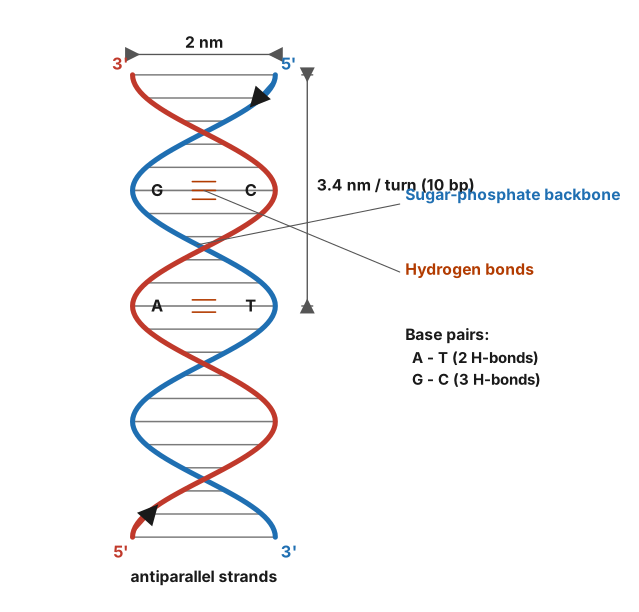
DNA and RNA differ in one critical nitrogenous base. Both contain adenine (A), guanine (G), and cytosine (C), but DNA uses thymine (T) while RNA uses uracil (U). This distinction is not arbitrary—thymine is 5-methyluracil, and the extra methyl group serves important functions in DNA stability and repair mechanisms. The presence of thymine allows cells to detect and repair deaminated cytosine (which becomes uracil) as damage, since uracil should never appear in DNA under normal circumstances.
A common mistake is to confuse the bases in DNA and RNA. Remember: DNA has Thymine, RNA has Uracil. The mnemonic "DNA is True" can help.
Evaluating the Assertion
Assertion (A): Uracil base is present in DNA.
This statement is false. DNA contains the four bases adenine, guanine, cytosine, and thymine. Uracil is exclusively found in RNA under normal physiological conditions. While uracil can occasionally appear in DNA through spontaneous cytosine deamination or misincorporation during replication, these are recognized as errors and are promptly removed by DNA repair enzymes like uracil-DNA glycosylase.
Evaluating the Reason
Reason (R): DNA undergoes self-replication.
This statement is true. DNA replication is a fundamental property of genetic material. During the S phase of the cell cycle, DNA molecules serve as templates for their own duplication through semi-conservative replication. Each strand acts as a template, and complementary base pairing (A with T, G with C) ensures accurate copying. This self-replication is essential for cell division, growth, and the transmission of genetic information from parent to offspring.
The semi-conservative nature of DNA replication was elegantly demonstrated by Meselson and Stahl in 1958 using nitrogen isotope labeling.
Analyzing the Relationship …
Unlock everything free for 14 days
- Full step-by-step solutions
- Concept-first explanations
- Methods, shortcuts & mistakes
- PYQ mapping + timed mock tests
Full access for 14 days. No credit card required.