Q.Which of the following compounds would be hydrolysed by aqueous KOH most easily ? (A) CH2=CH−Br (B) CH3−CH2−Br (C) CH3−CH(Br)−CH3 (D) CH2=CH−CH2−Br
Concept understanding — SN1 Reactivity Order
The Core Intuition: Who Wants to Leave, and Who Can Wait?
Imagine you're at a party where the host (the leaving group) is about to leave. The party (the reaction) happens in two stages. First, the host walks out the door — that's the slow, painful step. Then, a new guest (the nucleophile) rushes in to take the empty spot.
The SN1 reaction works exactly like this: the leaving group leaves first, forming a carbocation intermediate. The nucleophile attacks after the leaving group is gone. This means the rate of the reaction depends only on how easily the leaving group can leave — it does not depend on the nucleophile at all.
So the question becomes: What makes a carbocation form easily? The answer is stability. A carbocation that is more stable will form faster and last longer, making the SN1 reaction faster.
The Precise Statement of SN1 Reactivity Order
SN1 Reactivity Order (for alkyl halides):
Allylic≈Benzyl>3∘>2∘≫1∘≈Methyl
This is the order of how fast the SN1 reaction proceeds. Let's unpack why.
Why This Order? The Stability Ladder
A carbocation is a carbon with only six electrons in its valence shell — it's electron-deficient and positively charged. The more you can spread out (delocalize) that positive charge, the more stable the carbocation becomes.
1. Methyl and 1° Carbocations: The Unstable Ones
A methyl carbocation (CHX3X+) has no alkyl groups attached to the positive carbon. There is zero electron-donating effect to stabilize the charge. It is so unstable that it practically never forms in an SN1 reaction — the reaction simply doesn't happen.
A primary (1°) carbocation has one alkyl group attached. Alkyl groups are weakly electron-donating (through hyperconjugation and inductive effect), so it's slightly more stable than methyl — but still far too unstable to form under normal SN1 conditions.
Never say "SN1 happens on a primary carbon" in an exam. It is essentially impossible under standard conditions because the carbocation is too unstable.
2. Secondary (2°) Carbocations: The Borderline Case
A secondary carbocation has two alkyl groups donating electron density. It is moderately stable — stable enough to form, but only under certain conditions (like a good leaving group and a polar protic solvent). SN1 reactions on secondary carbons are possible, but they are slower than on tertiary carbons.
3. Tertiary (3°) Carbocations: The Sweet Spot
Three alkyl groups donate electron density to the positive carbon. This makes the carbocation very stable. Tertiary alkyl halides undergo SN1 reactions readily — they are the classic example.
4. Allylic and Benzylic: The Champions
These are special cases. In an allylic carbocation, the positive charge is adjacent to a carbon-carbon double bond. The π electrons of the double bond can delocalize the positive charge onto the second carbon:
CHX2=CH−CHX2X+↔+CHX2−CH=CHX2
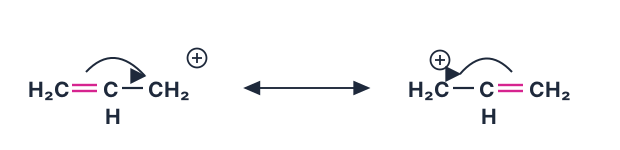
In a benzylic carbocation, the positive charge is adjacent to a benzene ring. The π system of the ring delocalizes the charge across multiple carbons:
CX6HX5−CHX2X+↔(several resonance structures)
Here are those resonance structures — the positive charge cycles from the CH₂ carbon onto the ortho and para positions of the ring:
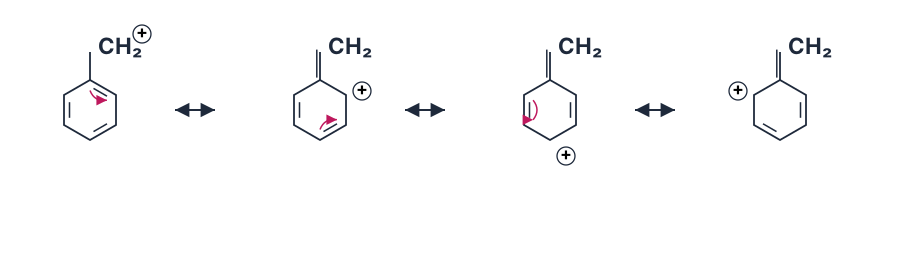
This resonance stabilization makes allylic and benzylic carbocations even more stable than tertiary ones. They form the fastest in SN1 reactions.
The Complete Picture in a Table
| Carbocation Type | Stability | SN1 Reactivity | Example |
|---|---|---|---|
| Methyl | Extremely unstable | Does not occur | CHX3Br |
| Primary (1°) | Very unstable | Does not occur | CHX3CHX2Br |
| Secondary (2°) | Moderately stable | Slow, possible | (CHX3)X2CHBr |
| Tertiary (3°) | Very stable | Fast | (CHX3)X3CBr |
| Allylic | Extremely stable (resonance) | Very fast | CHX2=CH−CHX2Br |
| Benzylic | Extremely stable (resonance) | Very fast | CX6HX5CHX2Br |
One More Thing: The Solvent Matters
SN1 reactions are fastest in polar protic solvents (like water, alcohols, or acetic acid). Why? Because these solvents can stabilize the carbocation intermediate through solvation (hydrogen bonding with the positive charge). They also help stabilize the leaving group after it departs.
In an exam, if you see a tertiary or allylic/benzylic halide in a polar protic solvent, think SN1. If you see a primary halide in a polar aprotic solvent, think SN2.
The Bottom Line
SN1 reactivity is all about carbocation stability. The more stable the carbocation that forms, the faster the reaction. Resonance beats hyperconjugation, so allylic and benzylic beat tertiary. Tertiary beats secondary. Secondary barely works. Primary and methyl don't work at all.
Final answer: The SN1 reactivity order is:
Allylic≈Benzyl>3∘>2∘≫1∘≈Methyl
(where ≫ means "much greater than" — essentially, SN1 does not happen for 1° and methyl substrates)
SN1 reactivity order is a classic topic from the NCERT Class 12 Chemistry chapter on Haloalkanes and Haloarenes, and ‘SN1 vs SN2 reactivity order’ is one of the most commonly searched organic-chemistry questions for CBSE boards, JEE Main and NEET alike. Getting this carbocation-stability-based ranking right is essential for scoring in reaction-mechanism-based important questions.
Why this formula?
SN1 Reactivity Order: Why It Holds
The SN1 reaction (Substitution Nucleophilic Unimolecular) proceeds via a carbocation intermediate. The reactivity order is determined entirely by the stability of this carbocation — because the rate-determining step is its formation.
The Core Principle
The rate law for SN1 is:
Rate=k[RX]
Only the substrate appears in the rate law — the nucleophile does not participate in the slow step. The slow step is:
RXslowR++X−
Thus, anything that stabilizes the carbocation (R⁺) lowers the activation energy and increases the reaction rate.
The Reactivity Order
For alkyl halides (RX), the SN1 reactivity order is:
Allylic>Benzyllic>Tertiary>Secondary>Primary>Methyl
Let's break down why each step holds.
1. Why Tertiary > Secondary > Primary > Methyl?
This is purely about hyperconjugation and inductive effect.
- Tertiary carbocation: Three alkyl groups donate electron density via hyperconjugation (C–H σ bonds overlap with empty p orbital) and +I effect. This spreads the positive charge over more atoms → most stable.
- Secondary: Two alkyl groups → less stabilization.
- Primary: Only one alkyl group → very little stabilization.
- Methyl: No alkyl groups → least stable (only inductive effect from H atoms, which is negligible).
Key formula: The number of α-hydrogens (H on carbons adjacent to the positive carbon) determines hyperconjugation. More α-H → more resonance structures → more stable.
2. Why Allylic and Benzylic Are Even Faster
These carbocations are resonance-stabilized.
- Allylic carbocation: The positive charge is delocalized over two carbon atoms via π-bond conjugation:
CH2=CH−CH2+⟷CH2+−CH=CH2
- Benzylic carbocation: The positive charge is delocalized into the aromatic ring:
C6H5−CH2+⟷several resonance forms involving the ring
Those resonance forms look like this:
This resonance stabilization is so powerful that even a primary allylic or benzylic carbocation is more stable than a tertiary alkyl carbocation.
3. The Complete Order (with reasoning)
| Substrate Type | Carbocation Stability Reason | Relative Rate |
|---|---|---|
| Benzylic | Resonance with aromatic ring | Fastest |
| Allylic | Resonance with C=C bond | Very fast |
| Tertiary | 3 alkyl groups (hyperconjugation + I-effect) | Fast |
| Secondary | 2 alkyl groups | Moderate |
| Primary | 1 alkyl group | Slow |
| Methyl | No alkyl groups | Slowest |
Why This Matters for Exams
- Never memorize the order blindly — always ask: "How stable is the carbocation?"
- Allylic and benzylic beat tertiary because resonance > hyperconjugation.
- Primary can be faster than secondary only if it's allylic/benzylic — otherwise, never.
Quick Check: A Common Exam Trap
Question: Which reacts faster in SN1 — 1-chloropropane (primary) or 2-chloropropane (secondary)?
Answer: 2-chloropropane (secondary) — because its carbocation is stabilized by two alkyl groups vs. one.
But if the question were allyl chloride (CH₂=CH–CH₂Cl) vs. isopropyl chloride — allyl chloride wins, even though it's primary, because of resonance.
Final takeaway: SN1 reactivity is carbocation stability in disguise. Master the why — the order will never trip you up.
Concept: SN1 reactivity order – carbocation stability governs ease of hydrolysis in aqueous KOH.
Aqueous KOH favors SN1 mechanism for substrates that can form stable carbocations. The rate-determining step is C–Br bond heterolysis to generate a carbocation intermediate.
Reasoning:
-
(A) CH2=CH–Br: Vinyl halide. The carbocation would be CH2=CH+ (vinyl cation), which is extremely unstable due to sp hybridization. Vinyl halides are essentially inert to SN1.
-
(B) CH3–CH2–Br: Forms primary carbocation (CH3–CH2+) – very unstable, poor SN1 substrate.
-
(C) CH3–CH(Br)–CH3: Forms secondary carbocation (CH3–CH+–CH3) – moderately stable, undergoes SN1.
-
(D) CH2=CH–CH2–Br: Allylic halide. Forms allyl carbocation (CH2=CH–CH2+↔CH2+–CH=CH2), which is resonance-stabilized across two positions. This stabilization makes it more reactive than even secondary carbocations.
The allyl cation's resonance delocalization provides exceptional stability, making allylic bromide the most reactive toward SN1 hydrolysis.
The compound hydrolysed most easily is (D) CH2=CH–CH2–Br due to resonance-stabilized allyl carbocation formation.
Allylic halides hydrolyse fastest because the carbocation (or transition state) is resonance-stabilized by the adjacent π-system. The correct option is (D).
Understanding SN1 Reactivity and Carbocation Stability
Hydrolysis by aqueous KOH can proceed through two pathways: SN2 (bimolecular substitution) or SN1 (unimolecular, carbocation-mediated). When we ask which compound hydrolyses "most easily," we're really asking which forms the most stable intermediate or transition state.
The key insight: carbocation stability dictates SN1 reactivity, and resonance stabilization trumps inductive effects. Let's examine each structure.
Step-by-Step Analysis
1. Identify the type of halide in each compound
- (A) CH2=CH−Br: Vinyl halide (Br directly on sp2 carbon)
- (B) CH3−CH2−Br: Primary alkyl halide
- (C) CH3−CH(Br)−CH3: Secondary alkyl halide
- (D) CH2=CH−CH2−Br: Allylic halide (Br on carbon adjacent to C=C)
2. Evaluate vinyl halide (A)
Vinyl halides are notoriously unreactive toward both SN1 and SN2. The C–Br bond has significant sp2 character (shorter, stronger), and the hypothetical vinyl cation would be extremely unstable due to the electron-withdrawing effect of the sp2 hybridized carbon. This compound is essentially inert under typical hydrolysis conditions.
Never expect a vinyl or aryl halide to undergo simple nucleophilic substitution — the carbocation would be far too high in energy.
3. Compare primary (B) vs. secondary (C) alkyl halides
- Primary carbocation: highly unstable, so (B) proceeds mainly via SN2 (slow with weak nucleophile in aqueous medium)
- Secondary carbocation: more stable than primary due to hyperconjugation from two adjacent alkyl groups, so (C) can proceed via SN1, but still not particularly fast
The order so far: (C) > (B) >> (A).
4. Recognize the allylic system in (D)
When CH2=CH−CH2−Br ionizes, it forms the allyl cation CH2=CH−CH2+. This cation is resonance-stabilized:
CH2=CH−CH2+↔CH2+−CH=CH2
The positive charge is delocalized over two carbons via the π-system. Resonance stabilization is far more powerful than the inductive stabilization available to a simple secondary carbocation.
Allylic and benzylic carbocations are exceptionally stable due to resonance. They react faster in SN1 than even tertiary alkyl halides in many cases.
5. Rank the overall reactivity
Allylic (D)≫Secondary (C)>Primary (B)≫Vinyl (A)
Compound (D) will hydrolyse most easily because the transition state leading to the allyl cation is significantly lowered in energy by resonance.
Whenever you see a halide next to a π-system (allylic or benzylic), flag it immediately as highly reactive in SN1 conditions.
The correct option is (D) CH2=CH−CH2−Br, the allylic halide.
- CBSE 2026Set 56/3/11 markMCQQ.Which of the following will be the least reactive towards nucleophilic substitution reaction ? (A) Benzyl chloride (C6H5CH2Cl) (B) 1-chloro-4-methylbenzene (4ext−CH3C6H4Cl) (C) CH3−Cl (D) Chlorocyclohexane (C6H11Cl)
›Reveal solutionSolution
The key idea is that nucleophilic substitution reactivity depends on the stability of the carbocation intermediate (for SN1) or the accessibility of the carbon (for SN2). Among the given options, 1-chloro-4-methylbenzene (4-methylchlorobenzene) is an aryl halide where the chlorine is directly attached to an aromatic ring — its lone pairs are delocalised into the ring, making the C–Cl bond extremely strong and resistant to both SN1 and SN2. The least reactive is therefore option (B).
Why this approach works
Nucleophilic substitution reactions (SN1 and SN2) both require the leaving group (here, Cl⁻) to depart. The ease of this departure depends on:
- For SN1: The stability of the carbocation formed after Cl⁻ leaves. More stable carbocations (tertiary, allylic, benzylic) react faster.
- For SN2: The steric hindrance around the carbon bearing the leaving group. Less hindered carbons (methyl > primary > secondary) react faster.
But there is a special case: when chlorine is directly bonded to an aromatic ring (an aryl halide), the C–Cl bond gains partial double-bond character due to resonance. This makes it much stronger and harder to break — so aryl halides are notoriously unreactive in typical nucleophilic substitutions unless special conditions (like very strong nucleophiles or high temperatures) are used.
Let’s examine each option.
Step-by-step reasoning
1. Option (A): Benzyl chloride (C6H5CH2Cl)
Here, chlorine is on a carbon next to the benzene ring, not directly on it. The benzylic carbocation (C6H5CH2+) is highly stabilised by resonance with the ring. So SN1 is very fast. SN2 is also possible because the benzylic carbon is primary and not too hindered. This compound is highly reactive.
2. Option (B): 1-chloro-4-methylbenzene (4-methylchlorobenzene)
Chlorine is directly attached to the benzene ring. The lone pairs on chlorine participate in resonance with the aromatic π-system, giving the C–Cl bond partial double-bond character. This bond is very strong — about 30–40 kJ/mol stronger than a typical alkyl C–Cl bond. Neither SN1 (no stable carbocation — aryl cations are extremely unstable) nor SN2 (the carbon is sp² hybridised and the backside is blocked by the ring) works under normal conditions. This is the least reactive.
Watch outA common mistake
Students often think that the methyl group on the ring makes it more reactive (like an electron-donating group activating the ring for electrophilic substitution). But for nucleophilic substitution, the methyl group does not help — the fundamental problem is the strong C–Cl bond and the sp² carbon. The methyl group is irrelevant here.
3. Option (C): CH3Cl (methyl chloride)
Methyl chloride is the classic substrate for SN2 — the carbon is completely unhindered, so SN2 is very fast. SN1 is not favoured (methyl carbocation is very unstable), but SN2 more than compensates. Overall, it is highly reactive.
4. Option (D): Chlorocyclohexane (C6H11Cl)
This is a secondary alkyl halide. It can undergo both SN1 (secondary carbocation, moderately stable) and SN2 (some steric hindrance, but still possible). It is moderately reactive — much more reactive than an aryl halide, but less than benzyl chloride or methyl chloride.
Putting it together
Reactivity order (most to least reactive):
Benzyl chloride > Methyl chloride > Chlorocyclohexane > 1-chloro-4-methylbenzene
The least reactive is clearly the aryl halide.
TipA quick shortcut
If you see a halogen directly attached to a benzene ring (aryl halide), it is almost always the least reactive in nucleophilic substitution — unless the question is about very special conditions (like benzyne mechanism). For standard exam questions, pick the aryl halide.
✓Final answerThe least reactive towards nucleophilic substitution is (B) 1-chloro-4-methylbenzene.
- CBSE 2026Set ANNUAL1 markMCQQ.SN1 reaction will be fastest in case of(a) Tertiary halide(b) Primary halide(c) Secondary halide(d) None of these
›Reveal solutionSolution
SN1 reaction rate depends on the stability of the carbocation intermediate formed in the rate-determining (ionisation) step; more substituted carbocations are more stable, so more substituted halides react faster.
The SN1 mechanism proceeds in two steps:
- Slow, rate-determining ionisation of R-X to form a carbocation R+ and X-.
- Fast attack of the nucleophile on the carbocation.
Since the rate depends only on the concentration of the halide (first-order kinetics) and on how easily it ionises, the ease of carbocation formation controls the rate. Carbocation stability order is: tertiary > secondary > primary, because more alkyl groups around the positive carbon provide greater +I (inductive) donation and hyperconjugation, stabilising the positive charge.
Therefore a tertiary halide ionises fastest and undergoes SN1 fastest.
✓Final answer(a) Tertiary halide.
- CBSE 2026Set ANNUAL1 markQ.Write True or False: Lower aliphatic amines are soluble in water while higher amines are essentially insoluble in water.
›Reveal solutionSolution
True - solubility falls as the amine's carbon chain lengthens.
Lower aliphatic amines (small molecules) can hydrogen-bond with water through their N-H and lone pair, so they dissolve readily in water. As the alkyl chain becomes longer (higher amines), the large hydrophobic hydrocarbon part outweighs the small polar -NH2 group, hydrogen bonding with water becomes insufficient, and solubility falls until the higher amines are practically insoluble in water. Hence the statement is true.
✓Final answerTrue.
- CBSE 2026Set ANNUAL1 markMCQQ.Which of the following is least reactive towards nucleophilic substitution (SN1) ?(a) Benzyl chloride(b) Methyl chloride(c) Chlorobenzene(d) Allyl chloride
›Reveal solutionSolution
SN1 rate follows carbocation stability; benzyl and allyl give resonance-stabilised cations and methyl a simple one, but chlorobenzene (aryl halide) cannot ionise, so it is least reactive. Answer: (c).
-
Benzyl chloride and allyl chloride ionise to resonance-stabilised (benzyl / allyl) carbocations -> fast SN1.
-
Methyl chloride gives a (poor but possible) methyl cation.
-
Chlorobenzene: the lone pair of Cl conjugates with the ring, giving the C-Cl bond partial double-bond character; the carbon is sp2 and an aryl cation is very unstable, so ionisation (SN1) essentially does not occur.
✓Final answer(c) Chlorobenzene.
-
- CBSE 2025Set 56/6/11 markMCQQ.Which of the following compounds would be hydrolysed by aqueous KOH most easily ? (A) CH2=CH−Br (B) CH3−CH2−Br (C) CH3−CH(Br)−CH3 (D) CH2=CH−CH2−Br
›Reveal solutionSolution
Allylic halides hydrolyse fastest because the carbocation (or transition state) is resonance-stabilized by the adjacent π-system. The correct option is (D).
Understanding SN1 Reactivity and Carbocation Stability
Hydrolysis by aqueous KOH can proceed through two pathways: SN2 (bimolecular substitution) or SN1 (unimolecular, carbocation-mediated). When we ask which compound hydrolyses "most easily," we're really asking which forms the most stable intermediate or transition state.
The key insight: carbocation stability dictates SN1 reactivity, and resonance stabilization trumps inductive effects. Let's examine each structure.
Step-by-Step Analysis
1. Identify the type of halide in each compound
- (A) CH2=CH−Br: Vinyl halide (Br directly on sp2 carbon)
- (B) CH3−CH2−Br: Primary alkyl halide
- (C) CH3−CH(Br)−CH3: Secondary alkyl halide
- (D) CH2=CH−CH2−Br: Allylic halide (Br on carbon adjacent to C=C)
2. Evaluate vinyl halide (A)
Vinyl halides are notoriously unreactive toward both SN1 and SN2. The C–Br bond has significant sp2 character (shorter, stronger), and the hypothetical vinyl cation would be extremely unstable due to the electron-withdrawing effect of the sp2 hybridized carbon. This compound is essentially inert under typical hydrolysis conditions.
Watch outNever expect a vinyl or aryl halide to undergo simple nucleophilic substitution — the carbocation would be far too high in energy.
3. Compare primary (B) vs. secondary (C) alkyl halides
- Primary carbocation: highly unstable, so (B) proceeds mainly via SN2 (slow with weak nucleophile in aqueous medium)
- Secondary carbocation: more stable than primary due to hyperconjugation from two adjacent alkyl groups, so (C) can proceed via SN1, but still not particularly fast
The order so far: (C) > (B) >> (A).
4. Recognize the allylic system in (D)
When CH2=CH−CH2−Br ionizes, it forms the allyl cation CH2=CH−CH2+. This cation is resonance-stabilized:
CH2=CH−CH2+↔CH2+−CH=CH2
The positive charge is delocalized over two carbons via the π-system. Resonance stabilization is far more powerful than the inductive stabilization available to a simple secondary carbocation.
ImportantAllylic and benzylic carbocations are exceptionally stable due to resonance. They react faster in SN1 than even tertiary alkyl halides in many cases.
5. Rank the overall reactivity
Allylic (D)≫Secondary (C)>Primary (B)≫Vinyl (A)
Compound (D) will hydrolyse most easily because the transition state leading to the allyl cation is significantly lowered in energy by resonance.
TipWhenever you see a halide next to a π-system (allylic or benzylic), flag it immediately as highly reactive in SN1 conditions.
✓Final answerThe correct option is (D) CH2=CH−CH2−Br, the allylic halide.
- CBSE 2025Set ANNUAL1 markMCQQ.Which of the following is most reactive towards nucleophilic substitution reaction –(i) C₆H₅Cl(ii) CH₂=CHCl(iii) ClCH₂CH=CH₂(iv) CH₃-CH=CHCl
›Reveal solutionSolution
Allylic halides (like ClCH₂CH=CH₂) are the most reactive towards nucleophilic substitution because the halogen is on an sp³ carbon and ionisation gives a resonance-stabilised allylic carbocation.
Compare the four halides:
- C₆H₅Cl (aryl halide): Cl is attached to an sp² ring carbon; the lone pair on Cl delocalises into the ring (resonance), giving the C–Cl bond partial double-bond character. This makes the bond strong and short, so it strongly resists nucleophilic substitution.
- CH₂=CHCl (vinyl halide): Cl is directly on the sp² double-bond carbon; the same resonance effect (halogen lone pair conjugating with the π bond) makes it unreactive.
- CH₃-CH=CHCl: Cl is again on an sp² vinylic carbon (same reason as above) — unreactive.
- ClCH₂-CH=CH₂ (allyl chloride): Cl is on an sp³ carbon, NOT directly on the double bond. On ionisation (SN1) it forms an allylic carbocation, whose positive charge is delocalised over two carbons by resonance with the adjacent C=C bond, making the carbocation (and hence the substitution pathway) unusually stable and fast.
Because vinylic/aryl C–X bonds resist substitution but allylic systems are activated by resonance-stabilisation of the cation, allyl chloride is by far the most reactive here.
✓Final answerClCH₂CH=CH₂ (option iii) is most reactive towards nucleophilic substitution.
- CBSE 2024Set 56/1/11 markMCQQ.The compound which undergoes SN1 reaction most rapidly is : (A) 3-Bromocyclohex-1-ene (C6H9Br — cyclohexene ring with Br on the allylic carbon) (B) (Bromomethyl)cyclohexane (C6H11CH2Br — cyclohexane ring−CH2−Br) (C) Bromocyclohexane (C6H11Br) (D) Bromobenzene (C6H5Br)
›Reveal solutionSolution
The key idea is that SN1 reactivity depends on carbocation stability. The allylic carbocation formed from 3-bromocyclohex-1-ene is resonance-stabilized, making it the most stable and thus the fastest in SN1 conditions. The correct option is (A).
Why SN1 Reactivity Order Matters
SN1 reactions proceed through a two-step mechanism: first, the leaving group departs to form a carbocation intermediate; second, the nucleophile attacks this carbocation. The rate-determining step is the first step — carbocation formation. So the faster a molecule can form a stable carbocation, the faster it undergoes SN1 reaction.
This means we don't look at steric hindrance or nucleophile strength here. We look purely at carbocation stability. The more stable the carbocation intermediate, the lower the activation energy for its formation, and the faster the reaction.
Let's examine each compound.
-
Compound (A): 3-Bromocyclohex-1-ene
The bromine is on the allylic carbon — the carbon adjacent to the double bond. When the Br leaves, the resulting carbocation is allylic.
An allylic carbocation is resonance-stabilized: the positive charge can be delocalized into the adjacent π bond. This gives two resonance structures, spreading the charge over two carbons.
Resonance stabilization of an allylic carbocation:
CHX2=CH−CHX2X++CHX2−CH=CHX2
This delocalization significantly lowers the energy of the carbocation, making it much more stable than a simple secondary or tertiary alkyl carbocation.
-
Compound (B): (Bromomethyl)cyclohexane
Here the bromine is on a primary carbon (the CH2 group attached to the ring). If Br leaves, we get a primary carbocation — RCHX2X+.
Primary carbocations are highly unstable (no alkyl groups to donate electron density via hyperconjugation, no resonance). They are so unstable that SN1 reactions on primary substrates are essentially impossible under normal conditions. This compound would react via SN2, not SN1.
-
Compound (C): Bromocyclohexane
The bromine is on a secondary carbon of the cyclohexane ring. Loss of Br gives a secondary carbocation.
Secondary carbocations are moderately stable — they have two alkyl groups providing hyperconjugative stabilization — but they are far less stable than an allylic carbocation. No resonance is possible here.
-
Compound (D): Bromobenzene
The bromine is directly attached to an aromatic ring. If Br leaves, we would get a phenyl carbocation — a positive charge on an sp2 carbon of the benzene ring.
This is extremely unstable because the positive charge cannot be delocalized into the ring (the ring's π system is already fully occupied, and the empty p orbital on the carbocation is orthogonal to the ring π system). In fact, aryl halides do not undergo SN1 or SN2 reactions under ordinary conditions. They require special conditions (like benzyne mechanism) for substitution.
Watch outA common mistake is to think that bromobenzene might undergo SN1 because "benzene is stable." But the carbocation formed is anti-aromatic in character (4 π electrons in the ring if the positive charge were delocalized) and is actually less stable than a primary carbocation. Aryl halides are famously unreactive in both SN1 and SN2.
Comparing Stabilities
Compound Carbocation type Stability (A) 3-Bromocyclohex-1-ene Allylic (secondary, resonance-stabilized) Highest (B) (Bromomethyl)cyclohexane Primary Very low (C) Bromocyclohexane Secondary (no resonance) Moderate (D) Bromobenzene Aryl (phenyl) Extremely low The allylic carbocation from (A) is stabilized by resonance, making it the most stable among the four. Therefore, (A) will form its carbocation intermediate most readily and undergo SN1 reaction most rapidly.
TipA quick way to rank SN1 reactivity: look for allylic or benzylic halides first — they always win because of resonance stabilization. Then tertiary > secondary > primary. Aryl and vinyl halides are essentially unreactive in SN1.
✓Final answerThe compound which undergoes SN1 reaction most rapidly is (A) 3-Bromocyclohex-1-ene.
-
- CBSE 2024Set D1 markMCQQ.Which of the following alkyl halides is hydrolysed by SN1 mechanism?(a) (CH3)2CHX(b) CH3CH2X(c) CH3CH2CH2X(d) (CH3)3CX
›Reveal solutionSolution
Tertiary halide (CH3)3CX follows SN1 (stable 3° carbocation intermediate).
SN1 is a two-step reaction going through a carbocation intermediate; its rate depends on carbocation stability. Stability order of carbocations: 3° > 2° > 1° > CH3+.
Among the options, (CH3)3CX (tert-butyl halide) forms a tertiary carbocation, the most stable, so it reacts fastest by SN1. Primary halides (CH3CH2X, CH3CH2CH2X) prefer SN2, and (CH3)2CHX (secondary) is intermediate.
✓Final answer(d) (CH3)3CX — tertiary alkyl halide undergoes SN1 hydrolysis.
- CBSE 2023Set 56/1/11 markMCQQ.In the reaction R−OH+HClZnCl2RCl+H2O, what is the correct order of reactivity of alcohol ? (A) 1∘<2∘<3∘ (B) 1∘>3∘>2∘ (C) 1∘>2∘>3∘ (D) 3∘>1∘>2∘
›Reveal solutionSolution
The Lucas test (HCl/ZnClX2) proceeds via an SN1 mechanism for secondary and tertiary alcohols, where carbocation stability governs reactivity: 3∘>2∘>1∘. The correct order is (A).
Understanding the Lucas Test
The reaction you're looking at is the Lucas test, a classic qualitative test to distinguish between primary, secondary, and tertiary alcohols. The reagent is a mixture of concentrated hydrochloric acid and zinc chloride (ZnClX2), which acts as a Lewis acid catalyst.
The key to predicting reactivity lies in understanding how this reaction proceeds. Zinc chloride coordinates with the oxygen of the alcohol, making it a better leaving group. For secondary and tertiary alcohols, the mechanism is predominantly SN1: the protonated alcohol loses water to form a carbocation, which then captures chloride ion. For primary alcohols, the mechanism leans toward SN2 because primary carbocations are too unstable to form.
Since carbocation stability increases in the order 1∘<2∘<3∘, and the rate-determining step in SN1 is carbocation formation, tertiary alcohols react fastest, followed by secondary, then primary.
Step-by-Step Analysis
-
Tertiary alcohols (3∘)
When a tertiary alcohol is treated with Lucas reagent, the −OH group is protonated and ZnClX2 coordinates to facilitate departure of water. The resulting tertiary carbocation (RX3CX+) is highly stable due to hyperconjugation and inductive effects from three alkyl groups. This carbocation forms rapidly, so the reaction is immediate — you see cloudiness (the insoluble alkyl chloride) within seconds at room temperature.
-
Secondary alcohols (2∘)
Secondary alcohols also proceed via SN1, but the secondary carbocation (RX2CHX+) is less stable than a tertiary one (only two alkyl groups stabilizing the positive charge). The reaction is slower, typically requiring 5–10 minutes of warming to produce visible turbidity.
-
Primary alcohols (1∘)
Primary carbocations are so unstable that they essentially don't form under these conditions. Instead, primary alcohols react via an SN2 mechanism, which is inherently slower with a bulky, poor nucleophile like chloride in the presence of ZnClX2. The reaction requires heating and prolonged time (often no reaction at room temperature).
TipA mnemonic for Lucas test: "3-2-1, ready, set, slow!" — tertiary reacts instantly, secondary takes minutes, primary needs heat.
Reactivity Order
Putting it all together, the reactivity order in the Lucas test is:
3∘>2∘>1∘
which is the same as saying:
1∘<2∘<3∘
This matches option (A).
Watch outDon't confuse this with SN2 reactivity (e.g., with NaI in acetone), where steric hindrance dominates and the order reverses to 1∘>2∘>3∘. The Lucas test is SN1-driven for 2∘ and 3∘ alcohols, so carbocation stability wins.
✓Final answerThe correct order of reactivity is 1∘<2∘<3∘, so the answer is (A).
-
- CBSE 2023Set 56/2/11 markMCQQ.Racemisation occurs in (A) SN1 reaction (B) SN2 reaction (C) Neither SN1 nor SN2 reaction (D) SN2 reaction as well as SN1 reaction
›Reveal solutionSolution
Racemisation occurs when a chiral centre is converted to a planar intermediate that can be attacked from either face, producing both enantiomers. This happens in SN1 reactions through a planar carbocation intermediate.
The question asks us to identify which substitution mechanism leads to racemisation—the formation of a 50:50 mixture of enantiomers from an optically active starting material.
To understand this, we need to examine what happens at the chiral centre during each mechanism.
Understanding the SN1 Mechanism
In an SN1 reaction, the mechanism proceeds in two distinct steps:
-
Formation of a carbocation intermediate
The leaving group departs first, creating a carbocation. This is the rate-determining step (hence "1" in SN1—the rate depends only on the substrate concentration).
-
Nucleophilic attack on the carbocation
Here's the crucial point: a carbocation is sp2 hybridised and planar. The three substituents lie in a plane, with an empty p-orbital perpendicular to that plane.
When the nucleophile approaches this planar carbocation, it can attack from either the front face or the back face with equal probability. If the starting material was a pure enantiomer (say, R-configuration), attack from one side regenerates the R-enantiomer while attack from the other side produces the S-enantiomer.
The result? A racemic mixture—equal amounts of both enantiomers. This is racemisation.
NoteIn practice, SN1 reactions often show partial racemisation with some inversion predominating, because the leaving group may still be nearby when the nucleophile attacks, slightly blocking one face. But the theoretical expectation is complete racemisation.
Understanding the SN2 Mechanism
The SN2 mechanism is fundamentally different:
-
Single concerted step
The nucleophile attacks from the backside (opposite to the leaving group) in a single step. There is no intermediate.
-
Inversion of configuration
Because the attack must occur from the back, the stereochemistry at the chiral centre is inverted—like an umbrella flipping inside-out. This is called Walden inversion.
If you start with a pure R-enantiomer, you get exclusively the S-enantiomer (or vice versa). There is no racemisation in SN2 reactions—only complete inversion.
Watch outA common mistake is thinking that because SN2 involves a transition state with partial bonds, it might lead to racemisation. But the transition state is not an intermediate—the reaction goes through it without stopping, and the backside attack ensures clean inversion.
Summary Table
Mechanism Intermediate/Transition State Stereochemical Outcome SN1 Planar carbocation (intermediate) Racemisation (50:50 mixture) SN2 Backside attack (transition state) Inversion (100% opposite config.) The key distinction is the presence of a planar, achiral carbocation in SN1 that allows attack from both faces.
✓Final answerThe correct option is (A) — racemisation occurs in SN1 reactions.
-
- CBSE 2023Set 56/2/11 markMCQQ.Which of the following reactions are feasible ? (A) CH3CH2Br+Na+−O−C(CH3)3→CH3CH2−O−C(CH3)3 (B) (CH3)3C−Cl+Na+−O−CH2CH3→CH3CH2−O−C(CH3)3 (C) Both (A) and (B) (D) Neither (A) nor (B)
›Reveal solutionSolution
The feasibility of these SN2 reactions depends on whether the nucleophile and substrate are matched to the correct mechanism. Reaction (A) is feasible (SN2), reaction (B) is not (elimination dominates), so the correct answer is (A).
This question tests your understanding of SN2 reactivity — specifically, how the structure of the alkyl halide and the nature of the nucleophile determine whether substitution actually happens. The key idea is simple: SN2 requires a sterically accessible carbon atom for the backside attack. A bulky substrate or a bulky nucleophile can shut it down.
Let’s examine each reaction step by step.
-
Reaction (A): CH3CH2Br+Na+−O−C(CH3)3→CH3CH2−O−C(CH3)3
Here, the substrate is ethyl bromide — a primary alkyl halide. Primary halides are excellent for SN2 because the carbon is wide open for attack. The nucleophile is the tert-butoxide ion −O−C(CH3)3, which is a very strong base and a bulky nucleophile.
Now, here’s the nuance: tert-butoxide is indeed bulky, but it can still perform SN2 on a primary substrate because the steric hindrance around the reacting carbon is minimal. The backside approach is not blocked. So this reaction proceeds via SN2, giving the ether product.
TipA common trap is to think tert-butoxide always does elimination. That’s true for secondary and tertiary halides, but on primary halides, SN2 is still the dominant pathway — the substrate’s openness outweighs the nucleophile’s bulk.
-
Reaction (B): (CH3)3C−Cl+Na+−O−CH2CH3→CH3CH2−O−C(CH3)3
Here, the substrate is tert-butyl chloride — a tertiary alkyl halide. Tertiary carbons are sterically crowded; the three methyl groups block the backside approach completely. SN2 is impossible.
The nucleophile is ethoxide ion −O−CH2CH3, which is a strong base. With a tertiary halide, a strong base overwhelmingly favours E2 elimination over substitution. The product would be isobutylene ((CH3)2C=CH2), not the ether.
Watch outDo not confuse the product shown in (B) with the actual outcome. The ether product is written, but the reaction does not form it — elimination takes over. The question asks which reactions are feasible, meaning which actually occur as written.
-
Comparing both:
- (A) is feasible because primary halide + bulky base still allows SN2.
- (B) is not feasible because tertiary halide + strong base gives elimination, not substitution. Therefore, only (A) works.
✓Final answerThe correct option is (A) — only reaction (A) is feasible.
-
- CBSE 2019Set ANNUAL1 markQ.Arrange the following in order of decreasing SN1 reactivity: (CH3)3CCl, CH3Cl, (CH3)2CHCl, CH3CH2Cl
›Reveal solutionSolution
SN1 reactivity tracks carbocation stability: the more substituted the carbon, the more stable the intermediate carbocation, and the faster the SN1 reaction.
An SN1 reaction proceeds through a carbocation intermediate formed by ionisation of the C–Cl bond in the rate-determining step. The rate of this ionisation step depends directly on how stable that carbocation is — and carbocation stability increases with the number of alkyl groups attached (due to +I inductive donation and hyperconjugation):
3∘ carbocation>2∘ carbocation>1∘ carbocation>methyl cation
Applying this to the given halides:
-
(CH3)3CCl (tert-butyl chloride) → 3° carbocation, most stable → fastest SN1.
-
(CH3)2CHCl (isopropyl chloride) → 2° carbocation.
-
CH3CH2Cl (ethyl chloride) → 1° carbocation.
-
CH3Cl (methyl chloride) → methyl cation, least stable, essentially does not undergo SN1 at all.
✓Final answerDecreasing SN1 reactivity: (CH3)3CCl>(CH3)2CHCl>CH3CH2Cl>CH3Cl.
-
🎓Unlock everything free for 14 days
- ✓Full step-by-step solutions
- ✓Concept-first explanations
- ✓Methods, shortcuts & mistakes
- ✓PYQ mapping + timed mock tests
Full access for 14 days. No credit card required.