Q.Find the shortest distance of the point (0,c) from the parabola y=x2, where 21≤c≤5.
🔒You're viewing a preview — the full solution, concept, methods & PYQ mapping are locked.
🔒 Start your 14-day free trial to unlock the full solution →Concept understanding — Distance Minimization
Distance Minimization
Stand in a field and you want the shortest walk to a straight fence. You would not stroll at a slant — you would head straight for it, meeting it at a right angle. That perpendicular length is the shortest distance. The same instinct works for a curved path: the closest point is where the line from you meets the curve squarely.
In Class 12, distance minimisation is a maxima–minima application: find the point on a given curve that is nearest a fixed point, and report that smallest distance.
The goal is not "find the smallest number" — it is to locate the point on the curve closest to the given point, then compute the distance to it.
The Calculus Method
Let the fixed point be P=(a,b) and let a general point on the curve be Q=(x,f(x)). The distance is
D(x)=(x−a)2+(f(x)−b)2.
Minimise the squared distance S(x)=D(x)2 instead of D itself. Since squaring is increasing for non-negative values, the same x minimises both — and the algebra loses its square roots.
Set S′(x)=0, solve for x, and confirm it is a minimum with S′′(x)>0 (or a sign check of S′). Then D at that x is the answer.
A Worked Example
Find the point on the line y=2x+1 closest to the origin.
With Q=(x,2x+1), the squared distance is
S(x)=x2+(2x+1)2=5x2+4x+1.
Then S′(x)=10x+4=0⟹x=−52, and S′′(x)=10>0, a minimum. So y=2(−52)+1=51, and
D=(−52)2+(51)2=255=51.
The Geometric Check …
Concept: Distance from a point to a curve — minimise the squared distance using calculus.
Let a general point on the parabola be (t,t2). The squared distance from (0,c) is
D2=(t−0)2+(t2−c)2=t2+(t2−c)2.
Differentiate with respect to t and set to zero:
dtd(D2)=2t+2(t2−c)(2t)=2t[1+2(t2−c)]=0.
So either t=0 or t2=c−21.
Since 21≤c≤5, the value c−21 is non-negative, so t2=c−21 is valid.
- For t=0: distance =∣c∣=c (since c>0). …
Minimizing the squared distance gives the shortest distance from (0,c) to y=x2 as c−41 for 21≤c≤5.
Squared distance. A general point on y=x2 is (t,t2). Let
D(t)=t2+(t2−c)2=t4+(1−2c)t2+c2.
Critical points.
D′(t)=4t3+2(1−2c)t=2t(2t2+1−2c)=0⇒t=0 or t2=22c−1.
For c≥21 the second option is real.
Compare the values.
D(0)=c2,D(t2=22c−1)=c−41.
Their difference is
c2−(c−41)=(c−21)2≥0, …
Method: Minimizing the Distance From a Point to a Curve
The general technique for "closest point on a curve" problems — and a reminder to check every critical point the algebra produces, not just the first one found.
Steps
Step 1: Parametrize a general point on the curve
Write a typical point on the curve using one parameter (here, a point on y=x2 can be written (t,t2)), then form the squared distance to the fixed point.
Step 2: Minimise the squared distance, not the distance itself
D(t)2=(difference in x)2+(difference in y)2
Since squaring preserves order for non-negative values, the same t minimises both D and D2 — but D2 avoids differentiating a square root.
Step 3: Differentiate, solve for ALL critical points, and check validity
dtd(D2)=0
This can factor to give more than one critical value of t (or, as here, a condition on the fixed point's own parameter). Discard any critical value that falls outside the problem's stated range. …
Common Mistakes
Mistake 1: Stopping at the critical point t=0 and reporting distance =c
Why it's wrong: solving dtd(D2)=0 gives 2t[1+2(t2−c)]=0, which has two families of solutions — t=0 and t2=c−21 — but a student who only factors out t and drops the bracket entirely gets just the first, weaker candidate. Correct approach: solve the full factored equation and keep every branch; here the second branch gives the genuinely smaller squared distance c−41 for c>21.
Mistake 2: Forgetting to check that t2=c−21 is a valid (real, in-range) solution …
- CBSE 2023Set ANNUAL6 marksQ.Find the points on the curve y=x2+1, which are nearest to the point (0,2).
›Reveal solutionSolution
Minimizing the squared distance from (0,2) to a general point (x,x2+1) on the curve gives x=±1/2.
A general point on the curve is (x,x2+1). Squared distance from (0,2):
D=x2+(x2+1−2)2=x2+(x2−1)2
Let f(x)=x2+(x2−1)2=x4−x2+1.
f′(x)=4x3−2x=2x(2x2−1)
Setting f′(x)=0: x=0 or x2=21⇒x=±21.
…
- CBSE 2022Set ANNUAL6 marksQ.An Apache helicopter of enemy is flying along the curve given by y=x2+7. A soldier, placed at (3,7), wants to shoot down the helicopter when it is nearest to him. Find the nearest distance.(OR)Find the equation of the tangent and normal at the point (am2,am3) for the curve ay2=x3.
›Reveal solutionSolution
Minimise the squared distance from (3,7) to a general point (x,x2+7) on the curve using calculus. (OR: implicit differentiation of ay2=x3 to get the slope at the given point.)
Main part. A general point on y=x2+7 is (x,x2+7). Squared distance from (3,7):
D2=(x−3)2+(x2+7−7)2=(x−3)2+x4
Let f(x)=x4+(x−3)2=x4+x2−6x+9.
f′(x)=4x3+2x−6=2(2x3+x−3)
Setting f′(x)=0: 2x3+x−3=0. Testing x=1: 2+1−3=0 ✓, so x=1 is a root.
Factor: 2x3+x−3=(x−1)(2x2+2x+3). The quadratic 2x2+2x+3 has discriminant 4−24=−20<0 (no real roots), so x=1 is the only critical point.
f′′(x)=12x2+2>0 for all x⇒x=1 is a minimum
f(1)=1+1−6+9=5⇒D=5
(At x=1, the point is (1,8); distance from (3,7) is (1−3)2+(8−7)2=4+1=5.)
OR. ay2=x3. Differentiating implicitly:
2aydxdy=3x2⇒dxdy=2ay3x2
At (am2,am3): …
- CBSE 2019Set ANNUAL6 marksQ.Show that the shortest distance of the point (0,8a) from the curve ax2=y3 is 2a11.
›Reveal solutionSolution
Express the squared distance from a general point on the curve to (0,8a) as a function of y alone, minimize it via calculus, and evaluate at the minimizing y.
Curve: ax2=y3, i.e. x2=ay3. Point: P=(0,8a).
For a point (x,y) on the curve, squared distance to P:
D2=x2+(y−8a)2=ay3+(y−8a)2
Minimize with respect to y:
dyd(D2)=a3y2+2(y−8a)=0
Multiply by a: 3y2+2ay−16a2=0
y=6−2a±4a2+192a2=6−2a±196a2=6−2a±14a
So y=2a or y=−38a.
Since the curve requires y3=ax2≥0 (for a>0), y must be ≥0; so y=−38a is rejected, leaving y=2a.
At y=2a: x2=a(2a)3=a8a3=8a2
…
- CBSE 2019Set ANNUAL6 marksQ.An Apache helicopter of enemy is flying along the curve given by y = x^2+7. A soldier, placed at (3,7), wants to shoot down the helicopter when it is nearest to him. Find the nearest distance.
›Reveal solutionSolution
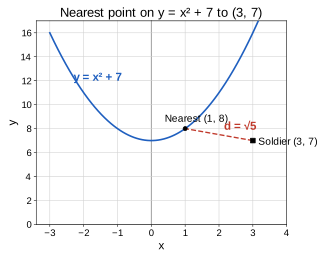
Minimising distance from the soldier at (3, 7) to the curve y = x² + 7; the nearest point is (1, 8) with shortest distance d = √5. Main: the helicopter is nearest at (1,8), distance 5. OR: tangent x−ty+at2=0, normal tx+y−2at−at3=0.
Main part. A point on y=x2+7 is (x,x2+7); distance from soldier (3,7):
D2=(x−3)2+(x2+7−7)2=(x−3)2+x4.
Let f(x)=x4+(x−3)2. Then
f′(x)=4x3+2(x−3)=4x3+2x−6=2(2x3+x−3)=2(x−1)(2x2+2x+3).
Since 2x2+2x+3 has discriminant 4−24<0 (no real root), the only critical point is x=1. As f′′(x)=12x2+2>0, this is a minimum.
Nearest point (1,12+7)=(1,8) and
D=(1−3)2+14=4+1=5.
…
- CBSE 2017Set ANNUAL6 marksQ.Find the point on the curve y2=4x which is nearest to the point (2, −8). OR An open box with a square base is to be made out of a given quantity of sheet of area a2. Show that the maximum volume of the box is 63a3.
›Reveal solutionSolution
Write a general point on the parabola in terms of y, minimize the squared distance to (2,-8) using calculus.
Any point on y2=4x can be written as (4y2,y).
Squared distance to (2,−8): D(y)=(4y2−2)2+(y+8)2
dydD=2(4y2−2)⋅2y+2(y+8)=4y3−2y+2y+16=4y3+16 …
🎓Unlock everything free for 14 days
- ✓Full step-by-step solutions
- ✓Concept-first explanations
- ✓Methods, shortcuts & mistakes
- ✓PYQ mapping + timed mock tests
Full access for 14 days. No credit card required.