Q.Show that in any triangle ABC, a=bcosC+ccosB.
🔒You're viewing a preview — the full solution, concept, methods & PYQ mapping are locked.
🔒 Start your 14-day free trial to unlock the full solution →Concept understanding — Methods of Proof
In mathematics, a "proof" is a rigorous, logical argument that establishes the truth of a statement. Unlike scientific theories, which are supported by evidence and can be disproven by new observations, mathematical theorems, once proven, are considered absolutely true within the given system of axioms and definitions.
Why Do We Need Proofs?
Imagine you observe that the sum of two odd numbers is always an even number:
- 1+3=4 (even)
- 5+7=12 (even)
- 11+9=20 (even)
You could test many pairs of odd numbers, and each time you'd find their sum is even. This might make you believe the statement is true. However, no matter how many examples you check, you can never check all possible pairs of odd numbers. There's always a chance that the very next pair you haven't checked might break the pattern.
This is where proofs come in. A proof doesn't just show that a statement is true for some examples; it shows that it must be true for all cases that fit the description, based on fundamental definitions and logical rules. It provides absolute certainty.
What is a Proof?
A proof is a sequence of logical deductions, starting from known facts (like definitions, axioms, or previously proven theorems) and leading step-by-step to the conclusion you want to establish. Each step must be justified by a rule of logic or a known mathematical truth.
We use different "methods of proof" depending on the nature of the statement we want to prove. These methods are strategies for constructing a valid logical argument.
Common Methods of Proof
Here are some of the most common methods of proof:
1. Direct Proof
This is the most straightforward method. To prove a statement of the form "If P, then Q" (denoted P⟹Q), you assume that P is true and then use definitions, axioms, and logical deductions to show that Q must also be true.
Example: Prove that the sum of two even integers is an even integer.
Proof:
Let a and b be two even integers.
By the definition of an even integer, an integer is even if it can be written in the form 2k for some integer k.
So, we can write a=2m for some integer m, and b=2n for some integer n.
Now, consider their sum:
a+b=2m+2n
a+b=2(m+n)
Since m and n are integers, their sum (m+n) is also an integer. Let k=m+n.
Then a+b=2k, where k is an integer.
By the definition of an even integer, 2k is an even integer.
Therefore, the sum of two even integers is an even integer.
2. Proof by Contrapositive
The contrapositive of the statement "If P, then Q" (P⟹Q) is the statement "If not Q, then not P" (¬Q⟹¬P). These two statements are logically equivalent, meaning if one is true, the other must also be true, and vice versa.
Sometimes, it's easier to prove the contrapositive than the original statement directly.
Example: Prove that if n2 is an even integer, then n is an even integer.
Proof:
Let the original statement be P⟹Q, where P is "n2 is even" and Q is "n is even".
The contrapositive statement is ¬Q⟹¬P, which means "If n is not even, then n2 is not even".
In other words, "If n is odd, then n2 is odd".
Let's prove the contrapositive:
Assume n is an odd integer.
By the definition of an odd integer, n can be written in the form 2k+1 for some integer k.
Now, consider n2:
n2=(2k+1)2
n2=(2k)2+2(2k)(1)+12
n2=4k2+4k+1
n2=2(2k2+2k)+1
Let m=2k2+2k. Since k is an integer, m is also an integer.
So, n2=2m+1.
By the definition of an odd integer, 2m+1 is an odd integer.
Thus, if n is odd, then n2 is odd.
Since the contrapositive statement is true, the original statement "If n2 is an even integer, then n is an even integer" is also true.
3. Proof by Contradiction (Reductio ad Absurdum)
This method involves assuming that the statement you want to prove is false. Then, you show that this assumption leads to a logical contradiction (something that is impossible or contradicts a known truth). Since a false assumption led to a contradiction, the initial assumption must be wrong, meaning the original statement must be true.
Example: Prove that 2 is an irrational number.
Proof:
Assume, for the sake of contradiction, that 2 is a rational number.
By the definition of a rational number, if 2 is rational, it can be expressed as a fraction ba, where a and b are integers, b=0, and the fraction is in its simplest form (meaning a and b have no common factors other than 1, i.e., gcd(a,b)=1).
So, 2=ba.
Squaring both sides:
2=b2a2
2b2=a2
This equation implies that a2 is an even number (since it's 2 times an integer b2).
From our previous example (proof by contrapositive), if a2 is even, then a must also be an even number.
So, we can write a=2k for some integer k.
Substitute a=2k back into the equation 2b2=a2:
2b2=(2k)2
2b2=4k2
Divide both sides by 2:
b2=2k2
This equation implies that b2 is an even number.
Again, if b2 is even, then b must also be an even number.
So, we have found that both a and b are even numbers.
This means that a and b have a common factor of 2.
However, we initially assumed that the fraction ba was in its simplest form, meaning a and b have no common factors other than 1.
The conclusion that a and b both have a common factor of 2 contradicts our initial assumption that gcd(a,b)=1.
Since our assumption that 2 is rational led to a contradiction, the assumption must be false.
Therefore, 2 must be an irrational number.
4. Proof by Mathematical Induction
This method is used to prove statements about natural numbers (positive integers). It's like setting up a chain reaction or a line of dominoes. If you can show the first domino falls, and that if any domino falls, the next one will also fall, then all dominoes will fall.
A proof by mathematical induction consists of three steps:
- Base Case: Show that the statement is true for the initial value (usually n=1 or n=0).
- Inductive Hypothesis: Assume that the statement is true for an arbitrary positive integer k (i.e., assume P(k) is true).
- Inductive Step: Show that if the statement is true for k, it must also be true for k+1 (i.e., prove P(k)⟹P(k+1)). …
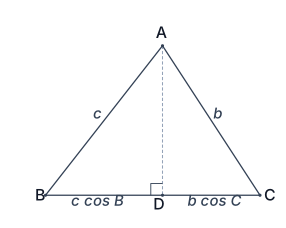
Drop a perpendicular from A to BC and split a using right-triangle cosines (proof by cases on angle C).
With foot D of the perpendicular from A, in right triangles ADB and ADC: BD=ccosB and DC=bcosC.
- If C is acute, a=BD+DC=ccosB+bcosC.
- If C is obtuse, cos(180∘−C)=−cosC gives a=BD−DC=ccosB+bcosC. …
Drop the perpendicular from A to line BC and prove the identity by cases — ∠C acute, obtuse, or right — using right-triangle cosine ratios in each.
Use the standard notation a=BC, b=CA, c=AB. Drop the perpendicular AD from A onto line BC (produced if necessary), with foot D. Every triangle falls into exactly one of three cases according to the angle C, so we prove the result case by case.
Case (i): ∠C is acute. Here D lies between B and C, so a=BD+DC.
In right triangle ADB: ABBD=cosB⇒BD=ccosB.
In right triangle ADC: ACDC=cosC⇒DC=bcosC.
Therefore
a=BD+DC=ccosB+bcosC.(1)
Case (ii): ∠C is obtuse. Now the foot D lies on BC produced beyond C, so a=BC=BD−DC.
In right triangle ADB: BD=ABcosB=ccosB.
In right triangle ADC, the angle at C is ∠ACD=180∘−C, so
ACDC=cos(180∘−C)=−cosC ⇒ DC=−bcosC.
Hence …
Method: Proof by Cases Using a Dropped Perpendicular
This method applies to triangle identities that must be verified across every possible triangle shape (acute, obtuse, right), typically by dropping a perpendicular from one vertex and splitting into right triangles.
Steps
Step 1: Identify why cases are needed
Recognise that the position of the foot of a perpendicular from a vertex depends on whether the opposite angle is acute, obtuse, or exactly 90∘ — the perpendicular's foot can fall inside, outside, or at the base, so a single right-triangle picture doesn't cover every triangle.
Step 2: Draw the perpendicular and name the right triangles it creates
Drop the perpendicular from the chosen vertex to the opposite side (extended if necessary), and identify the right triangle(s) this creates, labelling their legs with the known side lengths and angles.
Step 3: Work out the acute-angle case
Use the standard cosine ratio (adjacent/hypotenuse) in each right triangle to express the base segments in terms of the given sides and angles, and add them to get the full base.
Step 4: Work out the obtuse-angle case …
Common Mistakes
Mistake 1: Only proving the acute-angle case and stopping
Why it's wrong: A picture drawn with an acute angle at C only proves the identity for that shape of triangle; since the question says "any triangle", the obtuse and right-angle possibilities must also be checked, or the proof is incomplete. Correct approach: explicitly identify all the distinct cases the angle can fall into, and prove the identity separately in each.
Mistake 2: Adding instead of subtracting the base segments in the obtuse case
Why it's wrong: When the angle at C is obtuse, the foot of the perpendicular from A lands outside segment BC, on the extension beyond C — so the actual side a=BC equals BD−DC, not BD+DC as in the acute case. Using the acute-case formula blindly in the obtuse case gives the wrong sign. Correct approach: redraw the obtuse case separately and read off which segments actually add up to the real side length from the figure.
Mistake 3: Forgetting cos(180∘−θ)=−cosθ in the obtuse case …
🎓Unlock everything free for 14 days
- ✓Full step-by-step solutions
- ✓Concept-first explanations
- ✓Methods, shortcuts & mistakes
- ✓PYQ mapping + timed mock tests
Full access for 14 days. No credit card required.