Q.A student of class XII studying Mathematics comes across an incomplete question in a book. Maximise 𝑍 = 3𝑥 + 2𝑦 + 1 Subject to the constraints 𝑥 ≥ 0, 𝑦 ≥ 0, 3𝑥 + 4𝑦 ≤ 12, He/ She notices the below shown graph for the said LPP problem, and finds that a constraint is missing in it: Help him/her choose the required constraint from the graph. The missing constraint is
(A) 𝑥 + 2𝑦 ≤ 2
(B) 2𝑥 + 𝑦 ≥ 2
(C) 2𝑥 + 𝑦 ≤ 2
(D) 𝑥 + 2𝑦 ≥ 2
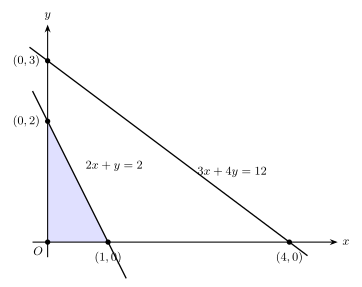
🔒You're viewing a preview — the full solution, concept, methods & PYQ mapping are locked.
🔒 Start your 14-day free trial to unlock the full solution →Concept understanding — Linear Programming Constraints
Linear Programming Constraints
Imagine you run a small workshop making chairs and tables. You have only so much wood, so many labour hours, and so much machine time. You would love to make everything at once, but the resources are finite. Those limits are your constraints — the rules that decide what is actually possible.
A constraint says, in effect: you cannot use more of a resource than you have. In a linear programming (LP) problem, every such rule is written as a linear inequality in the decision variables.
What a constraint looks like
Suppose x and y are your decision variables (say, acres of wheat and barley). A typical constraint has the form
a1x+a2y≤bora1x+a2y≥b,
where the ai are the coefficients (how much of a resource each unit consumes) and b is the amount available. For example, if wheat needs 2 bags of fertiliser per acre, barley needs 1, and you have 200 bags:
2x+y≤200.
Every constraint must be linear — no x2, no sinx, no xy. Variables appear only to the first power, multiplied by constants and added. That is exactly what makes it linear programming.
Types you will meet
| Type | Symbol | Meaning |
|---|---|---|
| Upper bound | ≤ | cannot exceed a limit (e.g. labour ≤300) |
| Lower bound | ≥ | must meet a minimum (e.g. protein ≥50) |
| Non-negativity | x,y≥0 | quantities cannot be negative |
The non-negativity constraints x≥0, y≥0 are almost always required — you cannot make a negative number of chairs — yet they are the ones students most often forget to write.
How constraints shape the problem
Each linear inequality divides the plane into two halves — a half-plane. The set of points satisfying all the constraints at once is their common region, called the feasible region. Any point inside it is an allowed plan; any point outside breaks at least one rule. …
The feasible region is fixed by x≥0, y≥0, 3x+4y≤12 plus one more line read off the graph. That fourth boundary passes through (2,0) and (0,1).
A line with x-intercept 2 and y-intercept 1 is
2x+1y=1⇒x+2y=2. …
The extra boundary runs through (2,0) and (0,1), giving the line x+2y=2; the origin satisfies it, so the missing constraint is x+2y≤2 — option (A).
The idea
Every constraint of an LPP is a straight line together with a choice of which side to keep. The stem already lists x≥0, y≥0 and 3x+4y≤12. The graph shows one more boundary that is not in this list — that hidden line is the missing constraint. To name it we (1) find its equation from its intercepts and (2) fix the inequality sign from the side on which the shaded region lies.
Step 1 — Equation of the fourth line
The fourth boundary meets the axes at (2,0) and (0,1), so x-intercept a=2 and y-intercept b=1. Using the intercept form ax+by=1:
2x+1y=1⇒x+2y=2.
Step 2 — Which side?
Test the origin (0,0), which lies inside the shown feasible region:
0+2(0)=0≤2(true). …
Method: Reading a Constraint's Inequality off its Graph
Use this when a boundary line is drawn on a feasible-region graph and you must name the inequality it represents (equation and direction).
Steps
Step 1: Get the line's equation from its intercepts.
Read where the line crosses the axes, say the x-axis at (a,0) and the y-axis at (0,b). Then use the intercept form:
ax+by=1.
Clearing denominators gives the constraint line in the form px+qy=r.
Step 2: Fix the ≤ or ≥ by a test point.
A line splits the plane into two half-planes; the constraint keeps only one. Pick any point not on the line — the origin (0,0) is easiest when the line misses it — and substitute into px+qy.
- If the test point lies inside the shaded feasible region and makes px+qy≤r true, the constraint is ≤. …
Common Mistakes
Mistake 1: Using the wrong line's intercepts.
Why it's wrong: the graph's fourth boundary passes through (2,0) and (0,1), giving x+2y=2; students who misread the intercepts as (1,0),(0,2) get 2x+y=2 (options B/C) — a different line entirely. Correct approach: read the exact axis crossings and build the equation with the intercept form ax+by=1.
Mistake 2: Guessing the inequality sign. …
Showing the 12 most recent of 14 on this concept.
- CBSE 2023Set 65/3/11 markMCQQ.The feasible region of a linear programming problem is shown in the figure below (a shaded region bounded by the lines x+2y=4 and x+y=3). Which of the following are the possible constraints ?(a) x+2y≥4, x+y≤3, x≥0, y≥0(b) x+2y≤4, x+y≤3, x≥0, y≥0(c) x+2y≥4, x+y≥3, x≥0, y≥0(d) x+2y≥4, x+y≥3, x≤0, y≤0
›Reveal solutionSolution
The feasible region is the intersection of the half-planes that lie above x+2y=4 and below x+y=3, together with the first quadrant. This matches option (a).
The key to this problem is understanding how a linear inequality translates into a half-plane on the graph. Every line ax+by=c splits the plane into two halves: one where ax+by≥c and the other where ax+by≤c. The feasible region is the overlap of all such half-planes, plus the non-negativity constraints x≥0, y≥0 (which restrict us to the first quadrant).
The figure shows a triangular region bounded by the two given lines and the axes. Let’s work out which side of each line contains the shaded area.
-
Identify the line x+2y=4.
This line meets the axes at (4,0) and (0,2). The shaded region lies above this line — for example, the point (0,3) is inside the shaded area. Check: 0+2(3)=6≥4. So the inequality is x+2y≥4.
-
Identify the line x+y=3.
This line meets the axes at (3,0) and (0,3). The shaded region lies below this line — the point (0,0) is outside the shaded area, but a point like (1,1) inside gives 1+1=2≤3. So the inequality is x+y≤3.
-
Non-negativity constraints.
The shaded region is entirely in the first quadrant: x≥0, y≥0. Any point with a negative coordinate (like (−1,2)) would lie outside the shaded area.
-
Match with the options.
- Option (a): x+2y≥4, x+y≤3, x≥0, y≥0 — exactly what we found.
- Option (b): x+2y≤4 would put the region below that line, which is the opposite side. …
-
- CBSE 2024Set 65/3/11 markMCQQ.The restrictions imposed on decision variables involved in an objective function of a linear programming problem are called: (A) feasible solutions (B) constraints (C) optimal solutions (D) infeasible solutions
›Reveal solutionSolution
In Linear Programming, the restrictions on decision variables are called constraints. They define the feasible region within which the optimal solution is found.
The core idea of Linear Programming (LP) is to optimize (maximize or minimize) a linear objective function, like profit or cost, subject to a set of linear restrictions. These restrictions are not optional — they are the boundaries of reality. For example, a factory cannot use more raw material than it has in stock, or a worker cannot work more than 24 hours a day.
These restrictions are what we call constraints. They are the mathematical inequalities or equations that limit the values the decision variables can take. Without constraints, the objective function could be made arbitrarily large (or small), and there would be no meaningful problem to solve.
The other options are related but distinct:
- Feasible solutions are any points that satisfy all the constraints.
- Optimal solutions are the feasible solutions that give the best value of the objective function.
- Infeasible solutions violate at least one constraint.
So, the restrictions themselves are the constraints.
- Identify the core concept: The question asks for the name of the "restrictions imposed on decision variables" in an LP problem. …
- CBSE 2024Set 65/1/11 markMCQQ.An optimal solution of a linear programming problem is related to : (A) Logarithmic function (B) Linear function (C) Quadratic function (D) Exponential function
›Reveal solutionSolution
Linear programming problems are about optimizing (maximizing or minimizing) a linear function (the objective) subject to linear constraints. The optimal solution is always tied to this linear objective, so the correct answer is (B) Linear function.
The heart of linear programming is the word linear. Every part of the problem — the goal you're trying to achieve and the rules you must follow — is expressed as a straight-line relationship. There are no curves, no exponents, no logs.
Think of it this way: you have a budget to buy two types of items. Your total cost is
price_A × quantity_A + price_B × quantity_B. That's a linear function. You also have constraints like "I can't carry more than 10 kg" — that's another linear inequality. The best combination (the optimal solution) is found at a corner of the feasible region, and that corner is determined entirely by these straight-line equations.-
Identify the objective function. In any linear programming problem, you are trying to maximize or minimize something — profit, cost, time, etc. This "something" is always a linear function of the decision variables. For example: Z=3x+5y.
-
Constraints are also linear. All the restrictions (like x+2y≤10, x≥0, y≥0) are linear inequalities or equations. They form a straight-edged polygon (or polyhedron in higher dimensions) called the feasible region.
-
The optimal solution lives at a vertex. Because the objective function is linear, its value changes at a constant rate as you move in any direction. The maximum or minimum of such a function over a convex polygon always occurs at one of the corners (vertices) of the feasible region — never at a point where the function curves.
-
Why not the other options? …
-
- CBSE 2024Set A11 markMCQQ.Which of the following is a non negative constraints in a Linear Programming Problem?(a) x≥0, y≤0(b) x≤0, y≤0(c) x≥0, y≥0(d) x≤0, y≥0
›Reveal solutionSolution
The standard non-negative restriction is x≥0, y≥0, so (c).
In a linear programming problem the decision variables cannot be negative, so the non-negative cons …
- CBSE 2024Set ANNUAL1 markQ.What is the region represented by the inequations x≥0,y≥0 ?
›Reveal solutionSolution
x≥0 and y≥0 together describe the first quadrant, including its boundary axes.
The inequation x≥0 represents all points on or to the right of the y-axis, and y≥0 represents all points on or above the x-axis. The intersection of these two half-planes is the region bounded by, and including, the non-negative x-axis and non-nega …
- CBSE 2023Set M1 markQ.Define feasible region in a linear programming problem.
›Reveal solutionSolution
Tests an LPP definition: the feasible region is the set of all points satisfying every constraint.
Definition. In a linear programming problem, the feasible region is the common region determined by all the constraints together with the non-negativity restrictions x≥0,y≥0. Every point in this region is a feasible solution, and points outside it are infeasible. …
- CBSE 2022Set M1 markQ.Define feasible region in a linear programming problem.
›Reveal solutionSolution
The feasible region is the set of all points satisfying every constraint of the LPP.
In a linear programming problem, the feasible region is the common region determined by all the constraints, including the non-negativity restrictions x≥0, y≥0. Every point of this region …
- CBSE 2020Set HE8231 markQ.Fill in the blank: The common region determined by all the constraints including the non-negative constraints x≥0, y≥0 of a linear programming problem is called ______ for the problem.
›Reveal solutionSolution
This common region is called the feasible region of the LPP.
In a Linear Programming Problem, each constraint (including the non-negativity restrictions x≥0,y≥0) defines a half-plane. The set of points (x,y) satisfying every constraint simultaneously — i.e. the intersection of all these half-planes — is called the feasible region. Every point of this region is called a feasible s …
- CBSE 2020Set HE8231 markQ.Write true or false: Any point outside the feasible region is the feasible solution.
›Reveal solutionSolution
The statement is False.
The feasible region of an LPP is precisely the set of all points satisfying every constraint of the problem; these points (and only these) are called feasible solutions. Any point lying outside the feasible region fails to satisfy at least one constraint, and is therefore cal …
- CBSE 2020Set ANNUAL1 markQ.Define the feasible solution of the Linear Programming problem.
›Reveal solutionSolution
A feasible solution is simply any point that lies inside (or on the boundary of) the feasible region.
In a linear programming problem, a feasible solution is any set of values of the decision variables (e.g. x,y) that satisfies ALL the given constraints (including the non-negativity restrictions x≥0,y≥0) simultaneously. The collection of all feasible solutions is called the feasible region. Every feasible solution is a candidate for the optimal solution, but not every fe …
- CBSE 2019Set HE1 markQ.Write True or False: The feasible region of a Linear Programming Problem is always a linear polygon.
›Reveal solutionSolution
The feasible region is always convex, but calling it "always a linear polygon" is false since it can be an unbounded region.
The feasible region of an LPP is the set of points satisfying all the linear constraints simultaneously — it is always a convex set bounded by straight-line edges. However, it is not always a closed polygon: when the constraints don't fully enclose the region (e.g. only ≥ type c …
- CBSE 2019Set ANNUAL1 markQ.Show the region of feasible solution under the following constraints: 2x+3y≤6; x≥0; y≥0.
›Reveal solutionSolution
Plot the line 2x+3y=6 and shade the region satisfying all three constraints in the first quadrant.
The line 2x+3y=6 meets the axes at (3,0) (put y=0) and (0,2) (put x=0).
Since 2x+3y≤6, the feasible side is towards the origin (test (0,0): 0≤6, true, so the origin's side is included).
…
🎓Unlock everything free for 14 days
- ✓Full step-by-step solutions
- ✓Concept-first explanations
- ✓Methods, shortcuts & mistakes
- ✓PYQ mapping + timed mock tests
Full access for 14 days. No credit card required.