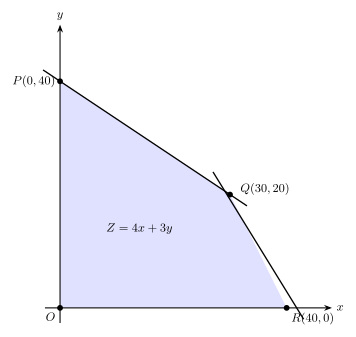
Q.For the linear programming problem (LPP), the objective function is Z=4x+3y and the feasible region determined by a set of constraints is shown in the graph: (Note: The figure is not to scale.) Which of the following statements is true?
(A) Maximum value of Z is at R(40,0).
(B) Maximum value of Z is at Q(30,20).
(C) Value of Z at R(40,0) is less than the value at P(0,40).
(D) The value of Z at Q(30,20) is less than the value at R(40,0).
🔒You're viewing a preview — the full solution, concept, methods & PYQ mapping are locked.
🔒 Start your 14-day free trial to unlock the full solution →Concept understanding — Corner Point Theorem
The Corner Point Theorem: Why the Best Answer Hides at the Edges
Imagine maximising profit for a factory that makes two products, with limited raw materials, machine hours, and labour. Every combination that doesn't break a limit is a feasible solution. Plot them all on a graph and they form a shape — always a polygon if your constraints are straight lines.
Where is the best (maximum profit) point? You might think anywhere inside the shape. But the Corner Point Theorem says something surprising: the best point is always at a corner — a vertex of the polygon. Never floating in the middle of an edge or inside.
This theorem is the backbone of linear programming — the method for solving optimisation problems with straight-line constraints.
The Intuition: Why Corners Win
Think of profit as a line you slide across the polygon; each position represents a profit level. You push the line as far as possible (higher profit) while still touching the polygon. The last point of contact before the line escapes is always a corner.
Why? Because both the profit line and the polygon's edges are straight, and the farthest point in any straight-line direction from a polygon is always a vertex. This holds for any flat-sided shape.
Solving a linear programming problem by hand, you only need to check the corners — usually just 3–5 points, not the infinite points inside.
The Precise Statement
Corner Point Theorem (Fundamental Theorem of Linear Programming):
If a linear programming problem has an optimal solution, then that optimal solution occurs at at least one corner point (vertex) of the feasible region.
Three key parts:
-
"If it has an optimal solution" — sometimes the problem is unbounded (profit increases forever) or infeasible (no point satisfies all constraints). The theorem applies only when a best answer exists.
-
"At least one corner point" — several corners can give the same optimal value. If the profit line is parallel to an edge, every point on that edge is optimal, including both endpoints (corners).
-
"Of the feasible region" — the polygon formed by all constraints. Corners are where two constraint lines intersect.
Why This Matters for Exams
To solve a linear programming problem:
- Find all corner points (solve pairs of constraint equations).
- Plug each corner into the objective function.
- Pick the best value.
The theorem guarantees you haven't missed a better answer hiding in the middle. …
Concept: Corner Point Theorem – For a linear programming problem with a bounded feasible region, the optimal value of the objective function occurs at one of the corner points of the region.
Step 1: Identify the corner points from the graph.
The feasible region has vertices P(0,40), Q(30,20), and R(40,0).
Step 2: Evaluate Z=4x+3y at each corner point.
- At P(0,40): Z=4(0)+3(40)=120
- At Q(30,20): Z=4(30)+3(20)=120+60=180
- At R(40,0): Z=4(40)+3(0)=160
Step 3: Compare the values.
Z is maximum at Q(30,20) with value 180. …
The Corner Point Theorem says the optimum of a linear objective over a convex polygon occurs at a vertex. Evaluating Z=4x+3y at the three corner points gives Z(P)=120, Z(Q)=180, Z(R)=160, so the maximum is at Q(30,20) and option (B) is correct.
The Corner Point Theorem (also called the Fundamental Theorem of Linear Programming) is the key idea here. It states that if a linear programming problem has an optimal solution and the feasible region is a bounded convex polygon, then the optimum occurs at one of the vertices (corner points) of that region. This saves us from checking every single point inside the region — we only need to evaluate the objective function at the corners.
In the given graph, the feasible region is a triangle with vertices P(0,40), Q(30,20), and R(40,0). Let’s evaluate Z=4x+3y at each.
-
At P(0,40):
Z=4(0)+3(40)=0+120=120
-
At Q(30,20):
Z=4(30)+3(20)=120+60=180
-
At R(40,0):
Z=4(40)+3(0)=160+0=160
Now compare the values: 120, 180, 160. The largest is 180 at Q(30,20). So the maximum value of Z is at Q. …
Method: Corner-Point Test for the Optimal Vertex
Use this when a bounded feasible region's vertices are known (or readable from a graph) and you must decide which corner optimises Z=ax+by, or judge which comparison statement about the corners is true.
Steps
Step 1: List every corner point.
By the Corner-Point Theorem, the optimum of a linear objective on a bounded region always sits at a vertex — so the interior can be ignored. Collect all vertices of the region.
Step 2: Evaluate Z=ax+by at each corner.
Substitute each vertex's coordinates into Z and tabulate the values. Do this for every corner — never assume the answer from a coordinate.
Step 3: Compare, then test the claim. …
Common Mistakes
Mistake 1: Assuming the corner with the largest x gives the maximum.
Why it's wrong: R(40,0) has the biggest x, but Z(R)=160 while Z(Q)=4(30)+3(20)=180 — the interior-edge corner Q wins because y carries weight 3. Correct approach: evaluate Z=4x+3y at every corner and compare, don't judge by a single coordinate.
Mistake 2: Mis-comparing two corner values in the statements. …
- CBSE 2025Set 65/1/11 markMCQQ.The corner points of the feasible region in graphical representation of a L.P.P. are (2,72),(15,20) and (40,15). If Z=18x+9y be the objective function, then (A) Z is maximum at (2,72), minimum at (15,20) (B) Z is maximum at (15,20), minimum at (40,15) (C) Z is maximum at (40,15), minimum at (15,20) (D) Z is maximum at (40,15), minimum at (2,72)
›Reveal solutionSolution
For a linear programming problem with a convex feasible region, the maximum and minimum of the objective function occur at corner points. Evaluating Z=18x+9y at the given points shows the maximum is at (40,15) and the minimum at (15,20).
The Corner Point Theorem (also called the Fundamental Theorem of Linear Programming) tells us that if a linear programming problem has an optimal solution, that solution must occur at a vertex (corner point) of the feasible region. This is because the objective function is linear — its level lines are straight lines, and as you slide them across the convex polygon of feasible points, the last point touched before leaving the region is always a corner.
So here, we don’t need to know the constraints. The three corner points given are the only candidates for both maximum and minimum of Z. We simply evaluate Z at each point and compare.
-
At (2,72):
Z=18(2)+9(72)=36+648=684
-
At (15,20):
Z=18(15)+9(20)=270+180=450
-
At (40,15):
Z=18(40)+9(15)=720+135=855
Now arrange them in order:
- Minimum value: 450 at (15,20)
- Maximum value: 855 at (40,15) …
-
- CBSE 2023Set 65/1/11 markMCQQ.The corner points of the feasible region in the graphical representation of a linear programming problem are (2,72), (15,20) and (40,15). If z=18x+9y is the objective function, then : (A) z is maximum at (2,72) and minimum at (15,20). (B) z is maximum at (15,20) and minimum at (40,15). (C) z is maximum at (40,15) and minimum at (15,20). (D) z is maximum at (40,15) and minimum at (2,72).
›Reveal solutionSolution
In a linear programming problem, the maximum and minimum of the objective function occur at corner points of the feasible region. Evaluating z=18x+9y at the given points shows the maximum is at (40,15) and the minimum at (15,20).
The Corner Point Theorem (also called the Fundamental Theorem of Linear Programming) tells us that if a linear programming problem has an optimal solution (a maximum or minimum), that solution must occur at one of the corner points (vertices) of the feasible region. This is because the objective function is linear, and the feasible region is a convex polygon — the function’s value changes linearly as you move across the region, so the extreme values will always be at the boundaries, specifically at the corners.
So, to find where z is maximum and where it is minimum, we don’t need to graph anything or solve inequalities. We simply plug each corner point into z=18x+9y and compare the results.
-
Evaluate at (2,72)
z=18(2)+9(72)=36+648=684
-
Evaluate at (15,20)
z=18(15)+9(20)=270+180=450
-
Evaluate at (40,15)
z=18(40)+9(15)=720+135=855
Now compare the three values:
- 684 at (2,72)
- 450 at (15,20)
- 855 at (40,15)
The largest is 855 at (40,15) — that’s the maximum.
The smallest is 450 at (15,20) — that’s the minimum. …
-
- CBSE 2024Set 65/1/11 markMCQQ.The number of corner points of the feasible region determined by the constraints x≥0,y≥0,x+y≥4 is : (A) 0 (B) 1 (C) 2 (D) 3
›Reveal solutionSolution
The feasible region is unbounded, but its boundary has exactly two corner points where the constraints intersect: (4,0) and (0,4). The correct option is (C).
Why the Corner Point Theorem matters here
In linear programming, corner points (also called extreme points) are the vertices of the feasible region — the points where two or more boundary lines meet. The Corner Point Theorem tells us that if an optimal solution exists, it occurs at one of these corner points. But even when we're just counting them, the key is to find all intersections of the constraint boundaries that satisfy all constraints.
The constraints here are:
- x≥0 (the y-axis and everything to its right)
- y≥0 (the x-axis and everything above it)
- x+y≥4 (the half-plane above the line x+y=4)
The first two constraints restrict us to the first quadrant. The third constraint cuts off the region near the origin.
Step-by-step reasoning
-
Identify the boundary lines.
Each inequality becomes an equality at its boundary:
x=0, y=0, and x+y=4.
-
Find all pairwise intersections of these lines.
- Intersection of x=0 and y=0: (0,0).
- Intersection of x=0 and x+y=4: substitute x=0 gives 0+y=4, so (0,4).
- Intersection of y=0 and x+y=4: substitute y=0 gives x+0=4, so (4,0).
So we have three candidate points: (0,0), (0,4), and (4,0).
-
Check which candidates satisfy all constraints.
- At (0,0): x≥0 ✓, y≥0 ✓, but x+y≥4 becomes 0≥4 ✗. So (0,0) is not in the feasible region.
- At (0,4): x≥0 ✓, y≥0 ✓, 0+4≥4 ✓. So (0,4) is a corner point.
- At (4,0): x≥0 ✓, y≥0 ✓, 4+0≥4 ✓. So (4,0) is a corner point.
-
Are there any other corner points? …
- CBSE 2020Set 65/2/11 markQ.The corner points of the feasible region of an LPP are (0,0), (0,8), (2,7), (5,4) and (6,0). The maximum profit P=3x+2y occurs at the point ____________ .
›Reveal solutionSolution
To find the maximum profit in a Linear Programming Problem, we evaluate the objective function at each corner point of the feasible region. The maximum profit P=3x+2y occurs at the point (5,4).
In Linear Programming Problems (LPPs), we aim to optimize (maximize or minimize) a linear objective function subject to a set of linear constraints. These constraints define a region in the coordinate plane called the feasible region. This region is always a convex polygon (or an unbounded convex region).
The core idea behind solving such problems is the Corner Point Theorem. This theorem provides a powerful shortcut:
ImportantCorner Point Theorem: If an optimal solution (maximum or minimum value) exists for a Linear Programming Problem, it must occur at one of the corner points (vertices) of the feasible region.
Why does this work?
Imagine the objective function, say P=3x+2y, as a family of parallel lines 3x+2y=k, where k is the value of the profit. As we change k, these lines shift parallel to each other. To maximize P, we want to find the line with the largest possible k that still intersects the feasible region.
Since the feasible region is a convex polygon, the "last" point this moving line will touch before leaving the region entirely will always be one of its vertices (corner points). Similarly, for minimization, the "first" point touched will also be a vertex. This geometric intuition is why we only need to check the corner points.
Let's apply this to the given problem.
-
Identify the Objective Function and Corner Points:
We are given the objective function P=3x+2y, which we need to maximize.
The corner points of the feasible region are provided as:
- (0,0)
- (0,8)
- (2,7)
- (5,4)
- (6,0)
-
Evaluate the Objective Function at Each Corner Point:
We substitute the coordinates (x,y) of each corner point into the profit function P=3x+2y to find the profit value at that point.
-
At (0,0):
P=3(0)+2(0)=0+0=0
-
At (0,8):
P=3(0)+2(8)=0+16=16
-
At (2,7): …
-
-
- CBSE 2026Set ANNUAL1 markMCQQ.Maximum value of Z = 5x + 3y + 2, subject to the constraints x + y ≤ 7, x, y ≥ 0, is on the point.(a) (7, 0)(b) (0, 7)(c) (3, 4)(d) (4, 3)
›Reveal solutionSolution
The feasible region is the triangle with corners (0,0), (7,0), (0,7); evaluating Z at each corner shows (7,0) gives the largest value.
The feasible region for x+y≤7, x≥0, y≥0 is the triangle with corner points (0,0), (7,0) and (0,7).
Evaluate Z=5x+3y+2 at each corner:
- At (0,0): Z=0+0+2=2 …
- CBSE 2026Set ANNUAL1 markMCQQ.The maximum value of the objective function is located:(a) inside the feasible region(b) at corner points of the feasible region(c) outside the feasible region(d) in second quadrant
›Reveal solutionSolution
This is the Fundamental Theorem of Linear Programming.
Concept: For a linear objective function Z optimised over a bounded convex feasible region (a polygon formed by the constraint lines), the maximum (or minimum) value of Z always occurs at one of the corner points (vertices) of the feasible region — never strictly inside …
- CBSE 2026Set ANNUAL1 markMCQQ.The objective function z=ax+by of a LPP has maximum value 42 at (4,6) and minimum value 19 at (3,2). Which of the following is true?(a) a=9, b=1(b) a=9, b=2(c) a=3, b=5(d) a=5, b=3
›Reveal solutionSolution
4a+6b=42 and 3a+2b=19 give a=3, b=5.
At (4,6): 4a+6b=42.
At (3,2): 3a+2b=19.
…
- CBSE 2025Set ANNUAL1 markMCQQ.What are the vertices of the feasible region of the following LPP? Maximize Z=5x+2y subject to 2x+3y≥6, x≥0, y≥0.(i) (0,0),(3,0),(0,2)(ii) (0,3),(2,0)(iii) (3,0),(0,2)(iv) (0,0),(0,3),(2,0)
›Reveal solutionSolution
Find where the boundary line 2x+3y=6 meets the coordinate axes.
The constraint 2x+3y≥6 together with x≥0, y≥0 gives a feasible region that is unbounded, lying on and beyond the line 2x+3y=6.
The line meets the axes at:
- y=0⇒x=3, giving (3,0)
- x=0⇒y=2, giving (0,2) …
- CBSE 2024Set ANNUAL1 markMCQQ.The corner points of the feasible region determined by a system of linear constraints are (0,0), (0,40), (20,40), (60,20) and (60,0). The maximum value of Z=4x+3y is(a) 120(b) 240(c) 300(d) 200
›Reveal solutionSolution
Evaluate the objective Z=4x+3y at every corner point and pick the largest.
Compute Z=4x+3y at each corner point:
Corner point Z=4x+3y (0,0) 0 (0,40) 0+120=120 (20,40) 80+120=200 (60,20) 240+60=300 - CBSE 2023Set M1 markMCQQ.The corner points of the feasible region determined by the system of linear constraints are (0,0), (0,50), (30,0), (20,30). The maximum value of the objective function z=4x+y is(a) 210(b) 150(c) 110(d) 120
›Reveal solutionSolution
Tests LPP corner-point evaluation of z=4x+y; maximum is 120.
By the corner-point method, evaluate z=4x+y at every corner of the feasible region:
(0,0):0,(0,50):50, …
🎓Unlock everything free for 14 days
- ✓Full step-by-step solutions
- ✓Concept-first explanations
- ✓Methods, shortcuts & mistakes
- ✓PYQ mapping + timed mock tests
Full access for 14 days. No credit card required.