Q.Solve the following problem graphically: Minimise and Maximise Z=3x+9y subject to the constraints: x+3y≤60, x+y≥10, x≤y, x≥0, y≥0.
🔒You're viewing a preview — the full solution, concept, methods & PYQ mapping are locked.
🔒 Start your 14-day free trial to unlock the full solution →Concept understanding — Linear Programming Graphical Method
The Graphical Method for Linear Programming
When a linear programming problem has just two decision variables, x and y, you can solve it by drawing a picture. This is the graphical method, and it is the technique the CBSE Class-12 course expects you to use.
The idea
Each constraint is a linear inequality such as 2x+3y≤100. On the xy-plane its boundary is a straight line, and the inequality picks one side of that line (a half-plane). The points that satisfy all the constraints at once form a single region — the feasible region. Your job is to find the point inside this region that makes the objective function Z=ax+by largest or smallest.
The step-by-step procedure
- Draw each constraint line. Replace every inequality by an equation and plot the line, usually by finding where it meets the axes.
- Shade the correct side. Test a simple point (often the origin (0,0)) in the inequality. If it holds, the origin's side is the wanted half-plane; if not, take the other side. Always include the non-negativity conditions x≥0, y≥0, which keep you in the first quadrant.
- Identify the feasible region. It is the overlap of all the shaded half-planes — the region satisfying every constraint together.
- Find the corner (vertex) points. These are the points where the boundary lines cross. Read them off the graph or solve the two relevant lines simultaneously.
- Evaluate Z at every corner and pick the largest value (for a maximum) or the smallest (for a minimum).
The whole method rests on the Corner-Point Theorem: if an optimum exists, it occurs at a vertex of the feasible region. So you never test interior points — only the corners.
Bounded vs unbounded …
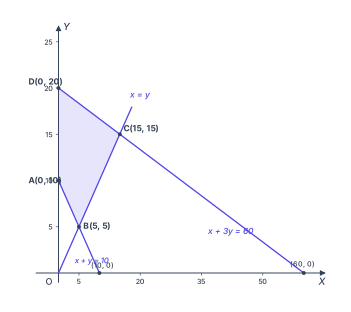
Minimise and maximise Z=3x+9y subject to x+3y≤60, x+y≥10, x≤y, x,y≥0.
Feasible corner points:
- x+y=10 ∩ x=0: (0,10)
- x+y=10 ∩ x=y: (5,5)
- x=y ∩ x+3y=60: (15,15)
- x+3y=60 ∩ x=0: (0,20) …
The feasible region has corners (0,10),(5,5),(15,15),(0,20); the minimum of Z=3x+9y is 60 at (5,5) and the maximum is 180, reached all along the edge from (15,15) to (0,20).
Set up
Minimise and maximise Z=3x+9y subject to
x+3y≤60,x+y≥10,x≤y,x,y≥0.
So we stay below x+3y=60, above x+y=10, and above the line y=x (since x≤y), in the first quadrant.
Find the corner points (each must satisfy all constraints)
- x+y=10 and x=0: (0,10). Check x≤y ✓, x+3y=30≤60 ✓.
- x+y=10 and x=y: 2x=10⇒x=y=5 → (5,5). Check x+3y=20≤60 ✓.
- x=y and x+3y=60: x+3x=60⇒x=15, y=15 → (15,15). Check x+y=30≥10 ✓.
- x+3y=60 and x=0: (0,20). Check x≤y ✓, x+y=20≥10 ✓.
Points like (10,0) or (60,0) satisfy x+y≥10 but fail x≤y, so they are not corners.
Evaluate Z at each corner
| Corner | Z=3x+9y |
|---|---|
| (0,10) | 90 |
| (5,5) | 15+45=60 |
Method: Corner-Point Method for Both Minimum and Maximum (and Multiple Optima)
Some problems ask for both the minimum and the maximum of Z=ax+by over one feasible region. The graphical corner-point technique handles both at once, and also flags when the optimum is not unique.
Steps
Step 1: Build the feasible region.
Plot every constraint line, shade the correct half-plane for each (origin test), and intersect them, keeping x≥0, y≥0. A constraint like x≤y is the line y=x with the region kept on the side where y is larger.
Step 2: List all corner points.
Solve each pair of adjacent boundary lines and keep only intersections that satisfy every constraint. An intersection that fails even one constraint is not a vertex of this region.
Step 3: Evaluate Z at every corner.
Build a small table of Z=ax+by for each vertex. The smallest entry gives the minimum; the largest gives the maximum — read both off the same table.
Step 4: Watch for a tie — the sign of multiple optimal solutions. …
Common Mistakes
Mistake 1: Reporting the maximum only at (0,20) (or only at (15,15)).
Why it's wrong: both corners give Z=180, so Z is constant along the whole edge joining them — every point on that segment is optimal. Correct approach: when two adjacent corners tie for the optimum, state that the optimum holds along the entire connecting segment.
Mistake 2: Ignoring the constraint x≤y and admitting points like (10,0).
Why it's wrong: (10,0) satisfies x+y≥10 but violates x≤y (since 10≤0), so it is not in the feasible region. Correct approach: every corner must satisfy all constraints, including x≤y (i.e. it lies on or above the line y=x).
Mistake 3: Confusing minimum and maximum in the corner table. …
Showing the 12 most recent of 28 on this concept.
- CBSE 2026Set 65/2/11 markMCQQ.For the feasible region shown below, the non-trivial constraints of the linear programming problem are (A) x+y≤5, x+3y≤9 (B) x+y≤5, x+3y≥9 (C) x+y≥5, x+3y≤9 (D) x+y≥5, 3x+y≤9
›Reveal solutionSolution
The feasible region is bounded by two lines that form its upper boundary. By checking which inequalities produce the shaded area (the region below both lines), the correct constraints are x+y≤5 and x+3y≤9, which is option (A).
In Linear Programming, the graphical method works because each linear constraint cuts the plane into two half-planes — one where the inequality holds, one where it doesn’t. The feasible region is the intersection of all such half-planes. When you’re given a picture of the region, the trick is to identify which side of each boundary line is shaded.
The two lines visible in the diagram are:
- x+y=5 (passing through (5,0) and (0,5))
- x+3y=9 (passing through (9,0) and (0,3))
The feasible region is the pentagon-shaped area that lies below both of these lines (since the origin (0,0) is inside the region, and it satisfies 0≤5 and 0≤9). That means the inequalities must be of the “less than or equal to” type.
Let’s check each option:
-
Option (A): x+y≤5, x+3y≤9
The origin satisfies both. The shaded region is below both lines — matches the diagram.
-
Option (B): x+y≤5, x+3y≥9
The origin fails the second inequality (0≥9 is false). So the region would not include the origin — contradicts the diagram.
-
Option (C): x+y≥5, x+3y≤9
The origin fails the first inequality (0≥5 is false). Again, the origin would be excluded — not the case.
-
Option (D): x+y≥5, 3x+y≤9 …
- CBSE 2023Set 65/2/11 markMCQQ.The corner points of the feasible region of a linear programming problem are (0,4), (8,0) and (320,34). If Z=30x+24y is the objective function, then (maximum value of Z − minimum value of Z) is equal to:(a) 40(b) 144(c) 120(d) 136
›Reveal solutionSolution
The maximum and minimum values of the objective function Z occur at the corner points of the feasible region. By evaluating Z at each given corner point, we find the maximum Zmax=240 and minimum Zmin=96, leading to a difference of 144.
In Linear Programming, the objective is to optimize (maximize or minimize) a linear function, called the objective function, subject to a set of linear inequalities, known as constraints. These constraints define a region in the coordinate plane called the feasible region.
The fundamental theorem of linear programming states that if an optimal solution exists, it must occur at one of the corner points (vertices) of the feasible region. This is because the objective function represents a family of parallel lines, and as we move these lines across the feasible region, the extreme values (maximum or minimum) will always be touched first or last at a vertex.
Therefore, to find the maximum and minimum values of the objective function, we simply need to evaluate it at each of the given corner points of the feasible region.
Here's how we approach this problem:
-
Identify the objective function and corner points:
The objective function is given as Z=30x+24y.
The corner points of the feasible region are (0,4), (8,0), and (320,34).
-
Evaluate the objective function at each corner point:
We substitute the (x,y) coordinates of each corner point into the objective function Z to find its value at that point.
-
At point (0,4):
Z1=30(0)+24(4)
Z1=0+96
Z1=96
-
At point (8,0):
Z2=30(8)+24(0)
Z2=240+0
Z2=240 …
-
-
- CBSE 2023Set 65/2/11 markMCQQ.The objective function Z=ax+by of an LPP has maximum value 42 at (4,6) and minimum value 19 at (3,2). Which of the following is true?(a) a=9, b=1(b) a=5, b=2(c) a=3, b=5(d) a=5, b=3
›Reveal solutionSolution
In a linear programming problem, the objective function Z=ax+by attains its maximum and minimum at corner points of the feasible region. Given the maximum 42 at (4,6) and minimum 19 at (3,2), solving the two equations 4a+6b=42 and 3a+2b=19 gives a=3, b=5, which corresponds to option (c).
The graphical method for solving a Linear Programming Problem (LPP) relies on a fundamental theorem: if an optimal solution exists, it occurs at one of the corner points (vertices) of the feasible region. The objective function Z=ax+by is a linear function, so its value changes linearly as you move across the region. The maximum and minimum values will therefore be found at extreme points — the corners.
Here, we are told that the maximum value 42 occurs at (4,6) and the minimum value 19 occurs at (3,2). This means both points are vertices of the feasible region. Since the objective function is the same linear expression ax+by at every point, we can plug these coordinates into Z to get two equations in a and b.
- Set up the equations from the given data. At (4,6), Z=42:
4a+6b=42
At (3,2), Z=19:
3a+2b=19
- Solve the system of linear equations. We have:
4a+6b=42(1)
3a+2b=19(2)
Multiply equation (2) by 3 to align coefficients of b:
9a+6b=57(3)
Subtract equation (1) from equation (3):
(9a+6b)−(4a+6b)=57−42
5a=15
a=3
- Substitute a=3 back into equation (2) to find b.
3(3)+2b=19
9+2b=19
2b=10
b=5
- Verify with the other equation. …
- CBSE 2025Set 65/4/11 markMCQQ.The corner points of the feasible region of a Linear Programming Problem are (0,2), (3,0), (6,0), (6,8) and (0,5). If Z=ax+by; (a,b>0) be the objective function, and maximum value of Z is obtained at (0,2) and (3,0), then the relation between a and b is : (A) a=b (B) a=3b (C) b=6a (D) 3a=2b
›Reveal solutionSolution
In a linear programming problem, if the maximum occurs at two distinct corner points, the objective function is constant along the edge joining them. Here, the maximum at (0,2) and (3,0) forces 2a=3b, so the correct relation is 3a=2b, which is option (D).
The key idea in the graphical method of linear programming is that the optimal value of a linear objective function Z=ax+by (with a,b>0) over a convex feasible region always occurs at a corner point. If it occurs at two different corner points, then every point on the line segment joining them also gives the same optimal value — the objective function is constant along that edge.
Here, the maximum occurs at both (0,2) and (3,0). That means Z has the same value at these two points. Let's work through the reasoning step by step.
-
Write the objective function at each given point.
At (0,2): Z=a(0)+b(2)=2b.
At (3,0): Z=a(3)+b(0)=3a.
-
Since both give the same maximum value, we equate them:
2b=3a
- Rearrange to find the relation between a and b. From 2b=3a, we get 3a=2b. This is a direct linear relation.
Watch outA common mistake is to stop at 2b=3a and pick an option like a=3b or b=6a by misreading the equation. Always check: 2b=3a means b=23a, not b=3a or a=3b. The correct form matching the options is 3a=2b.
- Verify against the options. …
-
- CBSE 2024Set 65/3/11 markMCQQ.Of the following, which group of constraints represents the feasible region given below (shown in the figure of the question paper)? (A) x+2y≤76, 2x+y≥104, x,y≥0 (B) x+2y≤76, 2x+y≤104, x,y≥0 (C) x+2y≥76, 2x+y≤104, x,y≥0 (D) x+2y≥76, 2x+y≥104, x,y≥0
›Reveal solutionSolution
The problem asks us to identify the set of linear inequalities that define a given feasible region in a graph. By finding the equations of the boundary lines and testing a point (like the origin) to determine the correct inequality direction, we find the constraints are x+2y≤76, 2x+y≤104, x≥0, and y≥0. The correct option is (B).
In Linear Programming, a "feasible region" is the set of all points (x,y) that satisfy all the given constraints simultaneously. Each linear inequality defines a half-plane, and the feasible region is the intersection of these half-planes. When given a graph of a feasible region, we need to reverse this process: identify the boundary lines, find their equations, and then determine the correct inequality sign (≤ or ≥) for each line based on which side of the line the feasible region lies.
Here's how we can determine the constraints from the given figure:
-
Identify the boundary lines and their intercepts.
The figure shows a feasible region bounded by two lines in the first quadrant. This immediately tells us that the non-negativity constraints x≥0 and y≥0 are part of the group.
Let's identify the intercepts of the two main lines from the figure:
- Line 1: This line intersects the x-axis at (76,0) and the y-axis at (0,38).
- Line 2: This line intersects the x-axis at (52,0) and the y-axis at (0,104).
-
Determine the equation for each line.
We can use the intercept form of a linear equation, ax+by=1, where a is the x-intercept and b is the y-intercept.
- For Line 1 (intercepts (76,0) and (0,38)):
76x+38y=1
To clear the denominators, multiply the entire equation by the least common multiple of $76$ and $38$, which is $76$:76(76x)+76(38y)=76(1)
x+2y=76
* **For Line 2 (intercepts $(52, 0)$ and $(0, 104)$):**52x+104y=1
To clear the denominators, multiply the entire equation by the least common multiple of $52$ and $104$, which is $104$:104(52x)+104(104y)=104(1)
2x+y=104
-
Determine the inequality for each line.
The feasible region is the shaded area. We need to determine if the region satisfies ≤ or ≥ for each line. A common method is to pick a test point that is clearly inside the feasible region (or clearly outside) and substitute its coordinates into the line's equation. The origin (0,0) is usually the easiest test point, provided it does not lie on the line itself. In this case, the origin (0,0) is clearly part of the feasible region.
-
For the line x+2y=76:
Test the origin (0,0):
Substitute x=0,y=0 into x+2y:
0+2(0)=0.
Since the origin (0,0) is within the feasible region, the inequality must hold true for (0,0). Comparing 0 with 76, we need 0≤76.
Therefore, the inequality for this line is x+2y≤76.
-
For the line 2x+y=104: …
-
-
- CBSE 2023Set 65/1/11 markMCQQ.The number of corner points of the feasible region formed by the constraints x−y≥0, 2y≤x+2, x≥0, y≥0 is : (A) 2 (B) 3 (C) 4 (D) 5 Questions number 19 and 20 are Assertion and Reason based questions and each question carries 1 mark. Two statements are given, one labelled Assertion (A) and the other labelled Reason (R). Select the correct answer to these questions from the codes (a), (b),(c) and(d) as given below :(a) Both Assertion (A) and Reason (R) are true and Reason (R) is the correct explanation of the Assertion (A).(b) Both Assertion (A) and Reason (R) are true, but Reason (R) is not the correct explanation of the Assertion (A).(c) Assertion (A) is true but Reason (R) is false.(d) Assertion (A) is false but Reason (R) is true.
›Reveal solutionSolution
The constraints give y≤x, y≤2x+1, x≥0, y≥0. The region is unbounded with exactly 2 corner points, (0,0) and (2,2) — option (A).
Rewrite each constraint as a boundary line and identify the feasible side:
- x−y≥0 ⇒ y≤x
- 2y≤x+2 ⇒ y≤2x+1
- x≥0, y≥0 (first quadrant)
Intersections of the boundary lines.
- y=x and y=2x+1: x=2x+1⇒x=2, y=2, giving (2,2).
- y=x with the axes: (0,0).
- y=2x+1 with x=0: (0,1), but this fails y≤x (since 1≤0 is false), so it is not in the region.
- y=2x+1 with y=0: x=−2, outside x≥0. …
- CBSE 2026Set A1 markMCQQ.The maximum value of Z=4x+y subject to the constraints x+y≤50, x≥0, y≥0 is(a) 50(b) 250(c) 0(d) none of these
›Reveal solutionSolution
Evaluate Z at the corner points; the maximum is 200, not listed.
The feasible region has corner points (0,0), (50,0), (0,50).
- Z(0,0)=0
- Z(50,0)=4(50)+0=200
- Z(0,50)=4(0)+50=50 …
- CBSE 2026Set ANNUAL1 markMCQQ.What is the maximum value of Z=3x+4y subject to the constraints x+y≤4, x≥0 and y≥0?(a) 12(b) 14(c) 16(d) 19
›Reveal solutionSolution
Evaluating Z=3x+4y at the corner points of the feasible region gives a maximum of 16 at (0,4).
The constraints are x+y≤4, x≥0, y≥0. This describes a triangular feasible region with corner points where the boundary lines meet:
- Intersection of x=0 and y=0: (0,0)
- Intersection of x+y=4 and y=0: (4,0)
- Intersection of x+y=4 and x=0: (0,4) …
- CBSE 2026Set ANNUAL1 markMCQQ.The maximum value of the objective function Z = 3x + 4y under the constraints x + y \le 1, x \ge 0, y \ge 0 will be:(a) 4(b) 5(c) 0(d) 6
›Reveal solutionSolution
By the corner-point method, evaluate Z=3x+4y at each vertex of the feasible region and pick the largest.
Feasible region: x+y≤1, x≥0, y≥0 is the triangle with vertices (0,0), (1,0), (0,1).
Evaluate Z=3x+4y at each corner (Fundamental Theorem of LPP — the optimum of a linear objective over a bounded feasible region occurs at a corner point): …
- CBSE 2025Set 65/2/11 markMCQQ.A factory produces two products X and Y. The profit earned by selling X and Y is represented by the objective function Z=5x+7y, where x and y are the number of units of X and Y respectively sold. Which of the following statement is correct? (A) The objective function maximizes the difference of the profit earned from products X and Y. (B) The objective function measures the total production of products X and Y. (C) The objective function maximizes the combined profit earned from selling X and Y. (D) The objective function ensures the company produces more of product X than product Y.
›Reveal solutionSolution
The objective function Z=5x+7y is a linear combination of the number of units sold, where the coefficients (5 and 7) are the per-unit profits. Therefore, Z represents the total profit from selling both products, and the goal is to maximize this combined profit. The correct option is (C).
The core idea here is what an objective function means in linear programming. In any optimization problem — whether it's profit, cost, distance, or time — the objective function is a single mathematical expression that quantifies what you want to make as large (or as small) as possible.
Here, the function is Z=5x+7y.
The variables x and y stand for the number of units of product X and product Y that are sold. The numbers 5 and 7 are the profit per unit of X and Y respectively. So:
- If you sell one unit of X, you add ₹5 to Z.
- If you sell one unit of Y, you add ₹7 to Z.
That means Z is simply the total profit from all units sold:
Z=(profit per unit of X)×(units of X)+(profit per unit of Y)×(units of Y).
Now, in a typical linear programming problem, you are asked to maximize or minimize this Z subject to some constraints (like limited raw materials, labour, or demand). The question here doesn't give constraints — it only asks what the objective function itself represents.
Let’s examine each option:
-
Option (A) says the objective function maximizes the difference of the profits from X and Y.
That would look like 5x−7y or 7y−5x — a subtraction. But here we have addition, so this is wrong.
-
Option (B) says it measures the total production (i.e., total number of units).
Total production would be x+y (just adding the counts, ignoring profit). But here each unit is weighted by its profit, so Z is not the count — it’s the profit.
-
Option (C) says it maximizes the combined profit from selling X and Y. …
- CBSE 2025Set E1 markMCQQ.The maximum value of Z=2x+y subject to constraints x+y≤35, x≥0, y≥0 is(a) 35(b) 105(c) 70(d) 140
›Reveal solutionSolution
Evaluate Z at the corner points of the feasible region; the maximum is 70.
The feasible region defined by x+y≤35, x≥0, y≥0 is a triangle with corner points (0,0), (35,0) and (0,35).
Evaluate Z=2x+y:
- At (0,0): Z=0 …
- CBSE 2025Set E1 markMCQQ.The maximum value of Z=3x−y subject to constraints x+y≤8, x≥0, y≥0 is(a) −8(b) 24(c) 16(d) 8
›Reveal solutionSolution
Evaluate Z=3x−y at the corner points; the largest value is 24 at (8,0).
The feasible region for x+y≤8, x≥0, y≥0 is a triangle with corner points (0,0), (8,0), (0,8). Evaluate Z=3x−y:
…
🎓Unlock everything free for 14 days
- ✓Full step-by-step solutions
- ✓Concept-first explanations
- ✓Methods, shortcuts & mistakes
- ✓PYQ mapping + timed mock tests
Full access for 14 days. No credit card required.