Q.Case Study - 2 : In order to set up a rain water harvesting system, a tank to collect rain water is to be dug. The tank should have a square base and a capacity of 250 m3. The cost of land is Rs 5,000 per square metre and cost of digging increases with depth and for the whole tank, it is Rs 40,000h2, where h is the depth of the tank in metres. x is the side of the square base of the tank in metres. Based on the above information, answer the following questions :
🔒You're viewing a preview — the full solution, concept, methods & PYQ mapping are locked.
🔒 Start your 14-day free trial to unlock the full solution →Part (a)Concept understanding — Optimization Word Problem
Optimization Word Problems
Imagine planning a garden with 40 metres of fencing and wanting the largest rectangular area. A long, thin rectangle wastes space; a square feels roomier; somewhere in between lies the best shape. That is an optimisation problem — a fixed resource and a quantity to make as large (or as small) as possible.
Every optimisation word problem has the same skeleton: the best outcome — maximum area, minimum cost, largest volume, shortest time — under a constraint — limited material, a fixed budget, a given perimeter.
The Plan of Attack
The problem gives you a story, not a graph. Your job is to turn it into a single-variable function and find its peak or valley:
- Name the quantity to optimise — call it Q, and write it using variables.
- Find the constraint — a relation between those variables (e.g. "perimeter =40").
- Reduce to one variable — use the constraint to eliminate the rest.
- Differentiate — solve Q′(x)=0 to find the critical points.
- Confirm — use Q′′(x)<0 for a maximum or Q′′(x)>0 for a minimum.
- Answer the question asked — give the actual dimensions/cost, not just x.
In board exams these problems almost always reduce to a quadratic or cubic. Once Q(x) is written, the calculus is mechanical.
The Garden, Worked
40 m of fencing encloses a rectangle; maximise the area.
- Objective: A=lw.
- Constraint: 2l+2w=40, so l+w=20.
- Reduce: w=20−l, giving A(l)=l(20−l)=20l−l2.
- Differentiate: A′(l)=20−2l=0⟹l=10.
- Confirm: A′′(l)=−2<0, a maximum.
So l=w=10 m — a 10 m × 10 m square.
A common slip: solving A′(l)=0 and stopping. Always check max vs min, and answer in the units asked.
The Common Families
| Problem type | Typical objective | Typical constraint |
|--------------|-------------------|--------------------| …
Part (b)Concept understanding — Increasing Function Test
The Intuition: What Does "Increasing" Really Mean?
Imagine walking along the graph of a function from left to right. If the function is increasing, then as you step right (increasing x), you always move upward — your height f(x) never drops. You might stay flat briefly, but you never go down.
That's the visual idea. But we need a precise way to check it without drawing the entire graph — that's the Increasing Function Test, which uses the derivative to tell you where a function is rising.
A function f is increasing on an interval if, for any two points x1<x2 in it, f(x1)≤f(x2). With strict inequality (<), it's strictly increasing.
The Core Idea: Derivative as a Slope Detector
The derivative f′(x) gives the slope of the tangent line — the instantaneous rate of change. Positive slope means the function is rising at that instant; negative means falling. So the natural question: if the derivative is positive everywhere on an interval, does that guarantee the function is increasing on that whole interval? The answer is yes — and that's the Increasing Function Test.
The Precise Statement
Increasing Function Test
Let f be continuous on [a,b] and differentiable on (a,b).
- If f′(x)>0 for every x in (a,b), then f is strictly increasing on [a,b].
- If f′(x)≥0 for every x in (a,b), then f is increasing (non-decreasing) on [a,b].
The conditions "continuous on the closed interval" and "differentiable on the open interval" ensure there are no jumps or corners that could break the logic.
Why Does This Work? (A Quick Proof Sketch)
The proof relies on the Mean Value Theorem. For x1<x2 in [a,b], there exists some c between them such that:
f(x2)−f(x1)=f′(c)(x2−x1)
Since x2−x1>0, if f′(c)>0 the right-hand side is positive, so f(x2)>f(x1). This holds for any pair x1<x2 — exactly the definition of strictly increasing.
The converse is not true. A function can be strictly increasing even if its derivative is zero at some isolated points. Example: f(x)=x3 is strictly increasing everywhere, but f′(0)=0. The test gives a sufficient condition, not a necessary one.
How to Use It in Practice
- Compute f′(x).
- Solve f′(x)>0 — the solution intervals tell you where f is strictly increasing.
- Check endpoints if needed. …
Common parts. Volume x2h=250⇒h=x2250.
- Cost = land + digging =5000x2+40000h2=5000x2+x42.5×109.
- dxdC=10000x−x51010.
Part (a)
Set dxdC=0: 10000x=x51010⇒x6=106⇒x=10. …
(i) C(x)=5000x2+x42.5×109; (ii) dxdC=10000x−x51010; (iii)(a) minimum cost at x=10 m; (iii)(b) C is decreasing on (0,10) and increasing on (10,∞), hence not increasing everywhere.
Common set-up (parts i and ii).
The tank has a square base of side x and depth h, with fixed volume x2h=250, so
h=x2250.
(i) Total cost = cost of land (per base area x2) + cost of digging:
C(x)=5000x2+40000h2=5000x2+40000(x2250)2=5000x2+x440000⋅62500=5000x2+x42.5×109.
(ii) Writing C(x)=5000x2+2.5×10⁹x−4 and using the power rule:
dxdC=10000x−1010x−5=10000x−x51010.
Part (a)
For a minimum, set the first derivative to zero:
10000x−x51010=0 ⇒ 10000x6=1010 ⇒ x6=106 ⇒ x=10 (x>0).
Second-derivative test:
dx2d2C=10000+x65×1010. …
Showing the 12 most recent of 29 on this concept.
- CBSE 2026Set CX1 markMCQQ.Interval in which the given function f(x)=x2−4x+6 is increasing, is:(a) (2,10)(b) (2,∞)(c) (−2,∞)(d) (0,∞)
›Reveal solutionSolution
f′(x)=2x−4 is positive for x>2, so f is increasing on (2,∞) — option (b).
Concept: A differentiable function increases where its derivative is positive.
f(x)=x2−4x+6⇒f′(x)=2x−4.
Set f′(x)>0:
2x−4>0⇒x>2. …
- CBSE 2026Set ANNUAL1 markQ.(Continuing the aluminium-box case study of Q.38) What will be the dimensions of the largest box?
›Reveal solutionSolution
Substitute the optimal square side x=32 m (found by maximising the volume function) into the length, breadth and height expressions.
From the case study, cutting a square of side x from each corner of the 3 m×8 m sheet and folding up the sides gives a box of:
- Length =(8−2x) m
- Breadth =(3−2x) m
- Height =x m
Maximising V(x)=x(3−2x)(8−2x)=4x3−22x2+24x using V′(x)=12x2−44x+24=0 (i.e. 3x2−11x+6=0) gives roots x=3 or x=32. Since 0<x<1.5 is required for the box to be valid, the admissible root is x=32, and V′′(32)=−28<0 confirms this is the maximum.
Substituting x=32:
Length=8−2(32)=8−34=320 m …
- CBSE 2026Set ANNUAL1 markQ.(Continuing the aluminium-box case study of Q.38) What will be the side of the square removed to form the largest box?
›Reveal solutionSolution
The optimal square side is the critical point of the volume function that lies in the valid domain and satisfies the second-derivative maximum test.
For a square of side x removed from each corner of the 3 m×8 m sheet, the box volume is:
V(x)=x(3−2x)(8−2x)=4x3−22x2+24x,0<x<1.5
Differentiating and setting V′(x)=0:
V′(x)=12x2−44x+24=0⟹3x2−11x+6=0
x=611±121−72=611±7⟹x=3 or x=32
Since the breadth (3−2x) must stay positive, only x<1.5 is valid, so x=3 is rejected and x=32 is the only admissible critical point.
Confirming it is a maximum: …
- CBSE 2026Set ANNUAL1 markQ.Show that the function f(x) = x³ − 3x² + 3x + 10 is always increasing.
›Reveal solutionSolution
A function is increasing on an interval where its derivative is non-negative there; we show f′(x)≥0 for every real x.
f(x)=x3−3x2+3x+10
f′(x)=3x2−6x+3=3(x2−2x+1)=3(x−1)2
…
- CBSE 2026Set ANNUAL1 markMCQQ.Assertion (A): f(x)=x4 is decreasing in the interval (0,∞). Reason (R): Any derivable function y=f(x) is decreasing if dxdy<0. Answer by selecting the appropriate option:(a) Both A and R are true and R is the correct explanation of A(b) Both A and R are true and R is not the correct explanation of A(c) A is true but R is false(d) A is false but R is true
›Reveal solutionSolution
f(x)=x4 has f′(x)=4x3>0 on (0,∞), so it is increasing (A false). The Reason (negative derivative ⇒ decreasing) is a true criterion (R true).
Assertion: f′(x)=4x3. For x∈(0,∞), f′(x)>0, so f is increasing, not decreasing. Hence A is false.
…
- CBSE 2025Set 65/2/11 markMCQQ.The function f(x)=x2−4x+6 is increasing in the interval: (A) (0,2) (B) (−∞,2] (C) [1,2] (D) [2,∞)
›Reveal solutionSolution
The function f(x)=x2−4x+6 is a parabola opening upward, so it decreases until its vertex and then increases. The vertex is at x=2, so the function is increasing on [2,∞). The correct option is (D).
The key idea here is the Increasing Function Test from calculus: a function f(x) is increasing on an interval if its derivative f′(x)≥0 for all x in that interval (and strictly increasing if f′(x)>0). But before we dive into derivatives, let's think about what this function looks like.
f(x)=x2−4x+6 is a quadratic — a parabola. The coefficient of x2 is positive (it's 1), so the parabola opens upward. That means it has a single minimum point (the vertex), falls to the left of that vertex, and rises to the right. So the function is decreasing on (−∞,vertex] and increasing on [vertex,∞). The question is simply: where is the vertex?
Let's work through it step by step.
-
Find the derivative.
f′(x)=2x−4. This is a linear function. The sign of f′(x) tells us where f is increasing or decreasing.
-
Set the derivative to zero to find the critical point.
2x−4=0⟹x=2. This is the vertex of the parabola — the point where the function stops decreasing and starts increasing.
-
Test the sign of f′(x) on either side of x=2.
- For x<2, say x=0: f′(0)=−4<0. So f is decreasing on (−∞,2).
- For x>2, say x=3: f′(3)=2>0. So f is increasing on (2,∞).
-
What about at x=2 itself?
f′(2)=0. The function is neither increasing nor decreasing at that single point, but by convention, we include the endpoint where the derivative is zero when describing intervals of monotonicity. So the function is increasing on [2,∞). …
-
- CBSE 2025Set 65/4/11 markMCQQ.If f(x)=2x+cosx, then f(x) : (A) has a maxima at x=π (B) has a minima at x=π (C) is an increasing function (D) is a decreasing function
›Reveal solutionSolution
A function is increasing when its derivative is always positive. Since f′(x)=2−sinx≥1>0 for all x, the function is strictly increasing everywhere.
The question asks about the monotonicity and extrema of f(x)=2x+cosx. To understand the behavior of any function, we look at its derivative: the sign of f′(x) tells us whether the function is climbing or falling at each point.
A function has a local maximum or minimum only where f′(x)=0 (critical points), and even then only if the derivative changes sign. If f′(x) never changes sign—if it's always positive or always negative—the function marches steadily in one direction without any peaks or valleys.
Let me find the derivative and analyze its sign.
- Differentiate f(x):
f′(x)=dxd(2x+cosx)=2−sinx
-
Examine the range of f′(x):
We know that sinx oscillates between −1 and 1 for all real x. Therefore:
−1≤sinx≤1
Multiplying by −1 (which reverses inequalities):
−1≤−sinx≤1
Adding 2 throughout:
1≤2−sinx≤3
-
Interpret the result:
The derivative f′(x)=2−sinx satisfies 1≤f′(x)≤3 for all x. In particular, f′(x)≥1>0 everywhere.
-
Conclude about monotonicity: …
- CBSE 2025Set A1 markQ.Find the intervals in which the function f given by f(x)=x2−2x is increasing.
›Reveal solutionSolution
Find f′(x) and determine where it is positive.
Given f(x)=x2−2x:
f′(x)=2x−2=2(x−1)
f is increasing where f′(x)>0:
2(x−1)>0⟹x>1
…
- CBSE 2025Set ANNUAL1 markMCQQ.In which interval is the function y=lnx, x∈R+ increasing?(i) (0,∞)(ii) (−∞,∞)(iii) (−∞,0)(iv) (−1,∞)
›Reveal solutionSolution
y=lnx has y′=1/x>0 on its entire domain, so it is increasing on (0,∞).
y=lnx⟹dxdy=x1
For x∈R+ (i.e. x>0), x1>0 always. A function whose derivative is positive throughout an interval is strictly increasing on that interval.
…
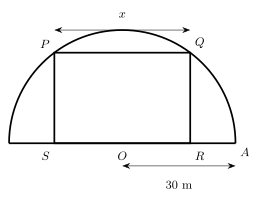
- CBSE 2025Set ANNUAL1 markQ.A gardener plans to plant flowers in a rectangular flower bed in such a way that a rectangle is inscribed in the semi-circular field (as shown in the figure). Radius of the semi-circular field is 30 m. Let the length of the rectangle be PQ = x m. Based on above information answer the following: What will be the breadth of the rectangular flower bed in terms of x?
›Reveal solutionSolution
The rectangle's top corners lie on the semicircle of radius 30, so the Pythagorean relation between half the length and the breadth gives the breadth as a function of x.
Place the centre O of the semicircle at the origin, with the diameter along the x-axis. Since the rectangle PQRS is symmetric about O with top side PQ=x, the top corners P,Q are at horizontal distance x/2 from O. Let the breadth (height of the rectangle) be b. …
- CBSE 2025Set ANNUAL1 markQ.A gardener plans to plant flowers in a rectangular flower bed in such a way that a rectangle is inscribed in the semi-circular field (as shown in the figure). Radius of the semi-circular field is 30 m. Let the length of the rectangle be PQ = x m. Based on above information answer the following: What will be the area of rectangular region as a function of x?
›Reveal solutionSolution
Area = length × breadth, using the breadth found in terms of x.
The rectangle has length PQ=x and breadth b=900−x2/4 (from the semicircle constraint). So the area is …
- CBSE 2025Set ANNUAL1 markQ.A gardener plans to plant flowers in a rectangular flower bed in such a way that a rectangle is inscribed in the semi-circular field (as shown in the figure). Radius of the semi-circular field is 30 m. Let the length of the rectangle be PQ = x m. Based on above information answer the following: Gardener wants maximum area for the rectangular flower bed. For this to happen, what will be the value of x?
›Reveal solutionSolution
Maximize A(x)2 (equivalent and algebraically simpler) by setting its derivative to zero.
From A(x)=x900−x2/4, consider A2=x2(900−4x2)=900x2−4x4 (maximizing A2 maximizes A since A≥0).
dxd(A2)=1800x−x3=x(1800−x2)
Setting this to zero: x=0 (rejected, gives zero area) or x2=1800⇒x=1800=302.
…
🎓Unlock everything free for 14 days
- ✓Full step-by-step solutions
- ✓Concept-first explanations
- ✓Methods, shortcuts & mistakes
- ✓PYQ mapping + timed mock tests
Full access for 14 days. No credit card required.