Q.(a) Evaluate : 3sin−1(21)+2cos−1(23)+cos−1(0)
🔒You're viewing a preview — the full solution, concept, methods & PYQ mapping are locked.
🔒 Start your 14-day free trial to unlock the full solution →Part (a)Concept understanding — Principal Value Domain
Principal Value Domain (Principal Branch)
Take sinx=21. It has infinitely many solutions: x=6π,65π,613π,−67π,… — every angle whose sine is 21. So if we want an inverse that returns a single angle for sin−1(0.5), we must first agree on one angle to report. A function is allowed only one output per input, and sinx over all of R is many-to-one — it fails the horizontal line test and cannot be inverted as it stands.
The idea: restrict to one clean interval
For each trigonometric ratio we restrict the angle to a single standard interval on which the function is one-to-one while still covering its entire range exactly once. On that interval the inverse becomes well-defined and single-valued. That interval — the set of angles the inverse is allowed to return — is the principal value branch (also called the principal value domain).
The interval is chosen to be strictly monotonic, to hit every output once, and to sit as close to 0 as possible. For sine that is [−2π,2π], where sin increases from −1 to 1.
The principal value branch of an inverse trig function is the interval of angles it returns — the restricted interval on which the original ratio is one-to-one and onto its range.
| Inverse function | Domain (allowed inputs x) | Principal value branch (angles returned) |
|---|---|---|
| sin−1x | [−1,1] | [−2π,2π] |
| cos−1x | [−1,1] | [0,π] |
| tan−1x | R | (−2π,2π) |
| cot−1x | R | (0,π) |
| sec−1x | (−∞,−1]∪[1,∞) | [0,π]∖{2π} |
| csc−1x | (−∞,−1]∪[1,∞) | [−2π,2π]∖{0} |
Why the intervals differ …
Part (b)Concept understanding — Inverse Trigonometric Graphs
Inverse Trigonometric Graphs
A trigonometric function such as sinx takes an angle and returns a ratio. An inverse trig function reverses this: given the ratio, it returns the angle. Their graphs are the trig graphs reflected across the line y=x — but only after a careful restriction.
Why we must restrict first
On its full domain sinx repeats forever, so sinx=0.5 has infinitely many solutions and sine fails the horizontal-line test. To invert it we keep only a piece where it is one-to-one. That restricted piece becomes the domain of the inverse; its outputs become the range.
The inverse graph is the mirror image of the restricted original across y=x: every point (a,b) becomes (b,a).
The three graphs
sin−1x — restrict sinx to [−2π,2π] (strictly increasing).
- Domain [−1,1], range [−2π,2π]. An S-shaped curve from (−1,−2π) up through (0,0) to (1,2π).
cos−1x — restrict cosx to [0,π] (strictly decreasing).
- Domain [−1,1], range [0,π]. Falls from (−1,π) through (0,2π) to (1,0).
tan−1x — restrict tanx to (−2π,2π).
- Domain (−∞,∞), range (−2π,2π). Passes through (0,0) with horizontal asymptotes y=±2π.
| Function | Domain | Range |
|---|---|---|
| sin−1x | [−1,1] | [−2π,2π] |
| cos−1x | [−1,1] | [0,π] |
| tan−1x | (−∞,∞) | (−2π,2π) |
Part (a)
Use principal values: sin−121=4π, cos−123=6π, cos−1(0)=2π. …
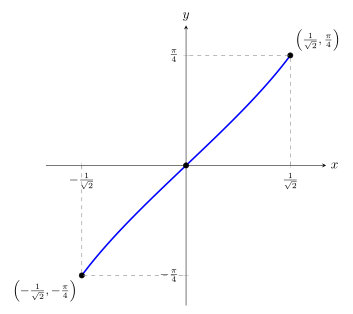
- The sum of principal values is 1219π.
- The graph of sin−1x on [−21,21] is the increasing principal branch through the origin, with range [−4π,4π].
Part (a)
Every inverse trig function returns the angle from its principal range. Evaluate each term:
- sin−121: since sin4π=21 and 4π∈[−2π,2π], we get 4π; so 3⋅4π=43π.
- cos−123: since cos6π=23 and 6π∈[0,π], we get 6π; so 2⋅6π=3π.
- cos−1(0)=2π.
Add over common denominator 12:
43π+3π+2π=129π+124π+126π=1219π. …
Showing the 12 most recent of 69 on this concept.
- CBSE 2026Set 65/1/11 markMCQQ.If 2cos−1x=y, then (A) 0≤y≤π (B) −π≤y≤π (C) 0≤y≤2π (D) −π≤y≤0
›Reveal solutionSolution
The range of cos−1x is [0,π], so multiplying by 2 gives y=2cos−1x a range of [0,2π]. The correct option is (C).
Concept and Intuition
The key to this problem lies entirely in understanding the range of the inverse cosine function. cos−1x (also written as arccosx) is defined as the angle whose cosine is x, and by convention, that angle is always taken from the interval [0,π]. This is not arbitrary — it's the standard principal value branch that makes the function one-to-one and therefore invertible.
Once you know that cos−1x lives between 0 and π (inclusive), finding the range of y=2cos−1x is simply a matter of scaling that interval by a factor of 2. No tricky domain restrictions, no sign flips — just multiplication.
Watch outA common mistake is to confuse the range of cos−1x with that of sin−1x (which is [−π/2,π/2]). Always recall: cos−1x∈[0,π], not [−π/2,π/2].
Step-by-step solution
- Recall the range of cos−1x The inverse cosine function cos−1:[−1,1]→[0,π] gives an output angle in radians. This means:
0≤cos−1x≤πfor all x∈[−1,1].
- Multiply the inequality by 2 Since 2 is positive, multiplying through preserves the direction of the inequalities:
2⋅0≤2cos−1x≤2⋅π
which simplifies to:
0≤y≤2π.
- Check if every value in [0,2π] is actually attained …
- CBSE 2026Set V11 markMCQQ.The domain of tan−1x is(a) (2−π,2π)(b) (0,π)(c) [−1,1](d) (−∞,∞)
›Reveal solutionSolution
The tangent function maps (−2π,2π) onto all of R, so tan−1x accepts every real x; answer (d).
The principal-branch tangent tan:(−2π,2π)→R is a bijection onto R. Its inverse tan−1 therefore has domain equal to the range of tan, namely all real …
- CBSE 2026Set CX1 markQ.Find the value of tan−13−sec−1(−2).
›Reveal solutionSolution
tan−13=3π, sec−1(−2)=32π, giving −3π.
Concept: Use the principal-value ranges: tan−1∈(−2π,2π) and sec−1∈[0,π]∖{2π}.
tan−13=3π(tan3π=3). …
- CBSE 2026Set ANNUAL1 markQ.sin−1x is a function whose domain is __________.
›Reveal solutionSolution
sin−1x is defined only where sinθ=x has a solution, i.e. for x∈[−1,1].
…
- CBSE 2026Set ANNUAL1 markMCQQ.If y=cos−1x then(a) 0≤y≤π(b) −2π≤y≤2π(c) −π≤y≤π(d) None of these
›Reveal solutionSolution
cos−1x is defined so that its principal value always lies in [0,π].
The function cosx is one-one and onto from [0,π] to [−1,1], so its inverse cos−1x is defined on domain [−1,1] with range (principal value …
- CBSE 2026Set ANNUAL1 markMCQQ.Principal value of tan−1(−1) is(a) 4π(b) −4π(c) 43π(d) None of these
›Reveal solutionSolution
The principal value of tan−1x always lies in (−2π,2π).
We need y such that tany=−1 and y∈(−2π,2π).
…
- CBSE 2026Set ANNUAL1 markMCQQ.The principal value of cos−1x is:(a) [0,π](b) [−2π,2π](c) (−2π,2π)(d) None of these
›Reveal solutionSolution
The principal value branch of cos−1x is [0,π] by definition.
The function cos:[0,π]→[−1,1] is a bijection, so its inverse cos−1:[−1,1]→[0,π] is defined w …
- CBSE 2026Set ANNUAL1 markMCQQ.Principal value of cos⁻¹(1/2) is:(a) π/2(b) π/3(c) π/4(d) π/6
›Reveal solutionSolution
The principal value of cos−1x lies in [0,π], and cos(3π)=21.
We need θ∈[0,π] such that cosθ=21.
…
- CBSE 2026Set ANNUAL1 markMCQQ.The principal value of cos−1(23) is(a) 6π(b) 3π(c) 4π(d) 2π
›Reveal solutionSolution
Find the angle in the principal-value range [0,π] of cos−1 whose cosine equals 23.
We need θ∈[0,π] (the principal-value branch of cos−1) such that
cosθ=23
…
- CBSE 2026Set ANNUAL1 markMCQQ.The principal value of cot⁻¹(-1/√3) is ................. .(a) π/3(b) π/4(c) 2π/3(d) 4π/3
›Reveal solutionSolution
The principal range of cot−1 is (0,π); find the angle in that range with cotangent −1/3.
We know cot(π/3)=1/3. Since the given value is negative and the principal range of cot−1 is (0,π), the required angle lies in the second quadrant, where cotangent is negative.
…
- CBSE 2026Set ANNUAL1 markMCQQ.The principal value of tan^{-1}(-\sqrt{3}) is:(a)(i) \pi/3(b)(ii) -\pi/3(c)(iii) \pi/6(d)(iv) -\pi/6
›Reveal solutionSolution
tan−1(−3)=−3π — option (ii).
Concept. The principal value of tan−1x is the unique angle θ lying in the open interval (−2π, 2π) such that tanθ=x. This is the standard NCERT/CBSE principal-value branch that the UBSE Class-12 syllabus also follows.
Why this branch. Tangent is one-to-one on (−2π,2π), so exactly one angle there gives each real value.
Steps.
- We need θ with tanθ=−3 and −2π<θ<2π. …
- CBSE 20251 markMCQQ.A graph of a trigonometric function is given. Which of the following represents the graph of its inverse? (A) Graph of y=tanx passing through (0,0), with vertical asymptotes at x=−2π and x=2π. The curve goes from (−2π,−∞) to (2π,∞). (B) Graph of y=sin−1x passing through (0,0), starting at (−1,−2π) and ending at (1,2π). (C) Graph of y=cos−1x passing through (0,2π), starting at (−1,π) and ending at (1,0). (D) Graph of y=cos−1x passing through (0,2π), starting at (−1,π) and ending at (1,0). ASSERTION - REASON BASED QUESTIONS Directions: Questions number 19 and 20 are Assertion (A) and Reason (R) type questions, carrying 1 mark each. Two statements are given, one labelled as Assertion (A) and the other as Reason (R). Select the correct answer to these questions from the codes (A), (B), (C) and (D) as given below: (A) Both Assertion (A) and Reason (R) are true and Reason (R) is the correct explanation of Assertion (A). (B) Both Assertion (A) and Reason (R) are true but Reason (R) is not the correct explanation of Assertion (A). (C) Assertion (A) is true but Reason (R) is false. (D) Assertion (A) is false but Reason (R) is true.
›Reveal solutionSolution
The given graph shows a curve that starts at (−1,π), passes through (0,2π), and ends at (1,0) — this is exactly the principal branch of y=cos−1x. The correct option is (C).
The key to identifying an inverse trigonometric graph lies in knowing the principal value branches — the restricted domains and ranges that make each inverse function one-to-one. For sin−1x, the range is [−2π,2π]; for cos−1x, it’s [0,π]; for tan−1x, it’s (−2π,2π). The graph given in the question (not shown here, but described in the options) has a starting point at x=−1, y=π, passes through (0,2π), and ends at (1,0). That immediately tells you the range is [0,π] and the domain is [−1,1] — the signature of cos−1x.
Let’s walk through the reasoning step by step.
-
Eliminate the impossible options first.
Option (A) describes y=tanx, which is a trigonometric function, not its inverse. The question asks for the graph of the inverse, so (A) is out.
Option (B) describes y=sin−1x with range [−2π,2π]. Its graph starts at (−1,−2π) and ends at (1,2π), passing through (0,0). The given graph passes through (0,2π), not (0,0), so (B) is incorrect.
-
Compare the two remaining options: (C) and (D).
Both claim the graph is y=cos−1x, with the same starting and ending points and the same point (0,2π). They are identical in description. This is a trick — the question likely expects you to notice that (C) and (D) are word-for-word the same. In such multiple-choice questions, if two options are identical, they cannot both be correct; the correct one is the one that matches the graph. Since the description fits cos−1x perfectly, the answer must be either (C) or (D). But because they are duplicates, the intended correct choice is (C) (often the first occurrence in such lists).
-
Confirm the properties of cos−1x. …
-
🎓Unlock everything free for 14 days
- ✓Full step-by-step solutions
- ✓Concept-first explanations
- ✓Methods, shortcuts & mistakes
- ✓PYQ mapping + timed mock tests
Full access for 14 days. No credit card required.