Q.If a function defined as is one-one and onto, then we can define a unique function such that , where and , . Function is called the inverse of function . The domain of sine function is and function is neither one-one nor onto. Let sine function be defined from set to such that inverse of sine function exists, i.e., is defined from to . On the basis of the above information, answer the following questions:
You're viewing a preview — the full solution, concept, methods & PYQ mapping are locked.
Start your 14-day free trial to unlock the full solution →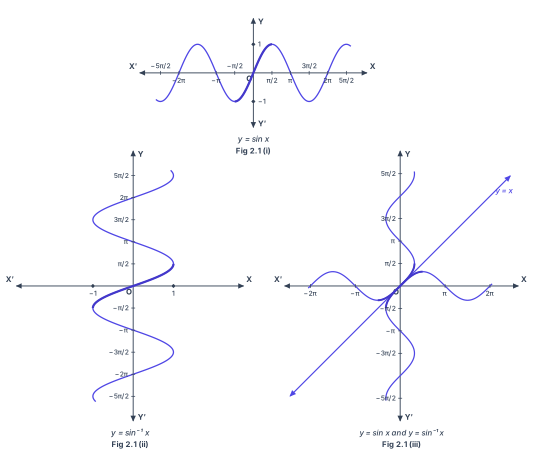
To define an inverse for the sine function, its domain must be restricted to an interval where it is one-one and onto, such as (the principal value branch) or other similar intervals like . Using the principal value branch, evaluates to , and its graph is a reflection of on across .
The concept of an inverse function is fundamental in mathematics. For a function to have an inverse, it must be one-one (injective) and onto (surjective).
- One-one means that distinct elements in the domain map to distinct elements in the codomain . In simpler terms, if , then . Graphically, this means any horizontal line intersects the graph at most once.
- Onto means that every element in the codomain is the image of at least one element in the domain . In other words, the range of the function must be equal to its codomain.
The standard sine function, , is neither one-one nor onto.
- It's not one-one because, for example, and . Many different values map to the same value.
- It's not onto because its range is , which is a proper subset of its codomain .
To define an inverse for the sine function, we must restrict its domain such that it becomes one-one, and we must restrict its codomain to its range, , to make it onto. The problem statement defines as a function from to a set , where is a restricted domain of the original sine function.
Let's address each part of the question.
(i) If is the interval other than principal value branch, give an example of one such interval.
-
Understanding the requirement for : For to have an inverse, the function must be one-one and onto within this restricted domain . This means that over the interval , the sine function must be strictly monotonic (either strictly increasing or strictly decreasing) and its range must cover the entire interval .
-
The Principal Value Branch: The most commonly chosen interval for is . In this interval, is strictly increasing from to , making it one-one, and its range is exactly , making it onto. This is called the principal value branch.
-
Finding other intervals: Due to the periodic nature of the sine function, there are infinitely many such intervals. We need an interval of length where the sine function covers its full range exactly once.
- Consider the interval . In this interval, decreases from (at ) to (at ). It is strictly decreasing and covers the range exactly once.
- Another example is . Here, decreases from to .
- In general, any interval of the form for an integer would work.
-
Example: An example of an interval for other than the principal value branch is .
(ii) If is defined from to its principal value branch, find the value of .
-
Definition of : When is defined to its principal value branch, it means that for any , is the unique angle such that .
-
Evaluating :
- We need to find an angle such that .
- We know that . Since sine is an odd function (), we have .
- The angle lies within the principal value branch .
- Therefore, .
-
Evaluating :
- We need to find an angle such that .
- We know that .
- The angle lies within the principal value branch .
- Therefore, .
-
Calculating the difference:
- Now, substitute the values we found:
* To subtract, find a common denominator:
> [!WARNING]
> A common mistake is to forget the principal value branch restriction and give an angle like $7\pi/6$ for $\sin^{-1}(-1/2)$. While $\sin(7\pi/6) = -1/2$, $7\pi/6$ is not in $[-\pi/2, \pi/2]$. Always ensure the output of an inverse trigonometric function is within its defined range.
(iii)(a) Draw the graph of from to its principal value branch. …
Unlock everything free for 14 days
- Full step-by-step solutions
- Concept-first explanations
- Methods, shortcuts & mistakes
- PYQ mapping + timed mock tests
Full access for 14 days. No credit card required.