Q.If f(x)=∣x∣+∣x−1∣, then which of the following is correct ?
(A) f(x) is both continuous and differentiable, at x=0 and x=1.
(B) f(x) is differentiable but not continuous, at x=0 and x=1.
(C) f(x) is continuous but not differentiable, at x=0 and x=1.
(D) f(x) is neither continuous nor differentiable, at x=0 and x=1.
Concept understanding — Differentiability of Absolute Value
Differentiability of the Absolute Value Function
Start with something familiar: the absolute value of x, written ∣x∣, is its distance from zero on the number line. So ∣3∣=3, ∣−5∣=5, and ∣0∣=0. Graphically, it looks like a V-shape — two straight lines meeting at the origin.
Differentiability is about whether a function has a well-defined slope (derivative) at a point. For smooth curves like x2 or sinx, the slope exists everywhere. But the absolute value function has a sharp corner at x=0 — and that corner is the whole story.
Intuition: Why the corner matters
Walk along y=∣x∣ from left to right. Approaching x=0 from the left, the slope is −1 (the line goes downward). Leaving x=0 to the right, the slope is suddenly +1 (the line goes upward). At x=0, there's no single slope — it changes abruptly. That's why ∣x∣ is not differentiable at x=0. Everywhere else — for x<0 and x>0 — the graph is a straight line with constant slope, so ∣x∣ is differentiable at every point except x=0.
A function must be continuous to be differentiable, but continuity alone isn't enough. The absolute value function is continuous at x=0 (no break), yet fails to be differentiable there because of the sharp corner.
The precise statement
Let f(x)=∣x∣. Then:
- For x>0: f(x)=x, so f′(x)=1.
- For x<0: f(x)=−x, so f′(x)=−1.
- At x=0: the derivative does not exist, because the left-hand and right-hand derivatives are different numbers.
f′(0)=limh→0h∣0+h∣−∣0∣=limh→0h∣h∣
This limit does not exist because:
- From the right (h→0+): h∣h∣=hh=1
- From the left (h→0−): h∣h∣=h−h=−1
Since the two one-sided limits differ, the two-sided limit does not exist.
A common mistake is to think that because ∣x∣ is continuous at x=0, it must be differentiable there. Continuity is necessary for differentiability, but not sufficient. The absolute value function is the classic counterexample.
The bigger picture
The absolute value function is the simplest example of a function that is continuous everywhere but differentiable only almost everywhere. This idea shows up in piecewise functions, functions with corners or cusps, and in real analysis when studying functions like ∣x∣p.
For exam purposes, remember:
- ∣x∣ is differentiable for all x=0.
- At x=0, the derivative does not exist.
- For x=0: f′(x)={1−1if x>0if x<0
That's the complete picture — just a sharp corner that breaks differentiability.
The non-differentiability of |x| at x = 0 is the textbook counterexample used throughout the NCERT Class 12 Continuity and Differentiability chapter to show that continuity alone doesn't guarantee differentiability. Students searching 'differentiability of modulus function class 12' or 'why is |x| not differentiable at 0' will find this left-hand/right-hand derivative mismatch is exactly the standard CBSE board explanation.
Concept: Differentiability of absolute value functions — each ∣x−a∣ has a corner (non-differentiable point) at x=a.
Step 1: f(x)=∣x∣+∣x−1∣ is a sum of two absolute value functions. Each absolute value is continuous everywhere, so f(x) is continuous at all points, including x=0 and x=1.
Step 2: Check differentiability at x=0. Write f piecewise:
For x<0: f(x)=−x+(1−x)=1−2x, derivative f′(x)=−2.
For 0<x<1: f(x)=x+(1−x)=1, derivative f′(x)=0.
Left-hand derivative at 0 is −2, right-hand derivative is 0 — they differ, so f is not differentiable at x=0.
Step 3: Check at x=1. For 0<x<1: f′(x)=0. For x>1: f(x)=x+(x−1)=2x−1, derivative f′(x)=2.
Left-hand derivative at 1 is 0, right-hand derivative is 2 — not equal, so f is not differentiable at x=1.
The function is continuous but not differentiable at x=0 and x=1, so option (C) is correct.
The function f(x)=∣x∣+∣x−1∣ is a sum of two absolute value functions, each continuous everywhere but with a corner at its respective critical point. At x=0 and x=1, the left and right derivatives differ, so f is continuous but not differentiable at both points — option (C).
The key to this problem is understanding what absolute value does to differentiability. The function ∣x∣ has a V-shaped graph — it is continuous everywhere, but at x=0 the slope changes abruptly from −1 to +1. That sharp corner means the derivative does not exist at x=0, even though the function is perfectly continuous there. The same logic applies to ∣x−1∣ at x=1.
When you add two such functions, the sum inherits the continuity of each piece. But at a point where either term has a corner, the sum may also have a corner — unless the slopes happen to cancel, which they do not here.
Let’s check each point carefully.
- Continuity at x=0 Compute the left-hand limit, right-hand limit, and the function value. For x<0: ∣x∣=−x, ∣x−1∣=−(x−1)=1−x, so
f(x)=−x+(1−x)=1−2x.
As x→0−, f(x)→1.
For x>0 but x<1: ∣x∣=x, ∣x−1∣=1−x, so
f(x)=x+(1−x)=1.
As x→0+, f(x)→1.
Also f(0)=∣0∣+∣0−1∣=0+1=1.
Since left limit = right limit = function value, f is continuous at x=0.
- Differentiability at x=0 The left-hand derivative uses the expression for x<0: f(x)=1−2x, so f′(x)=−2. Hence
f−′(0)=−2.
The right-hand derivative uses the expression for 0<x<1: f(x)=1, so f′(x)=0. Hence
f+′(0)=0.
Since −2=0, the left and right derivatives are different. Therefore f is not differentiable at x=0.
A common mistake is to think that because ∣x∣ alone is not differentiable at 0, the sum must also fail — which is true here, but you must check the actual slopes. If the slopes from both terms happened to match on both sides, the sum could become differentiable. Always compute the left and right derivatives explicitly.
- Continuity at x=1 For 0<x<1: f(x)=1 (as above). As x→1−, f(x)→1. For x>1: ∣x∣=x, ∣x−1∣=x−1, so
f(x)=x+(x−1)=2x−1.
As x→1+, f(x)→2(1)−1=1.
Also f(1)=∣1∣+∣0∣=1+0=1.
So f is continuous at x=1.
- Differentiability at x=1 Left-hand derivative (using f(x)=1 for x<1): f−′(1)=0. Right-hand derivative (using f(x)=2x−1 for x>1): f′(x)=2, so f+′(1)=2. Since 0=2, f is not differentiable at x=1.
You can also think graphically: f(x) is made of three linear pieces — for x<0 it is 1−2x (slope −2), for 0<x<1 it is constant 1 (slope 0), and for x>1 it is 2x−1 (slope 2). The slope jumps at both x=0 and x=1, confirming non-differentiability at those points.
The correct option is (C): f(x) is continuous but not differentiable at x=0 and x=1.
- CBSE 2026Set V11 markQ.Choose from [0,3,−1,2,−2,1]. The left hand derivative of ∣x∣ with respect to x at x=0 is ____.
›Reveal solutionSolution
Just left of 0, ∣x∣=−x has slope −1, so the left-hand derivative is −1.
The left-hand derivative at x=0 is
limh→0−h∣0+h∣−∣0∣=limh→0−h−h=−1,
since for h<0, ∣h∣=−h. (Geometrically, to the left of the origin ∣x∣=−x, a line of slope −1.)
✓Final answer−1
- CBSE 2025Set 65/1/11 markMCQQ.If f(x)=∣x∣+∣x−1∣, then which of the following is correct ? (A) f(x) is both continuous and differentiable, at x=0 and x=1. (B) f(x) is differentiable but not continuous, at x=0 and x=1. (C) f(x) is continuous but not differentiable, at x=0 and x=1. (D) f(x) is neither continuous nor differentiable, at x=0 and x=1.
›Reveal solutionSolution
The function f(x)=∣x∣+∣x−1∣ is a sum of two absolute value functions, each continuous everywhere but with a corner at its respective critical point. At x=0 and x=1, the left and right derivatives differ, so f is continuous but not differentiable at both points — option (C).
The key to this problem is understanding what absolute value does to differentiability. The function ∣x∣ has a V-shaped graph — it is continuous everywhere, but at x=0 the slope changes abruptly from −1 to +1. That sharp corner means the derivative does not exist at x=0, even though the function is perfectly continuous there. The same logic applies to ∣x−1∣ at x=1.
When you add two such functions, the sum inherits the continuity of each piece. But at a point where either term has a corner, the sum may also have a corner — unless the slopes happen to cancel, which they do not here.
Let’s check each point carefully.
- Continuity at x=0 Compute the left-hand limit, right-hand limit, and the function value. For x<0: ∣x∣=−x, ∣x−1∣=−(x−1)=1−x, so
f(x)=−x+(1−x)=1−2x.
As x→0−, f(x)→1.
For x>0 but x<1: ∣x∣=x, ∣x−1∣=1−x, so
f(x)=x+(1−x)=1.
As x→0+, f(x)→1.
Also f(0)=∣0∣+∣0−1∣=0+1=1.
Since left limit = right limit = function value, f is continuous at x=0.
- Differentiability at x=0 The left-hand derivative uses the expression for x<0: f(x)=1−2x, so f′(x)=−2. Hence
f−′(0)=−2.
The right-hand derivative uses the expression for 0<x<1: f(x)=1, so f′(x)=0. Hence
f+′(0)=0.
Since −2=0, the left and right derivatives are different. Therefore f is not differentiable at x=0.
Watch outA common mistake is to think that because ∣x∣ alone is not differentiable at 0, the sum must also fail — which is true here, but you must check the actual slopes. If the slopes from both terms happened to match on both sides, the sum could become differentiable. Always compute the left and right derivatives explicitly.
- Continuity at x=1 For 0<x<1: f(x)=1 (as above). As x→1−, f(x)→1. For x>1: ∣x∣=x, ∣x−1∣=x−1, so
f(x)=x+(x−1)=2x−1.
As x→1+, f(x)→2(1)−1=1.
Also f(1)=∣1∣+∣0∣=1+0=1.
So f is continuous at x=1.
- Differentiability at x=1 Left-hand derivative (using f(x)=1 for x<1): f−′(1)=0. Right-hand derivative (using f(x)=2x−1 for x>1): f′(x)=2, so f+′(1)=2. Since 0=2, f is not differentiable at x=1.
TipYou can also think graphically: f(x) is made of three linear pieces — for x<0 it is 1−2x (slope −2), for 0<x<1 it is constant 1 (slope 0), and for x>1 it is 2x−1 (slope 2). The slope jumps at both x=0 and x=1, confirming non-differentiability at those points.
✓Final answerThe correct option is (C): f(x) is continuous but not differentiable at x=0 and x=1.
- CBSE 2025Set X11 markMCQQ.For the given figure consider the following statements 1 and 2 :
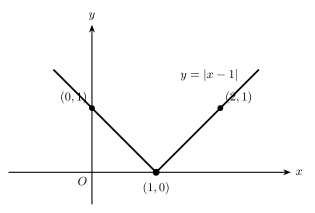 Statement 1 : Left hand derivative of y=f(x) at x=1 is −1.
Statement 2 : The function y=f(x) is differentiable at x=1.
Then which of the following are true?(a) Statement 1 is true, Statement 2 is false(b) Statement 1 is false, Statement 2 is true(c) Both Statements 1 and 2 are true(d) Both Statements 1 and 2 are false
Statement 1 : Left hand derivative of y=f(x) at x=1 is −1.
Statement 2 : The function y=f(x) is differentiable at x=1.
Then which of the following are true?(a) Statement 1 is true, Statement 2 is false(b) Statement 1 is false, Statement 2 is true(c) Both Statements 1 and 2 are true(d) Both Statements 1 and 2 are false›Reveal solutionSolution
One-sided derivatives / differentiability at a corner — correct option (a).
The left-hand derivative is the slope of the left branch from (0,1) to (1,0): 1−00−1=−1, so Statement 1 is true. The right branch rises from (1,0) to (2,1) with slope 2−11−0=+1. Since the left and right derivatives differ (−1=+1), the graph has a corner and f is not differentiable at x=1, so Statement 2 is false.
✓Final answer(a) Statement 1 is true, Statement 2 is false
- CBSE 2025Set ANNUAL1 markMCQQ.The function f(x)=∣x∣ at x=0 is(a) continuous but not differentiable(b) differentiable but not continuous(c) continuous and differentiable(d) neither continuous nor differentiable
›Reveal solutionSolution
|x| has a 'corner' at x = 0 — no jump (continuous) but a sharp change in slope (not differentiable).
Continuity: limx→0−∣x∣=0, limx→0+∣x∣=0, and f(0)=0. All three agree, so f is continuous at x = 0.
Differentiability: Left-hand derivative: limh→0−h∣0+h∣−∣0∣=limh→0−h−h=−1.
Right-hand derivative: limh→0+h∣0+h∣−∣0∣=limh→0+hh=1.
Since −1=1, f is not differentiable at x = 0.
✓Final answer(a) continuous but not differentiable.
- CBSE 2023Set 65/2/11 markMCQQ.The function f(x)=x∣x∣ is:(a) continuous and differentiable at x=0(b) continuous but not differentiable at x=0(c) differentiable but not continuous at x=0(d) neither differentiable nor continuous at x=0
›Reveal solutionSolution
The absolute value creates a piecewise definition, but the square in f(x)=x∣x∣ smooths out the corner that usually appears at the origin; both continuity and differentiability hold at x=0.
Understanding Differentiability of Absolute Value Functions
The absolute value function ∣x∣ itself has a sharp corner at x=0, making it continuous but not differentiable there. However, when we multiply x by ∣x∣, we're creating something different. The key insight is to rewrite f(x) in piecewise form and check whether the pieces "join smoothly" at the origin.
Start by recalling that ∣x∣=x when x≥0 and ∣x∣=−x when x<0. This gives us:
f(x)=x∣x∣={x⋅x=x2x⋅(−x)=−x2if x≥0if x<0
Notice that both pieces are parabolas, one opening upward and one downward, meeting at the origin.
Checking Continuity at x=0
- Compute the left-hand limit:
limx→0−f(x)=limx→0−(−x2)=0
- Compute the right-hand limit:
limx→0+f(x)=limx→0+x2=0
- Evaluate at the point:
f(0)=0⋅∣0∣=0
Since limx→0−f(x)=limx→0+f(x)=f(0)=0, the function is continuous at x=0.
Checking Differentiability at x=0
Differentiability requires that the derivative from the left equals the derivative from the right. We use the definition of the derivative:
- Left-hand derivative:
f−′(0)=limh→0−hf(0+h)−f(0)=limh→0−h−h2−0=limh→0−h−h2=limh→0−(−h)=0
- Right-hand derivative:
f+′(0)=limh→0+hf(0+h)−f(0)=limh→0+hh2−0=limh→0+hh2=limh→0+h=0
Since f−′(0)=f+′(0)=0, the function is differentiable at x=0 with f′(0)=0.
TipFor x=0, you can verify that f′(x)=2∣x∣, which also gives f′(0)=0 by direct substitution, confirming our result.
Watch outDon't confuse f(x)=x∣x∣ with g(x)=∣x∣. The latter is not differentiable at x=0 because its left and right derivatives are −1 and +1 respectively. The extra factor of x in f(x) eliminates the corner.
✓Final answerThe correct option is (a): the function is continuous and differentiable at x=0.
- CBSE 2023Set ANNUAL1 markMCQQ.The function f(x) = |x| for all x ∈ R is –(a) continuous and differentiable at x = 0(b) continuous but not differentiable at x = 0(c) differentiable but not continuous at x = 0(d) neither continuous nor differentiable at x = 0
›Reveal solutionSolution
The modulus function has no break in its graph (continuous everywhere) but has a sharp corner at x=0 where the left-hand and right-hand derivatives differ.
Continuity at x=0: limx→0−∣x∣=0, limx→0+∣x∣=0, and f(0)=0. All three agree, so f is continuous at x=0 (and everywhere else, being a composition of continuous functions).
Differentiability at x=0:
LHD=limh→0−h∣h∣−0=limh→0−h−h=−1,RHD=limh→0+hh−0=1.
Since LHD = RHD, f is not differentiable at x=0.
✓Final answerf(x) = |x| is continuous but not differentiable at x = 0 — option (b).
- CBSE 2020Set 65/2/11 markMCQQ.The function f:R→R given by f(x)=−∣x−1∣ is (A) continuous as well as differentiable at x=1 (B) not continuous but differentiable at x=1 (C) continuous but not differentiable at x=1 (D) neither continuous nor differentiable at x=1
›Reveal solutionSolution
The absolute value function creates a sharp corner (a cusp) at x=1, so f(x)=−∣x−1∣ is continuous there but not differentiable — the left and right slopes don't match. The correct option is (C).
Why This Problem Tests a Core Idea
The absolute value function ∣x−1∣ is the classic example of a function that is continuous everywhere but fails to be differentiable at the point where its "kink" occurs — here, at x=1. The negative sign in front just flips the V-shape upside down; it doesn't change the nature of the corner.
Continuity asks: Does the graph have a break? Differentiability asks: Does the graph have a unique tangent line? At a sharp corner, the answer to the first is "no" and to the second is "no" — that's exactly what we'll verify.
Step-by-Step Reasoning
1. Rewrite the function without the absolute value
The expression ∣x−1∣ behaves differently depending on whether x−1 is positive or negative:
- If x≥1, then x−1≥0, so ∣x−1∣=x−1.
- If x<1, then x−1<0, so ∣x−1∣=−(x−1)=1−x.
Therefore, f(x)=−∣x−1∣ becomes:
f(x)={−(x−1)=1−x,−(1−x)=x−1,x≥1x<1
So the function is two straight lines meeting at x=1: for x<1 it's the line y=x−1 (slope +1), and for x≥1 it's the line y=1−x (slope −1).
TipYou can also think of f(x)=−∣x−1∣ as the graph of y=∣x−1∣ reflected across the x-axis. The V-shape becomes an inverted V — still a sharp point at x=1.
2. Check continuity at x=1
A function is continuous at x=1 if:
- f(1) exists,
- limx→1f(x) exists,
- They are equal.
Left-hand limit (x→1−):
For x<1, f(x)=x−1. As x approaches 1 from the left, x−1→0. So:
limx→1−f(x)=0
Right-hand limit (x→1+):
For x≥1, f(x)=1−x. As x approaches 1 from the right, 1−x→0. So:
limx→1+f(x)=0
Function value:
At x=1, using the x≥1 piece: f(1)=1−1=0.
Since both one-sided limits equal f(1)=0, the function is continuous at x=1.
Watch outA common mistake is to think that because the graph has a sharp point, it must be discontinuous. That's false — continuity only cares about the value and the limit matching, not about smoothness.
3. Check differentiability at x=1
Differentiability requires the derivative to exist, which means the left-hand derivative and right-hand derivative must be equal.
Left-hand derivative (using x<1 piece f(x)=x−1):
f−′(1)=limh→0−hf(1+h)−f(1)
For h<0, 1+h<1, so f(1+h)=(1+h)−1=h. And f(1)=0. Thus:
f−′(1)=limh→0−hh−0=limh→0−1=1
Right-hand derivative (using x≥1 piece f(x)=1−x):
f+′(1)=limh→0+hf(1+h)−f(1)
For h>0, 1+h>1, so f(1+h)=1−(1+h)=−h. And f(1)=0. Thus:
f+′(1)=limh→0+h−h−0=limh→0+(−1)=−1
The left-hand derivative is 1, the right-hand derivative is −1. They are not equal.
For f(x)=−∣x−1∣ at x=1:
f−′(1)=1,f+′(1)=−1
Since f−′(1)=f+′(1), the derivative does not exist at x=1.
4. Conclusion
The function is continuous at x=1 (the graph has no break) but not differentiable at x=1 (the graph has a corner, so no unique tangent exists).
✓Final answerThe function is continuous but not differentiable at x=1, so the correct option is (C).
- CBSE 2019Set 65/2/11 markQ.If y=x∣x∣, find dxdy for x<0.
›Reveal solutionSolution
The absolute value creates a piecewise definition; for x<0 we have ∣x∣=−x, so y=−x2 and dxdy=−2x.
Understanding Differentiability of Absolute Value
The function y=x∣x∣ looks deceptively simple, but the absolute value hides a piecewise structure. The key insight is that ∣x∣ behaves differently on either side of zero: it equals x when x≥0 and equals −x when x<0. This means our function has two different algebraic forms depending on the sign of x.
Rather than wrestling with the absolute value directly, we rewrite the function in its piecewise form, then differentiate the piece that applies to our domain of interest.
Step-by-Step Solution
-
Rewrite using the definition of absolute value
Recall that ∣x∣={x−xif x≥0if x<0
Therefore:
y=x∣x∣={x⋅x=x2x⋅(−x)=−x2if x≥0if x<0
-
Identify the relevant piece for x<0
Since we're asked to find dxdy specifically for x<0, we work with the second piece:
y=−x2for x<0
-
Differentiate using the power rule
For x<0, we have a simple polynomial:
dxdy=dxd(−x2)=−2x
TipNotice that dxdy=−2x is actually positive when x<0 (since we're multiplying two negatives). This makes geometric sense: the function y=−x2 for x<0 is indeed increasing as we move from left toward zero.
Watch outA common mistake is to try differentiating ∣x∣ using the chain rule without first simplifying. While dxd∣x∣=∣x∣x for x=0, it's cleaner to use the piecewise definition directly, especially when ∣x∣ appears in a product.
✓Final answerFor x<0, we have dxdy=−2x.
-
- CBSE 2019Set HE1 markMCQQ.Function f(x)=∣x∣ at x=0 is:(a) Continuous but not differentiable(b) Discontinuous and not differentiable(c) Discontinuous and differentiable(d) Continuous and differentiable
›Reveal solutionSolution
∣x∣ is continuous everywhere but its left and right derivatives at x=0 disagree, so it is not differentiable there.
Continuity: limx→0∣x∣=0=f(0), so f is continuous at x=0.
Differentiability: the right-hand derivative is limh→0+h∣h∣−0=limh→0+hh=1, while the left-hand derivative is limh→0−h∣h∣−0=limh→0−h−h=−1. Since 1=−1, f is not differentiable at x=0 — the graph has a sharp corner (kink) there.
✓Final answer(a) Continuous but not differentiable.
🎓Unlock everything free for 14 days
- ✓Full step-by-step solutions
- ✓Concept-first explanations
- ✓Methods, shortcuts & mistakes
- ✓PYQ mapping + timed mock tests
Full access for 14 days. No credit card required.