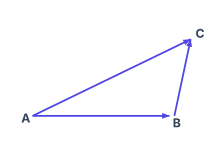
Concept understanding — Vector Addition Triangle Law
Triangle Law of Vector Addition
How do you combine two vectors into a single one? If you make two journeys one after the other, the net journey is a single vector from where you started to where you finished. That is exactly the triangle law.
The law
Important
If two vectors are represented, in magnitude and direction, by two sides of a triangle taken in order (the tip of the first joined to the tail of the second), then their sum is represented by the third side taken in the reverse order — from the tail of the first to the tip of the second.
Place a, then start b where a ends. The arrow that closes the triangle, drawn from the start of a to the end of b, is the resultant a+b.
AB+BC=AC
Why it works
Read the vectors as directed displacements: going from A to B and then B to C lands you at C, and the single displacement that achieves the same is A to C. The intermediate point B cancels — only the overall start and finish survive.
Consequences
Commutative:a+b=b+a. Completing the triangle the other way gives the same closing side — which is why the parallelogram law agrees with the triangle law.
Closed triangle = zero: if three vectors form a triangle taken in order, AB+BC+CA=0, since you return to the start.
To subtract, add the negative: a−b=a+(−b), reversing b before joining it. …
Using the triangle law of vector addition, the head-to-tail sum of vectors around a closed triangle is zero. Option (C) is the only one that does not simplify to 0, so it is the false statement.
The core idea here is the Triangle Law of Vector Addition: if you place vectors head to tail, the resultant vector goes from the first tail to the last head. When you go completely around a closed polygon (like a triangle) and return to the starting point, the net displacement is zero. That is, for any triangle ABC,
AB+BC+CA=0.
This is the fundamental relation. Every option is just a rearrangement of these three vectors. Our job is to check which one does not reduce to 0.
Let’s go through each option one by one.
Option (A):AB+BC+CA=0
This is exactly the closed-triangle condition. It is true by definition.
Option (B):AB+BC−AC=0
Notice that −AC=CA (reversing a vector flips its direction). So the expression becomes AB+BC+CA, which is exactly option (A). Hence it is true.
Option (C):AB+BC−CA=0
Here −CA=AC. So the expression is AB+BC+AC.
But AB+BC=AC (by the triangle law, going from A to B to C gives the same as going directly from A to C). So this sum becomes AC+AC=2AC, which is not zero unless the triangle is degenerate. Therefore this statement is false. …
Method: Deciding Which Triangle-Law Identity is False
This is a reasoning task on the triangle law of vector addition. The technique is to reduce every option to the closed-loop form and see which one fails to become 0.
Steps
Step 1: State the anchor identity.
Going around a closed triangle returns you to the start:
AB+BC+CA=0.
Step 2: Rewrite every reversed vector using −PQ=QP.
Whenever you see a minus sign in front of a directed vector, flip its letters: −AC=CA, −CB=BC, and so on. This exposes hidden closed loops.
Why it's wrong: reversing a vector flips its letters, so −CA=AC. Forgetting this turns the false option (C) into the true identity by accident. Correct approach: apply −PQ=QP before simplifying.
Same / Similar Concept — real previous-year questions on the same or a closely similar concept, not this exact question.
CBSE 20251 markMCQ
Q.If a+b+c=0, ∣a∣=37, ∣b∣=3 and ∣c∣=4, then angle between b and c is
(A) 6π
(B) 4π
(C) 3π
(D) 2π
›Reveal solutionSolution
Using the triangle law of vector addition, the three vectors form a closed triangle. Applying the cosine rule to the triangle formed by b and c (with a as their resultant) gives cosθ=21, so the angle between b and c is 3π.
The key insight here is that when three vectors add to zero, they form the sides of a triangle taken head-to-tail. This is the Triangle Law of Vector Addition in reverse: if a+b+c=0, then a+b=−c, meaning the sum of any two gives the negative of the third. Geometrically, the three vectors can be arranged as three sides of a triangle, with each side representing one vector's magnitude and direction.
So we have a triangle whose sides have lengths ∣a∣=37, ∣b∣=3, and ∣c∣=4. The angle between b and c is the interior angle of this triangle at the vertex where b and c meet. In the triangle, the side opposite this angle is a (since a connects the tail of b to the head of c when arranged head-to-tail).
Now we apply the cosine rule from trigonometry: in any triangle with sides p, q, r, where r is opposite the angle θ between p and q, we have r2=p2+q2−2pqcosθ.
Identify the sides: Let the angle between b and c be θ. Then the side opposite θ is ∣a∣=37. The two sides forming the angle are ∣b∣=3 and ∣c∣=4.
Write the cosine rule:
∣a∣2=∣b∣2+∣c∣2−2∣b∣∣c∣cosθ
Substitute the given magnitudes:
(37)2=32+42−2(3)(4)cosθ
37=9+16−24cosθ
37=25−24cosθ
Solve for cosθ:
37−25=−24cosθ
12=−24cosθ
cosθ=−2412=−21
Watch out
A common mistake is to forget the minus sign in the cosine rule. The formula is r2=p2+q2−2pqcosθ, not +2pqcosθ. Also, note that cosθ came out negative here — that's fine; it just means the angle is obtuse. But wait — let's check: cosθ=−21 gives θ=32π, which is not among the options. Something is off.
Let's re-examine the geometry. The angle between b and c in the vector equation is not the interior angle of the triangle where they meet head-to-tail. When vectors are placed head-to-tail, the angle between b and c is actually the exterior angle at that vertex, because c starts at the head of b, so the direction of c is away from b's head. The interior angle of the triangle is the supplement of the angle between the vectors. …
Q.If two forces of 3 units and 4 units are acting at an angle 90°, then its resultant force will be:
(a) 3 units
(b) 4 units
(c) 5 units
(d) 0 unit
›Reveal solutionSolution
Two forces at right angles combine like the legs of a right triangle — the resultant is the hypotenuse, found with the Pythagorean form of the parallelogram law.
When two forces (or vectors) P and Q act at a point with an angle θ between them, the magnitude of their resultant is:
Triangle law of vectors: If two vectors are represented in magnitude and direction by the two sides of a triangle taken in the same order, then their resultant (sum) is represented in magnitude and direction by the third side of the triangle taken in the reverse order.