Worked Examples · Example 6.5
Q.(a) A closed loop is held stationary in the magnetic field between the north and south poles of two permanent magnets held fixed. Can we hope to generate current in the loop by using very strong magnets?
(b) A closed loop moves normal to the constant electric field between the plates of a large capacitor. Is a current induced in the loop
(i) when it is wholly inside the region between the capacitor plates
(ii) when it is partially outside the plates of the capacitor? The electric field is normal to the plane of the loop.
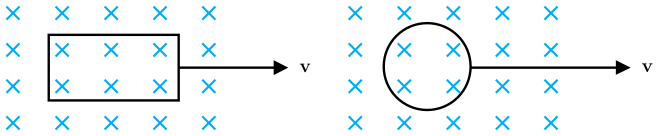
(c) A rectangular loop and a circular loop are moving out of a uniform magnetic field region (Fig. 6.8) to a field-free region with a constant velocity . In which loop do you expect the induced emf to be constant during the passage out of the field region? The field is normal to the loops.
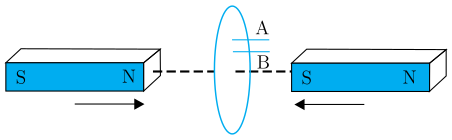
(d) Predict the polarity of the capacitor in the situation described by Fig. 6.9.
CBSENCERTSubjective· 5mImportance★★★★★
10% · 5/50 Questions
You're viewing a preview — the full solution, concept, methods & PYQ mapping are locked.
Start your 14-day free trial to unlock the full solution →Induction needs a changing magnetic flux, so: (a) No — a static field induces nothing however strong;
(b) No current in either case — an electrostatic field's changing electric flux cannot drive a loop current;
(c) the rectangular loop gives a constant emf;
(d) plate A is positive.
Guiding principle. Faraday's law, with , says an emf appears in a loop only when the magnetic flux linked with it changes. An electrostatic field is conservative, , so it can never drive a steady current around a closed loop.
- Stationary loop, stationary magnets.
Nothing moves, so and the loop's area are both fixed and is constant:
Using stronger magnets only raises the (still constant) flux; it does not make it change. No current is generated.
- Loop moving in the constant field of a capacitor.
Between the plates there is only an electric field (electrostatic, uniform); there is no magnetic field, so at every instant and .
- Wholly inside — the loop links no magnetic flux, so no current.
- Partly outside — now the electric flux through the loop does change, but a changing electrostatic flux does not induce a current in a conducting loop; only a changing magnetic flux does. So again there is no current. Hence no current is induced in either position.
- Rectangular vs circular loop leaving the field. With normal to the loops, , where is the area still inside the field.
- Rectangular loop: the edge parallel to has a fixed length , so and is constant — hence is constant while it exits. …
Unlock everything free for 14 days
- Full step-by-step solutions
- Concept-first explanations
- Methods, shortcuts & mistakes
- PYQ mapping + timed mock tests
Full access for 14 days. No credit card required.