Exercises · 11.8
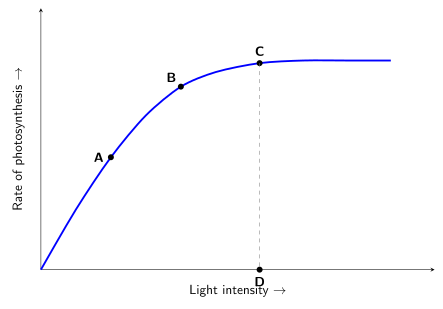
Q.Figure 11.10 shows the effect of light on the rate of photosynthesis. Based on the graph, answer the following questions:
(a) At which point/s (A, B or C) in the curve light is a limiting factor?
(b) What could be the limiting factor/s in region A?
(c) What do C and D represent on the curve?
Chandigarh CbseNCERTSubjective· 4mImportance★★★★★est
13% · 8/63 Questions
You're viewing a preview — the full solution, concept, methods & PYQ mapping are locked.
Start your 14-day free trial to unlock the full solution →On the light-response curve, light limits the rate only on the rising part (A); at the plateau, light is saturated — C marks the maximum (saturated) rate and D marks the light intensity at which saturation is reached.
Figure 11.10 plots the rate of photosynthesis (y-axis) against light intensity (x-axis). The curve rises steeply from the origin, then bends (around B) and flattens into a plateau (C).
- Where is light a limiting factor? Light is a limiting factor at point A, which lies on the initial, ascending part of the curve. Here every increase in light intensity produces a proportional increase in the rate of photosynthesis — a sign that light, being at sub-optimal levels, is the factor limiting the rate. At B and C the curve has levelled off, so light is no longer limiting there.
- Limiting factor in region A. In region A the rate rises in direct (linear) proportion to light intensity, showing that the process is being held back by the amount of light. Therefore the limiting factor in region A is light itself. Other factors (CO2 concentration, temperature) are adequate here and are not limiting.
- What do C and D represent?
- C lies on the flat plateau of the curve. It represents the light-saturation point — the stage at which the rate of photosynthesis has reached its maximum and does not increase further with additional light. Beyond this point, factors other than light (such as CO2 concentration or temperature) become limiting. (Recall that light saturation occurs at only about 10 per cent of full sunlight.) …
Unlock everything free for 14 days
- Full step-by-step solutions
- Concept-first explanations
- Methods, shortcuts & mistakes
- PYQ mapping + timed mock tests
Full access for 14 days. No credit card required.