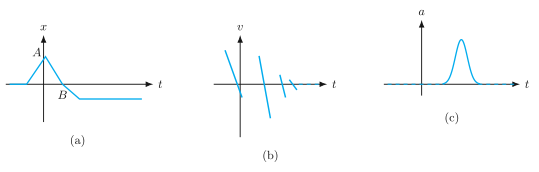
Q.Suggest a suitable physical situation for each of the following graphs (Fig 2.12):
You're viewing a preview — the full solution, concept, methods & PYQ mapping are locked.
Start your 14-day free trial to unlock the full solution →Each graph is the fingerprint of a common motion. Read off what position, velocity or acceleration does with time and name a matching situation: (a) an object thrown up and coming down past its start, (b) a ball bouncing with decreasing speed, and (c) a uniformly moving object hit briefly.
Concept
The three graphs describe the same kind of quantity trio — position, velocity, acceleration — versus time. To 'suggest a physical situation', identify the sign and rate of change in each phase and match it to a real motion whose , or behaves the same way.
(a) Position-time: rise to A, fall to B (below the start)
is zero, then rises (moving in ), reaches a maximum at A (momentarily at the top), then falls, crosses the start level and goes negative to B, then stays constant (at rest).
This matches an object thrown vertically upward from a raised platform (taking upward as with the launch point as origin): it rises to its highest point A, then falls back, passing the launch level and continuing down to the ground at a lower position B, where it comes to rest. (The straight segments are the idealised, uniform-velocity version of such up-and-down motion.)
(b) Velocity-time: reversing saw-tooth with shrinking magnitude
changes linearly (constant slope constant acceleration) during each segment, and at the end of each segment it suddenly reverses sign while its magnitude drops. A sudden velocity reversal is an impact; a constant slope between impacts is free flight under gravity; shrinking magnitude means energy lost per impact.
This matches a ball released and bouncing repeatedly on the floor: between bounces gravity changes its velocity uniformly, at each strike with the ground the velocity reverses direction, and because the collisions are not perfectly elastic the speed after each bounce is smaller.
(c) Acceleration-time: single short positive pulse …
Unlock everything free for 14 days
- Full step-by-step solutions
- Concept-first explanations
- Methods, shortcuts & mistakes
- PYQ mapping + timed mock tests
Full access for 14 days. No credit card required.