Question of 65
Q.Describe phosphorus cycle with diagram.
Chhattisgarh CgbseCGBSE Intermediate Board 2022Subjective· 3mImportance★★★★★
0% · 0/65 Questions
You're viewing a preview — the full solution, concept, methods & PYQ mapping are locked.
Start your 14-day free trial to unlock the full solution →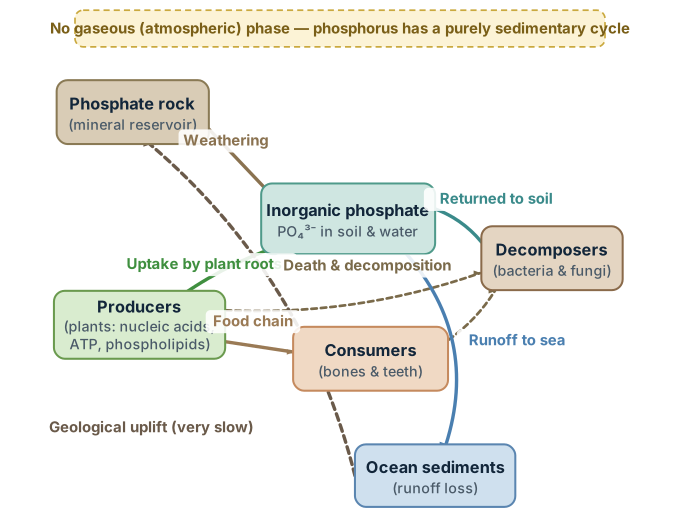
Phosphorus cycles between rocks, soil/water, living organisms and back to sediment, mainly through weathering, absorption, food chains, and decomposition — it is a sedimentary (not gaseous) cycle.
Phosphorus Cycle:
Reservoir: The main reservoir of phosphorus is rock (phosphate-containing minerals such as apatite), unlike carbon/nitrogen which have large atmospheric reservoirs. Hence phosphorus cycling is called a sedimentary cycle.
Steps:
- Weathering of rocks: Phosphorus is released from phosphate rocks by weathering, entering the soil as inorganic phosphate (PO4 3-).
- Uptake by plants: Plants absorb phosphate ions from the soil through their roots and incorporate them into organic compounds (e.g., nucleic acids, ATP, phospholipids).
- Transfer through food chain: Herbivores obtain phosphorus by eating plants, and carnivores obtain it by eating herbivores — phosphorus thus moves up the food chain.
- Return via decomposition: When plants and animals die, decomposers (bacteria and fungi) break down their organic matter, releasing phosphate back into the soil.
- Loss to sediments: Some phosphate is washed by rain/rivers into the sea, where it may be deposited as sediment on the ocean floor, eventually forming new phosphate rock over geological time — completing the (very slow) cycle. …
Unlock everything free for 14 days
- Full step-by-step solutions
- Concept-first explanations
- Methods, shortcuts & mistakes
- PYQ mapping + timed mock tests
Full access for 14 days. No credit card required.