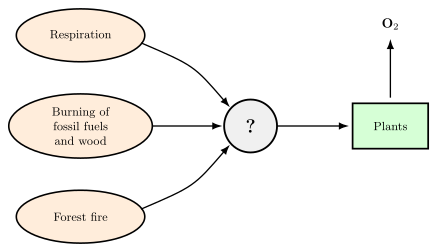
Q.The following diagram shows a simplified biogeochemical cycle: three ovals labelled 'Respiration', 'Burning of fossil fuels and wood', and 'Forest fire' each have an arrow pointing into a circle marked '?'; from that '?' circle an arrow points to a box labelled 'Plants', and from 'Plants' an arrow points upward to 'O2'. i) Name the compound whose cycle is shown in the above diagram. ii) What adverse effect does its excess amount cause on environment? iii) Suggest two ways of reducing its effect.
You're viewing a preview — the full solution, concept, methods & PYQ mapping are locked.
Start your 14-day free trial to unlock the full solution →The diagram shows the carbon cycle — respiration, burning of fossil fuels/wood, and forest fires all release CO2, which plants take up in photosynthesis and release O2 in return; excess CO2 causes global warming, and cutting fossil-fuel use plus afforestation reduce its build-up.
(i) Identifying the compound: All three source boxes shown — respiration (by living organisms), burning of fossil fuels and wood, and forest fires — are processes that release carbon dioxide (CO2) into the atmosphere. The diagram then shows this gas being taken up by Plants (via photosynthesis) and O2 being released — exactly matching how green plants use CO2 as a raw material for photosynthesis and release O2 as a by-product. So the compound represented by the '?' is carbon dioxide (CO2), and the diagram is a simplified version of the carbon biogeochemical cycle.
…
Unlock everything free for 14 days
- Full step-by-step solutions
- Concept-first explanations
- Methods, shortcuts & mistakes
- PYQ mapping + timed mock tests
Full access for 14 days. No credit card required.