Q.How is sex determined in honeybee? Explain with ray diagram.
You're viewing a preview — the full solution, concept, methods & PYQ mapping are locked.
Start your 14-day free trial to unlock the full solution →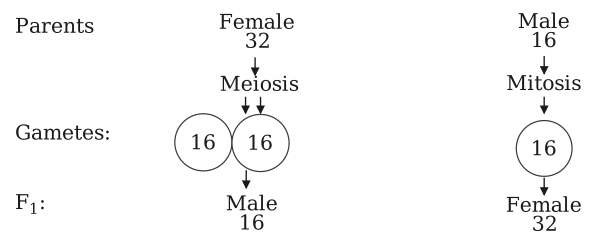
Honeybees show the haplodiploid sex-determination system: diploid (fertilised) eggs -> females; haploid (unfertilised) eggs -> males (drones), via parthenogenesis.
Unlike humans (XX-XY system), honeybees (Apis) do not have sex chromosomes at all. Instead, sex is determined by the number of chromosome sets (ploidy) an individual has, a system called haplodiploidy:
-
The queen bee mates with drones and stores the sperm. When she lays a fertilised egg (which receives one set of chromosomes from the queen and one set from the stored sperm, i.e., it is diploid, with 32 chromosomes), that egg develops into a female — either a worker (sterile female) or, if fed royal jelly, into a new queen (fertile female).
-
When the queen lays an unfertilised egg (containing only her own chromosome set, i.e., haploid, with 16 chromosomes), that egg develops by parthenogenesis (development without fertilisation) into a male — the drone.
Ray diagram (described, since it cannot be drawn here):
            Queen (diploid, 32) x Drone (haploid, 16, via meiosis -> sperm)
                          |
            -----------------------------
            |                           |
     Fertilised egg (32, diploid)   Unfertilised egg (16, haploid)
            |                           |
        Female                        Male …
Unlock everything free for 14 days
- Full step-by-step solutions
- Concept-first explanations
- Methods, shortcuts & mistakes
- PYQ mapping + timed mock tests
Full access for 14 days. No credit card required.