Q.Write the name and truth table of logic gate showing Boolean equation Y = \overline{A+B}.
🔒You're viewing a preview — the full solution, concept, methods & PYQ mapping are locked.
🔒 Start your 14-day free trial to unlock the full solution →Concept understanding — NOR Gate
The NOR Gate: "Not OR"
Imagine you're at home with a friend. Your parent says: "I'll turn off the Wi-Fi if neither of you has finished homework." That's a NOR gate in real life. The Wi-Fi stays on (output = 1) only when both of you have finished homework (both inputs = 0). If even one person hasn't finished, the Wi-Fi goes off.
That's the core idea: NOR gives a 1 only when every single input is 0. The moment any input becomes 1, the output drops to 0.
From OR to NOR
You already know the OR gate: output is 1 if at least one input is 1. The NOR gate is simply an OR gate followed by a NOT gate (inverter). The name itself tells you: Not OR.
Y=A+B
For two inputs A and B, the truth table is:
| A | B | A + B (OR) | A+B (NOR) |
|---|---|---|---|
| 0 | 0 | 0 | 1 |
| 0 | 1 | 1 | 0 |
| 1 | 0 | 1 | 0 |
| 1 | 1 | 1 | 0 |
Notice the pattern: the NOR column is the exact opposite of the OR column. Where OR gives 1, NOR gives 0 — and vice versa.
The precise statement
A NOR gate outputs 1 only when all its inputs are 0. For any other combination of inputs, the output is 0.
For n inputs, the output is 1 if and only if every input is 0. That's the complete, exam-ready definition.
Why "universal gate"?
NOR is one of two universal gates (the other is NAND). This means you can build any logic gate — AND, OR, NOT, XOR — using only NOR gates. For example:
- NOT from NOR: connect both inputs together. Y=A+A=A
- OR from NOR: NOR followed by a NOT (which is another NOR with tied inputs). Y=A+B=A+B
- AND from NOR: use De Morgan's law: A+B=A⋅B, so A⋅B=A+B
In exam problems, if you're asked to implement a circuit using only NOR gates, remember: NOR is OR followed by NOT. To get OR back, just add another NOR as a NOT at the end.
Common mistake to avoid …
Reading the given Boolean expression as 'first OR the inputs together, then invert the result' identifies exactly which gate it represents and lets its truth table be built directly from that rule. …
Y=A+B is the Boolean expression for a NOR gate — an OR gate followed by a NOT (inverter).
The Boolean expression Y=A+B means: first take the OR of inputs A and B, then invert (complement) the result. A gate performing this operation is called a NOR gate, realised by an OR gate followed by a NOT gate.
Truth table:
| A | B | A+B | Y = A+B |
|---|---|---|---|
| 0 | 0 | 0 | 1 |
| 0 | 1 | 1 | 0 |
- CBSE 2024Set ANNUAL1 markQ.Draw the circuit symbol of a NOR gate.
›Reveal solutionSolution
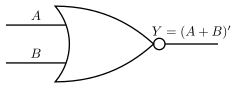
Figure — Standard 2-input NOR gate logic symbol NOR = OR + NOT, so its symbol is the OR-gate shape with an inversion bubble at the output.
The NOR gate performs the Boolean operation Y = (A + B)' — it is an OR gate followed by an inverter (NOT gate). Its standard circuit (logic) symbol is therefore built from the OR-gate symbol:
- Two inputs A and B enter from the left into a shape with a curved (concave) back and a curved, pointed front — exactly the standard OR-gate shape.
- A small circle (the 'inversion bubble') is drawn at the pointed output tip.
- The single output Y is taken from beyond this bubble. …
- CBSE 2021Set A1 markMCQQ.Boolean expression for NOR gate is (A) A + B = Y (B) ‾(A.B) = Y (C) A . B = Y (D) ‾(A + B) = Y
›Reveal solutionSolution
NOR = NOT of OR, so Y = ‾(A + B).
The OR operation is written A + B. A NOR gate inverts this output, so its Boolean expression is:
Y=A+B
…
- CBSE 2020Set ANNUAL1 markQ.Draw logic symbol of NOR gate.
›Reveal solutionSolution
A NOR gate is drawn as an OR gate symbol with a small inversion bubble (circle) at its output — it performs OR then NOT.
The standard logic symbol: two inputs A, B enter a curved-back, pointed OR-gate shape; a small circle is placed at the tip (output) of the gate to denote inversion. Boolean expression: Y=A+B.
Truth table:
A=0,B=0 → Y=1 …
- CBSE 2020Set ANNUAL1 markQ.Draw the logic symbol of NOR gate.
›Reveal solutionSolution
NOR = OR + NOT: draw the OR-gate symbol (curved-back, pointed-nose shape) with a bubble at the output; output Y=A+B.
Concept. A NOR gate gives output 1 only when all inputs are 0; it is the OR gate with its output inverted.
The logic symbol (description).
- Two input lines A and B enter the flat/curved back of an OR-gate shape.
- The body is the OR-gate shape: a concave (curved) input side tapering to a pointed output nose. …
- CBSE 2019Set ANNUAL1 markMCQQ.Figure shows the symbolic representation of (i)(OR)gate(ii) NAND gate(iii) NOR gate(iv) NOT gate
›Reveal solutionSolution
A curved-back OR-gate-shaped symbol with a small inversion bubble on its output is the standard symbol for a NOR gate.
Logic gate symbols are identified by their body shape plus the presence/absence of an output bubble:
- A curved (concave) back with a pointed front = OR-gate body (output HIGH if A OR B is HIGH).
- A flat back with a rounded/D-shaped front = AND-gate body.
- A small circle (bubble) on the output line means the output is inverted/complemented relative to the plain gate. …
- CBSE 2016Set ANNUAL1 markQ.Draw the symbol for the NOR gate.
›Reveal solutionSolution
NOR = OR gate symbol + a small inversion bubble at the output.
A NOR gate is a NOT-OR gate: it performs the OR operation on its inputs and then inverts (complements) the result, so its output is HIGH only when all inputs are LOW.
Symbol (described): it is drawn exactly like the standard 2-input OR gate — a shield-like body with a concave (curved-in) input side where the two input lines A and B enter, and a pointed, curved output side — but with a small circle ('bubble') placed at the pointed output tip. This bubble is the standard logic-symbol convention for inversion/complementation, distinguishing NOR from a plain OR gate.
…
🎓Unlock everything free for 14 days
- ✓Full step-by-step solutions
- ✓Concept-first explanations
- ✓Methods, shortcuts & mistakes
- ✓PYQ mapping + timed mock tests
Full access for 14 days. No credit card required.