Q.Derive the structure of
You're viewing a preview — the full solution, concept, methods & PYQ mapping are locked.
Start your 14-day free trial to unlock the full solution →Draw the parent carbon chain or ring first, number it according to IUPAC rules (lowest locants for substituents/functional groups), then attach substituents and functional groups at the specified positions. The five structures are systematically built from their names.
The IUPAC name of an organic compound is a complete blueprint: it tells you the carbon skeleton, where to number from, and exactly where each functional group and substituent sits. The art lies in translating that name into a structural formula by following a disciplined sequence.
The general strategy:
- Identify the parent chain or ring (the root word: hex = 6 carbons, pent = 5, cyclohex = 6-membered ring).
- Identify the principal functional group (suffix: -ane = alkane, -en = alkene, -ol = alcohol, -al = aldehyde) and any substituents (prefixes: chloro, nitro, hydroxy).
- Number the chain to give the principal functional group (or multiple bond, or substituent) the lowest possible locant.
- Attach everything at the positions indicated by the numbers.
Let's build each structure.
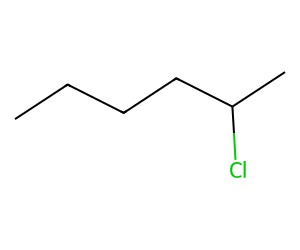
(i) 2-Chlorohexane
Parent: Hexane → 6-carbon saturated chain.
Substituent: Chloro at position 2.
- Draw a straight chain of 6 carbons:
-
Number from either end; we choose left-to-right as 1 through 6.
-
Attach to carbon 2:
Structure:
(ii) Pent-4-en-2-ol
Parent: Pent = 5 carbons.
Functional groups: -en (double bond at position 4), -ol (hydroxyl at position 2).
- Draw a 5-carbon chain:
-
The principal functional group is the alcohol (), so numbering must give it the lowest locant. Number from the end that puts at carbon 2.
-
Place at carbon 2 and a double bond between carbons 4 and 5:
Structure:
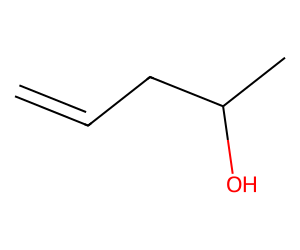
Students often number from the wrong end. The principal functional group (here, ) takes priority over the double bond when assigning locants.
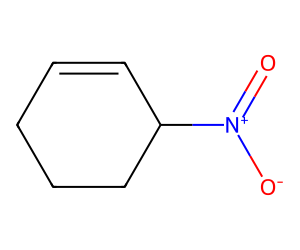
(iii) 3-Nitrocyclohexene
Parent: Cyclohexene → 6-membered ring with one double bond.
Substituent: Nitro () at position 3.
-
Draw a cyclohexane ring with one double bond. By convention, the double bond is between carbons 1 and 2 (cyclohex-1-ene is implied when no locant is given for the double bond in older nomenclature, but modern IUPAC would write cyclohex-1-ene; here "cyclohexene" implies the double bond starts at C1).
-
Number the ring so that the double bond gets the lowest locants: C1–C2 contains the double bond.
-
Attach at carbon 3.
Structure:
Or in a more standard depiction:
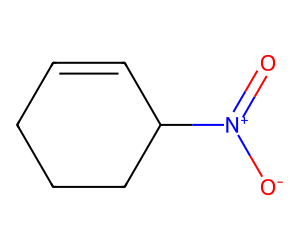
(The double bond is between C1 and C2; nitro group is on C3.)
(iv) Cyclohex-2-en-1-ol
Parent: Cyclohexene → 6-membered ring with one double bond.
Functional groups: -en (double bond at position 2), -ol (hydroxyl at position 1).
- Draw a 6-membered ring. …
Unlock everything free for 14 days
- Full step-by-step solutions
- Concept-first explanations
- Methods, shortcuts & mistakes
- PYQ mapping + timed mock tests
Full access for 14 days. No credit card required.