Q.What would be the per cent growth or birth rate per individual per hour for the same population mentioned in the previous question (Question 10)?
Concept understanding — Exponential Growth Rate
Exponential Growth Rate
A quantity grows exponentially when its rate of change is proportional to its current size: the more there is, the faster it grows. This differs sharply from linear growth, where a fixed amount is added each step. In exponential growth the quantity multiplies by the same factor over equal time intervals.
The differential equation
Let y(t) be the quantity and k>0 the proportionality constant. The rate law "rate of change proportional to the current amount" becomes
dtdy=ky.
This is a separable equation. Integrating,
∫ydy=∫kdt⟹log∣y∣=kt+C⟹y=y0ekt,
where y0=y(0) is the starting value. The constant k is the growth rate: a larger k means faster growth. (If k<0, the very same equation describes exponential decay.)
Reading the growth rate
Over each unit of time, y is multiplied by ek. So if the quantity doubles every unit of time, then ek=2, giving k=log2. This is how a stated doubling time is converted into the constant k.
Linear growth adds the same amount each step; exponential growth multiplies by the same factor. That is why an exponential quantity looks slow at first and then climbs steeply — the increase itself keeps getting bigger.
Where it appears
Population growth with unlimited resources, money under continuous compound interest, and the early stage of a spreading process all obey dtdy=ky, and therefore follow y=y0ekt. In each case the same single constant k controls how quickly the quantity multiplies.
Exponential growth and decay problems (population growth, radioactive decay, compound interest) are standard application questions in the NCERT Class 12 Differential Equations chapter, and "exponential growth rate formula class 12" is a frequently searched topic ahead of CBSE boards and JEE Main. Recognising the pattern dy/dt = ky quickly is what separates a fast solve from a slow one in exam conditions.
The per cent growth (birth) rate per individual is found by dividing the population's absolute increase by its STARTING size, then converting to a percentage -- not by the final size, and not by inventing a different pair of numbers.
From the previous question, the Paramoecium population grew from 50 to 150 in one hour, an absolute increase of $150 - 50 = 100$ individuals per hour.
$$\text{Per cent growth rate per individual} = \frac{\text{increase}}{\text{initial population}} \times 100$$
$$= \frac{100}{50} \times 100 = 200%$$
The per cent growth (birth) rate per individual per hour is 200, which corresponds to option (b).
The per capita growth (birth) rate is 200 per cent per individual per hour — option (B).
In Question 10 a population of 50 Paramoecium grew to 150 in one hour, so the population growth rate is
$$150 - 50 = 100 \text{ individuals per hour.}$$
The per cent growth (birth) rate per individual divides that increase by the starting population:
$$\frac{\text{individuals added}}{\text{initial population}} = \frac{100}{50} = 2 \text{ per individual per hour} = 200%.$$
The 100-per-hour figure from Question 10 is a whole-population rate; scaling it by the initial number present (50) converts it to a per-individual rate — 2 new individuals per existing individual, i.e. 200 per cent.
(B) 200 — the per cent growth/birth rate per individual per hour is $100 / 50 = 2 = 200%$.
Take the SAME absolute increase computed in the previous question and divide it by the STARTING population, not the final one, before converting to a percentage -- dividing by the wrong reference population is the most common slip on this type of question.
- GUJCET 2026Set 051 markMCQQ.In a forest, there are initially 100 deer. Over a certain period 30 are born and 10 die. Assuming food is abundant and predators are few. Calculate the intrinsic rate of natural increase for that population. (A) 0.4 (B) 0.18 (C) 0.2 (D) 0.015
›Reveal solutionSolution
Intrinsic rate r = per-capita birth rate − per-capita death rate.
Starting population N = 100, births B = 30, deaths D = 10. The intrinsic rate of natural increase is the per-capita difference: r=NB−D=10030−10=10020=0.2.
✓Final answerOption (C) 0.2
ANSWER: (C)
- GSEB Higher Secondary Certificate (HSC) Examination 2026Set ANNUAL1 markMCQQ.Choose the correct equation of Exponential Growth.(a) dN/dt = rN(b) dT/dN = rN(c) dN/dt = rN [(K - N)/N](d) dN/dt = rN [(N - K)/K]
›Reveal solutionSolution
Exponential growth occurs when resources are unlimited, giving the simple growth equation dN/dt = rN.
When resources (food, space) in a habitat are unlimited, a population grows exponentially, described by dN/dt = rN, where N is population size, t is time, and r is the intrinsic rate of natural increase. This produces a J-shaped growth curve. In contrast, dN/dt = rN[(K-N)/K] describes logistic growth under limited/resource-constrained conditions (K = carrying capacity), giving an S-shaped curve - the other listed options are not the standard correctly-written growth equations.
✓Final answer(a) dN/dt = rN.
- GSEB Higher Secondary Certificate (HSC) Examination 2025Set ANNUAL1 markMCQQ.Which is the correct equation for the Verhulst-Pearl logistic growth model?(a) dN/dt = (d - b) N(b) dN/dt = rN (K / (K - N))(c) dN/dt = (b - d) N(d) dN/dt = rN ((K - N) / K)
›Reveal solutionSolution
The Verhulst-Pearl logistic growth equation models population growth that slows as it approaches the carrying capacity K.
Unlike exponential growth (dN/dt = rN), the logistic model accounts for limited resources: as population size N approaches the carrying capacity K, growth rate slows and eventually stops. The equation is dN/dt = rN[(K − N)/K], where the factor (K − N)/K approaches 1 when N is small (near-exponential growth) and approaches 0 as N approaches K (growth levels off), producing the characteristic sigmoid (S-shaped) growth curve.
✓Final answer(d) dN/dt = rN ((K - N) / K).
- GSEB Higher Secondary Certificate (HSC) Examination 2024Set ANNUAL1 markMCQQ.Which of the following is correct equation for Verhulst Pearl Logistic growth?(a) dN/dt = rN(b) Nt = N0 e^rt(c) dN/dt = rN (K - N)/K(d) dN/dt = rN K/(K - N)
›Reveal solutionSolution
The logistic (Verhulst-Pearl) growth model describes population growth that slows as it approaches the environment's carrying capacity K, captured by the equation dN/dt = rN(K-N)/K.
Unlike exponential growth (dN/dt = rN, or Nt = N0.e^rt), which assumes unlimited resources and grows indefinitely, the logistic model recognises that resources are always finite. It introduces the carrying capacity K — the maximum population size an environment can sustain — and the term (K-N)/K acts as a brake: when N is small relative to K, this term is close to 1 and growth is nearly exponential, but as N approaches K, the term approaches 0 and growth rate slows to zero, producing the characteristic S-shaped (sigmoid) growth curve seen in most natural populations with resource limits.
✓Final answer(c) dN/dt = rN (K - N)/K.
- GSEB Higher Secondary Certificate (HSC) Examination 2022Set ANNUAL1 markMCQQ.When reactions do not limit growth, the graph is ..............(a) 'S' shaped(b) 'J' shaped(c) 'L' shaped(d) 'K' shaped
›Reveal solutionSolution
When resources (food, space) are not limiting, a population grows exponentially, producing a 'J'-shaped growth curve.
Population growth follows two idealised models: exponential growth, which occurs when resources in the environment are unlimited, allowing the population to grow at its maximum intrinsic rate (dN/dt = rN) without any environmental resistance — plotted, this produces a 'J'-shaped curve that keeps rising steeply. In contrast, when resources become limiting, growth slows as the population approaches the carrying capacity (K) of the environment, producing an 'S'-shaped (sigmoid) logistic growth curve instead.
✓Final answer(b) 'J' shaped.
- GUJCET 2021Set 151 markMCQQ.Logistic Growth is expressed by which of the following equation? (A) dN/dt=rN(KK−N) (B) dN/dt=rN (C) Nt=Noert (D) dN/dt=N(KK−N)
›Reveal solutionSolution
Logistic growth includes the carrying-capacity term (K-N)/K.
Concept. dtdN=rN(KK−N) describes density-dependent (logistic) growth.
Solution. Correct equation: dN/dt=rN(KK−N).
✓Final answer(A) dN/dt=rN(KK−N)
ANSWER: (A)
- GSEB Higher Secondary Certificate (HSC) Examination 2019Set ANNUAL1 markMCQQ.What does 'X' represent in the given diagram?(a) Logarithmic phase(b) Negative Acceleration(c) Positive Acceleration(d) Fluctuation in population
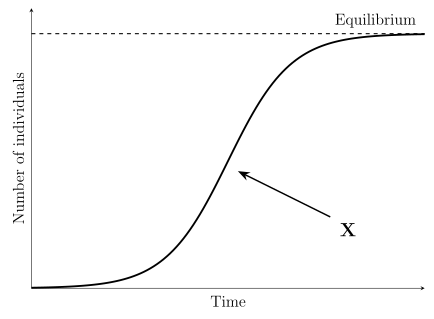
›Reveal solutionSolution
The steep, rapidly rising middle segment of a sigmoid (S-shaped) growth curve is the logarithmic/exponential growth phase, before growth slows and levels off at carrying capacity.
When a population grows in a habitat with limited resources, it follows a sigmoid (verhulst-pearl logistic) growth curve with three broad phases: an initial lag phase (slow start), a steep logarithmic/exponential phase where numbers rise rapidly because resources are still abundant, and a final plateau where growth rate falls to near zero as the population approaches the carrying capacity (K) of the environment. The point marked X, on the steeply rising middle portion before the curve flattens toward "Equilibrium", corresponds to this logarithmic growth phase.
✓Final answer(a) Logarithmic phase.
🎓Unlock everything free for 14 days
- ✓Full step-by-step solutions
- ✓Concept-first explanations
- ✓Methods, shortcuts & mistakes
- ✓PYQ mapping + timed mock tests
Full access for 14 days. No credit card required.