Question of 90
Q.Draw the labelled diagram of typical anatropous ovule.
Gujarat GsebGSEB Higher Secondary Certificate (HSC) Examination 2024Subjective· 2mImportance★★★★★
0% · 0/90 Questions
You're viewing a preview — the full solution, concept, methods & PYQ mapping are locked.
Start your 14-day free trial to unlock the full solution →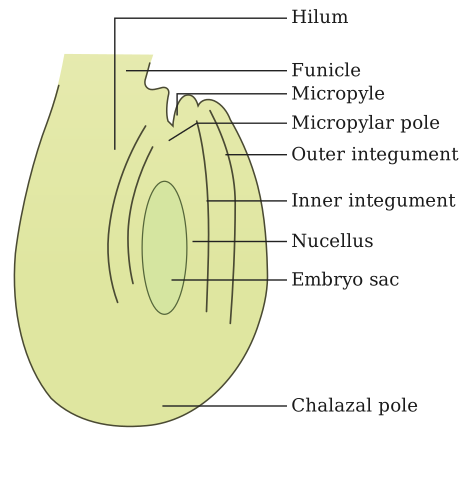
The anatropous ovule is the most common ovule type in flowering plants, distinguished by its whole body being inverted and fused along its length to the funicle, so the micropyle ends up pointing back toward the funicle's base.
Since this answer is delivered as text, the labelled diagram is described precisely below so it can be reproduced with all required labels:
- Funicle: the stalk attaching the ovule to the placenta; in the anatropous type, it runs along the entire length of the ovule body, fused to it.
- Hilum: the point where the funicle joins the body of the ovule (the point of attachment).
- Raphe: the fused portion of the funicle that runs along the ovule's body (a ridge visible along the length of the ovule), a distinguishing feature of the anatropous type.
- Chalaza: the basal part of the ovule opposite the micropyle, where the integuments and nucellus merge; in the anatropous ovule this lies at the end nearer the stalk's origin.
- Integuments: the outer protective layer(s) around the nucellus, which will develop into the seed coat after fertilisation. …
Unlock everything free for 14 days
- Full step-by-step solutions
- Concept-first explanations
- Methods, shortcuts & mistakes
- PYQ mapping + timed mock tests
Full access for 14 days. No credit card required.