Question of 90
Q.Describe, with a labelled diagram, the structure of a typical anatropous ovule of an angiosperm.
Gujarat GsebGSEB Higher Secondary Certificate (HSC) Examination 2025Subjective· 4mImportance★★★★★
0% · 0/90 Questions
You're viewing a preview — the full solution, concept, methods & PYQ mapping are locked.
Start your 14-day free trial to unlock the full solution →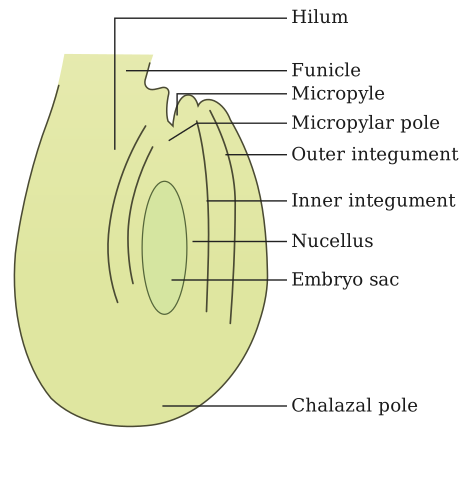
Anatropous is the commonest ovule type, in which the ovule body is inverted through 180° so that the micropyle points back toward the funicle.
Structure of a typical anatropous ovule (labelled description):
- Funicle — the stalk that attaches the ovule to the placenta.
- Hilum — the point/region where the funicle joins the body of the ovule.
- Because the ovule is anatropous (inverted), the body of the ovule bends around during development so that it becomes almost parallel to the funicle; the funicle then appears fused along one side of the ovule body, and this fused ridge is called the raphe.
- Micropyle — a small pore/opening at one end of the ovule (formed by the integuments), positioned close to the funicle (because of the inversion) and lying near the hilum; it is the point of pollen tube entry into the ovule.
- Integuments — one or two protective envelope layers surrounding the nucellus, which do not cover the extreme tip (leaving the micropylar pore).
- Nucellus — the mass of tissue enclosed by the integuments; it contains the megaspore mother cell and, later, the embryo sac.
- Chalaza — the basal region of the ovule, at the point opposite the micropyle, where the integuments and nucellus are joined. …
Unlock everything free for 14 days
- Full step-by-step solutions
- Concept-first explanations
- Methods, shortcuts & mistakes
- PYQ mapping + timed mock tests
Full access for 14 days. No credit card required.