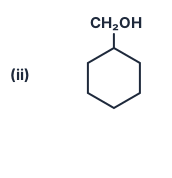
Q.Show how are the following alcohols prepared by the reaction of a suitable Grignard reagent on methanal?
Concept understanding — Williamson Ether Synthesis
Williamson Ether Synthesis: From Intuition to Mechanism
Imagine you want to build a simple bridge between two carbon chains — an oxygen atom linking them together. That bridge is an ether (R−O−R′). The Williamson ether synthesis is the most reliable way to build that bridge in a lab.
The Core Idea
You have two pieces: an alkoxide ion (RO−) and an alkyl halide (R′X). The alkoxide is a strong nucleophile — it loves positive charge. The alkyl halide has a carbon attached to a halogen (like Cl, Br, I) that is slightly positive because the halogen pulls electrons away.
When you mix them, the alkoxide attacks that slightly positive carbon, kicks out the halide ion, and forms a new C−O bond. The result? An ether.
R−O−+R′−X⟶R−O−R′+X−
That's the entire reaction in one line. But the devil is in the details — especially which alkyl halide you choose.
The Mechanism (SN2)
This is a classic SN2 reaction — one step, no intermediates. The alkoxide approaches the carbon from the opposite side of the halogen. As the C−O bond forms, the C−X bond breaks. The halide leaves as a stable anion.
Because it's SN2, the reaction is sensitive to steric hindrance. The carbon being attacked must be accessible.
If the alkyl halide is tertiary (3°), the reaction will not work via SN2. The bulky carbon blocks the backside attack. Instead, the alkoxide will act as a base and cause elimination (forming an alkene). You'll get no ether.
The Practical Rule
| Alkyl halide | Works? | Why |
|---|---|---|
| Methyl (CH3X) | Yes | Least hindered, fastest SN2 |
| Primary (1°) | Yes | Clean SN2 |
| Secondary (2°) | Sometimes | Works if not too bulky; elimination competes |
| Tertiary (3°) | No | Elimination dominates |
| Aryl (e.g., bromobenzene) | No | SN2 impossible on sp2 carbon |
To make an ether like R−O−R′, always use the less hindered alkyl halide and the more hindered alkoxide. For example, to make CH3CH2−O−CH(CH3)2, use CH3CH2O− (primary alkoxide) + (CH3)2CHBr (secondary halide) — not the other way around.
How to Choose the Alkoxide
You can't just buy alkoxide ions in a bottle. You make them by reacting an alcohol with a strong base like sodium hydride (NaH) or sodium metal.
ROH+NaH⟶RO−Na++H2
The alkoxide is then used immediately with the alkyl halide.
A Common Exam Trap
Students often try to make an ether by reacting two alcohols together. That doesn't work directly — you need one alcohol to become the nucleophile (alkoxide) and the other to become the electrophile (alkyl halide). The Williamson synthesis is asymmetric by design.
The Big Picture
Williamson ether synthesis is the go-to method for making unsymmetrical ethers (R−O−R′ where R=R′). It's reliable, high-yielding, and conceptually clean — as long as you respect the SN2 mechanism and avoid tertiary halides.
The one-line takeaway: An alkoxide attacks an alkyl halide in an SN2 reaction to form an ether — but only if the halide is primary or methyl.
Williamson ether synthesis is the standard method for making ethers, taught in the NCERT/CBSE Class 12 Chemistry chapter on Alcohols, Phenols and Ethers, and ‘Williamson synthesis mechanism’ or ‘Williamson ether synthesis limitations’ are frequently searched important-question topics for board exams, JEE Main and NEET. Knowing why tertiary halides fail in this SN2-based reaction is a common distinguishing question in competitive organic chemistry exams.
Why this formula?
Williamson Ether Synthesis: Why the Key Principles Hold
The Williamson Ether Synthesis is a classic method to prepare ethers. The core reaction is:
R-O−+R’-X→R-O-R’+X−
Where:
- R-O− is an alkoxide ion (strong nucleophile)
- R’-X is an alkyl halide (electrophile)
- X− is a halide ion (leaving group)
Let's break down why this works — the reasoning behind the key principles.
1. Why an Alkoxide (Not an Alcohol) is Needed
The Problem with Alcohols
Alcohols (R-OH) are weak nucleophiles. The oxygen has a partial negative charge, but the O–H bond is strong. If you mix an alcohol with an alkyl halide, the reaction is extremely slow or doesn't happen at all.
The Solution: Deprotonation
By treating the alcohol with a strong base (like NaH, Na, or KOH), you remove the proton:
R-OH+NaH→R-O−Na++H2
The alkoxide ion (R-O−) has a full negative charge on oxygen. This makes it:
- A much stronger nucleophile (higher electron density)
- More reactive toward the electrophilic carbon in the alkyl halide
Key takeaway: The alkoxide's full negative charge is what drives the reaction — it's not just about having oxygen, but about having a charged, electron-rich oxygen.
2. Why the Alkyl Halide Must Be Primary (or Methyl)
The Mechanism: SN2 is the Only Path
The Williamson synthesis proceeds exclusively via an SN2 mechanism (bimolecular nucleophilic substitution). This means:
- The nucleophile attacks the carbon from the backside
- The leaving group departs from the opposite side
- The reaction is concerted (one step, no intermediates)
Why Primary Halides Work Best
In SN2 reactions, the rate depends on steric hindrance:
| Alkyl Halide Type | Steric Hindrance | SN2 Reactivity |
|---|---|---|
| Methyl (CH3X) | Minimal | Very fast |
| Primary (RCH2X) | Low | Fast |
| Secondary (R2CHX) | Moderate | Slow |
| Tertiary (R3CX) | High | Does not occur |
Why Tertiary Halides Fail
With a tertiary halide, the bulky alkyl groups block the backside attack. Instead, the alkoxide (a strong base) will eliminate a proton from the halide, forming an alkene:
R-O−+R’3C-X→R-OH+alkene+X−
This is an E2 elimination — not the desired ether formation.
Key takeaway: The Williamson synthesis works only when the alkyl halide is primary or methyl because SN2 requires an unhindered backside.
3. Why the Leaving Group Must Be Good
The Role of the Halide
The halide (X−) must be a good leaving group — meaning it can stabilize the negative charge after departure.
| Halide | Leaving Group Ability | Reason |
|---|---|---|
| I− | Excellent | Large, polarizable, weak base |
| Br− | Good | Moderate size, weak base |
| Cl− | Fair | Smaller, stronger base |
| F− | Poor | Small, strong base, holds tightly |
Why Fluoride Fails
Fluoride is a strong base and a poor leaving group. The C–F bond is very strong, and F− does not depart easily. So alkyl fluorides are unreactive in Williamson synthesis.
Key takeaway: The leaving group must be weakly basic and polarizable — iodide and bromide are ideal.
4. Why the Alkoxide Must Be the Nucleophile (Not the Halide)
The "Wrong Way" Problem
If you try to use an alcohol as the nucleophile and an alkoxide as the leaving group, it won't work. Why?
- The alkoxide is a stronger base than the halide
- The halide is a better leaving group than the alkoxide
So the reaction is irreversible in the direction shown:
R-O−+R’-X→R-O-R’+X−
The reverse reaction (where X− attacks the ether) would require X− to be a nucleophile and R-O− to be a leaving group — but R-O− is a terrible leaving group (strong base).
Key takeaway: The reaction is driven by the difference in leaving group ability — halides leave easily, alkoxides do not.
Summary: The Three Pillars of Williamson Ether Synthesis
- Strong nucleophile (alkoxide, not alcohol) — full negative charge on oxygen
- Unhindered electrophile (primary or methyl halide) — SN2 requires backside access
- Good leaving group (iodide, bromide, or chloride) — halide must depart easily
If any of these conditions is violated, the reaction fails or gives elimination products.
Quick Exam Tip
When asked "Why does Williamson synthesis fail with tertiary halides?" — never say "because it's bulky." Say:
"Tertiary halides undergo E2 elimination instead of SN2 because the alkoxide acts as a strong base and the steric hindrance prevents backside attack."
This shows you understand the competition between substitution and elimination — a common exam trap.
Concept: Grignard reagents react with methanal (formaldehyde) to give primary alcohols after hydrolysis. The Grignard reagent supplies the alkyl group that attaches to the carbonyl carbon, and the —CH₂OH group comes from the formaldehyde.
Reasoning:
- Methanal has the structure H–CHO. A Grignard reagent R–MgX adds to the carbonyl, forming an alkoxide intermediate.
- Acidic hydrolysis (H₃O⁺) converts the alkoxide to the primary alcohol R–CH₂OH.
- To get a specific alcohol, choose the Grignard reagent with the same R group as the alkyl part of the alcohol.
For (i) CH3−CH(CH3)−CH2OH (2-methylpropan-1-ol): removing the −CH2OH unit leaves CH3−CH(CH3)−, the isopropyl group. Use isopropylmagnesium bromide with methanal.
For (ii) C6H11−CH2OH (cyclohexylmethanol): The alkyl group is cyclohexyl (C6H11−). Use cyclohexylmagnesium bromide with methanal.
- Use isopropylmagnesium bromide, (CH3)2CH−MgBr, with methanal;
- Use cyclohexylmagnesium bromide with methanal.
Grignard reagents react with methanal (formaldehyde) to give primary alcohols with one extra carbon. For (i) the alcohol is 2-methylpropan-1-ol, so the Grignard is isopropylmagnesium halide. For (ii) cyclohexylmethanol comes from cyclohexylmagnesium halide reacting with methanal.
This is a classic application of the Grignard reaction with formaldehyde. The key idea: methanal (HCHO) has no alkyl groups attached to the carbonyl carbon. When a Grignard reagent (RMgX) attacks it, the product after hydrolysis is always a primary alcohol with the structure R–CH₂OH — that is, the R group from the Grignard ends up attached to the –CH₂OH unit.
So to prepare a given primary alcohol of the form R–CH₂OH, you simply need the Grignard reagent R–MgX. The problem gives you the alcohol and asks you to work backwards to find the suitable Grignard.
Let’s do each one.
1. For alcohol (i): CH3−CH(CH3)−CH2OH
This is 2-methylpropan-1-ol. Write it as R–CH₂OH. Here R is the group attached to the –CH₂OH carbon. Remove the –CH₂OH part: the remaining group is CH3−CH(CH3)− (isopropyl group). So R = isopropyl.
Therefore the Grignard reagent needed is isopropylmagnesium halide: (CH3)2CH−MgX (where X = Cl, Br, or I). The reaction:
(CH3)2CH−MgX+HCHO1.ether,2.H3O+(CH3)2CH−CH2OH
Always check the carbon count: methanal contributes one carbon. The Grignard's R group has the same number of carbons as the alcohol minus one. Here the alcohol has 4 carbons, so the Grignard's R has 3 carbons — indeed isopropyl is C₃.
2. For alcohol (ii): C6H11−CH2OH (cyclohexylmethanol)
Here the –CH₂OH is attached to a cyclohexyl ring. So R = cyclohexyl (C6H11−). The Grignard reagent is cyclohexylmagnesium halide: C6H11−MgX.
The reaction:
C6H11−MgX+HCHO1.ether,2.H3O+C6H11−CH2OH
A common mistake: thinking that the Grignard must come from the alcohol's own alkyl halide. No — the Grignard's alkyl group is the part that becomes attached to the –CH₂OH, not the alcohol's carbon skeleton directly. Always identify R by removing the –CH₂OH unit from the target alcohol.
- Use isopropylmagnesium halide, (CH3)2CH−MgX;
- Use cyclohexylmagnesium halide, C6H11MgX.
Method: Grignard Reaction with Methanal (Formaldehyde)
This is a nucleophilic addition reaction. Methanal (HCHO) is the simplest aldehyde — it has no alkyl groups attached to the carbonyl carbon. When a Grignard reagent (RMgX) attacks methanal, the product after hydrolysis is always a primary alcohol with one extra carbon.
General Steps
- Identify the target alcohol's carbon skeleton — the alcohol carbon (−CH2OH) comes from methanal. The rest of the molecule (R−) comes from the Grignard reagent.
- Remove the −CH2OH group and replace it with a MgX group to get the required Grignard reagent.
- React the Grignard reagent with methanal, then hydrolyse.
(i) CH3−CH(CH3)−CH2OH (Isobutyl alcohol)
Step 1: Identify the R group attached to −CH2OH
R=CH3−CH(CH3)− (isopropyl group)
Step 2: Required Grignard reagent
CH3−CH(CH3)−MgX (isopropylmagnesium halide)
Step 3: Reaction with methanal
CH3−CH(CH3)−MgX+HCHOanhydrous etherthen H3O+CH3−CH(CH3)−CH2OH+MgX(OH)
Result: Isobutyl alcohol is obtained.
(ii) C6H11−CH2OH (Cyclohexylmethanol)
Step 1: Identify the R group
R=C6H11− (cyclohexyl group)
Step 2: Required Grignard reagent
C6H11−MgX (cyclohexylmagnesium halide)
Step 3: Reaction with methanal
C6H11−MgX+HCHOanhydrous etherthen H3O+C6H11−CH2OH+MgX(OH)
Result: Cyclohexylmethanol is obtained.
Key Exam Point
Methanal always gives a primary alcohol with one extra carbon — the Grignard reagent's R group attaches directly to the −CH2OH formed from HCHO.
This is a classic exam trap in Grignard reactions. Let's first clarify the concept, then list the common mistakes.
The Core Concept
The question asks: How to prepare these alcohols by reacting a Grignard reagent with methanal (formaldehyde, HCHO)?
When a Grignard reagent (RMgX) reacts with methanal, the product after hydrolysis is a primary alcohol with one more carbon than the Grignard reagent:
RMgX+HCHO1⋅ether2⋅HX3OX+R−CHX2OH
So the alcohol's carbon skeleton = R (from Grignard) + CH2 (from methanal).
Common Mistakes & How to Avoid Them
1. Mistaking the number of carbons added
- Mistake: Thinking methanal adds 2 or more carbons.
- Why it's wrong: Methanal has only one carbon (HCHO). It adds exactly one CH2 group.
- How to avoid: Always count: product = R–CH2OH. So if the alcohol has n carbons, the Grignard must have n−1 carbons.
2. Choosing the wrong Grignard reagent
- Mistake: For alcohol (i) CHX3−CH(CHX3)−CHX2OH, students misread the skeleton as a 5-carbon alcohol and pick (CHX3)X2CHCHX2−MgX (isobutyl, 4 carbons).
- Why it's wrong: That Grignard would give (CHX3)X2CHCHX2−CHX2OH — a 5-carbon alcohol (3-methylbutan-1-ol), not the 4-carbon target.
Correct approach:
- Target: CHX3−CH(CHX3)−CHX2OH → 4 carbons total.
- Remove the –CH2OH (from methanal) → remaining R = CHX3−CH(CHX3)X− (isopropyl, 3 carbons).
- So Grignard = isopropylmagnesium halide ((CHX3)X2CH−MgX).
How to avoid: Draw the alcohol, circle the –CH2OH part, and the rest is your Grignard's R group.
3. Forgetting that methanal gives only primary alcohols
- Mistake: Trying to use methanal to make secondary or tertiary alcohols.
- Why it's wrong: Methanal has no alkyl groups on the carbonyl carbon — it always yields a primary alcohol.
- How to avoid: If the target is secondary or tertiary, methanal is not the right carbonyl — use other aldehydes or ketones.
4. Incorrectly handling cyclic alcohols
- Mistake: For (ii) CX6HX11−CHX2OH (cyclohexylmethanol), students write the Grignard as CX6HX11−MgX but forget it's cyclohexyl, not phenyl.
- Why it's wrong: CX6HX11 is cyclohexyl (saturated), not benzene. The Grignard must be cyclohexylmagnesium halide.
- How to avoid: Draw the ring — if it's saturated (no double bonds), it's cyclohexyl, not phenyl.
5. Writing the wrong product after hydrolysis
- Mistake: Showing the product as R−CHX2OMgX or R−CHX2OH without proper hydrolysis step.
- Why it's wrong: The reaction sequence is: Grignard + methanal → alkoxide → acidic hydrolysis gives alcohol.
- How to avoid: Always write the two-step mechanism clearly: (i) dry ether, (ii) HX3OX+.
6. Ignoring the "suitable" condition
- Mistake: Using a Grignard that has acidic H (like –OH, –NH, –SH groups).
- Why it's wrong: Grignard reagents are destroyed by acidic protons.
- How to avoid: Ensure the R group has no acidic H (no –OH, –NH2, –COOH, etc.).
Quick Summary Table
| Mistake | Why it's wrong | How to avoid |
|---|---|---|
| Wrong carbon count | Methanal adds only 1 C | Count: R = alcohol minus CH2OH |
| Wrong R group | Product doesn't match | Circle –CH2OH, rest is R |
| Using methanal for 2°/3° alcohols | Methanal gives only 1° alcohols | Use other carbonyls for 2°/3° |
| Confusing cyclohexyl vs phenyl | Wrong structure | Check saturation of ring |
| Skipping hydrolysis step | Incomplete reaction | Always show HX3OX+ step |
| Grignard with acidic H | Reagent destroyed | Check R for –OH, –NH, etc. |
Final Correct Answers
(i) CHX3−CH(CHX3)−CHX2OH
Grignard: Isopropylmagnesium bromide ((CHX3)X2CH−MgBr) + methanal → hydrolysis.
(ii) CX6HX11−CHX2OH (cyclohexylmethanol)
Grignard: Cyclohexylmagnesium chloride (CX6HX11−MgCl) + methanal → hydrolysis.
Key takeaway: Always count carbons and identify the –CH2OH fragment — the rest is your Grignard. Methanal is your friend for making primary alcohols with one extra carbon.
- GUJCET 2023Set 091 markMCQQ.Which product is obtained between reaction of CH3ONa and (CH3)3CBr? (A) Only Ether (B) Only Alkene (C) Both alkene and ether (D) Alcohol
›Reveal solutionSolution
[!TLDR]
Williamson synthesis fails with a tertiary halide; CH3ONa+(CH3)3CBr gives only the alkene by E2 elimination.
Concept
Williamson ether synthesis (NCERT/GSEB alcohols-phenols-ethers) needs the alkyl halide to be primary for good SN2 ether formation. With secondary and especially tertiary halides, the alkoxide (a strong base) favours β-elimination (E2) over substitution.
Solution
(CH3)3CBr is tertiary — its carbon is too sterically crowded for backside SN2 attack. The methoxide instead removes a β-hydrogen:
(CH3)3CBr+CH3ONa→(CH3)2C=CH2+CH3OH+NaBr
The outcome is essentially exclusively the alkene (2-methylpropene), not the ether.
[!ANSWER]
(B) Only Alkene
🎓Unlock everything free for 14 days
- ✓Full step-by-step solutions
- ✓Concept-first explanations
- ✓Methods, shortcuts & mistakes
- ✓PYQ mapping + timed mock tests
Full access for 14 days. No credit card required.