Q.The best reagent for converting 2-phenylpropanamide into 1-phenylethanamine is ____.
🔒You're viewing a preview — the full solution, concept, methods & PYQ mapping are locked.
🔒 Start your 14-day free trial to unlock the full solution →Concept understanding — SN1 Reactivity Order
The Core Intuition: Who Wants to Leave, and Who Can Wait?
Imagine you're at a party where the host (the leaving group) is about to leave. The party (the reaction) happens in two stages. First, the host walks out the door — that's the slow, painful step. Then, a new guest (the nucleophile) rushes in to take the empty spot.
The SN1 reaction works exactly like this: the leaving group leaves first, forming a carbocation intermediate. The nucleophile attacks after the leaving group is gone. This means the rate of the reaction depends only on how easily the leaving group can leave — it does not depend on the nucleophile at all.
So the question becomes: What makes a carbocation form easily? The answer is stability. A carbocation that is more stable will form faster and last longer, making the SN1 reaction faster.
The Precise Statement of SN1 Reactivity Order
SN1 Reactivity Order (for alkyl halides):
Allylic≈Benzyl>3∘>2∘≫1∘≈Methyl
This is the order of how fast the SN1 reaction proceeds. Let's unpack why.
Why This Order? The Stability Ladder
A carbocation is a carbon with only six electrons in its valence shell — it's electron-deficient and positively charged. The more you can spread out (delocalize) that positive charge, the more stable the carbocation becomes.
1. Methyl and 1° Carbocations: The Unstable Ones
A methyl carbocation (CHX3X+) has no alkyl groups attached to the positive carbon. There is zero electron-donating effect to stabilize the charge. It is so unstable that it practically never forms in an SN1 reaction — the reaction simply doesn't happen.
A primary (1°) carbocation has one alkyl group attached. Alkyl groups are weakly electron-donating (through hyperconjugation and inductive effect), so it's slightly more stable than methyl — but still far too unstable to form under normal SN1 conditions.
Never say "SN1 happens on a primary carbon" in an exam. It is essentially impossible under standard conditions because the carbocation is too unstable.
2. Secondary (2°) Carbocations: The Borderline Case
A secondary carbocation has two alkyl groups donating electron density. It is moderately stable — stable enough to form, but only under certain conditions (like a good leaving group and a polar protic solvent). SN1 reactions on secondary carbons are possible, but they are slower than on tertiary carbons.
3. Tertiary (3°) Carbocations: The Sweet Spot
Three alkyl groups donate electron density to the positive carbon. This makes the carbocation very stable. Tertiary alkyl halides undergo SN1 reactions readily — they are the classic example.
4. Allylic and Benzylic: The Champions
These are special cases. In an allylic carbocation, the positive charge is adjacent to a carbon-carbon double bond. The π electrons of the double bond can delocalize the positive charge onto the second carbon:
CHX2=CH−CHX2X+↔+CHX2−CH=CHX2
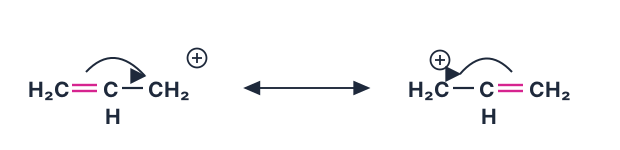
In a benzylic carbocation, the positive charge is adjacent to a benzene ring. The π system of the ring delocalizes the charge across multiple carbons:
CX6HX5−CHX2X+↔(several resonance structures)
Here are those resonance structures — the positive charge cycles from the CH₂ carbon onto the ortho and para positions of the ring:
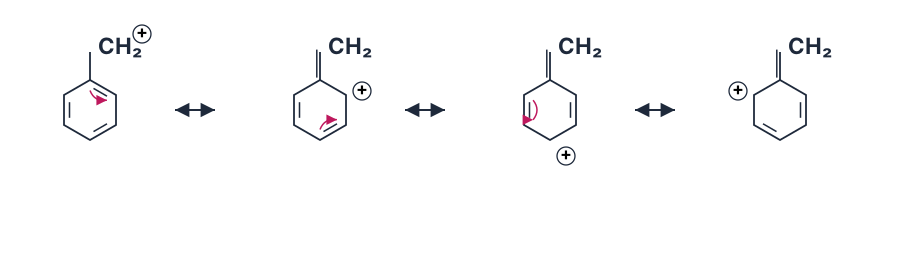
This resonance stabilization makes allylic and benzylic carbocations even more stable than tertiary ones. They form the fastest in SN1 reactions.
The Complete Picture in a Table
| Carbocation Type | Stability | SN1 Reactivity | Example |
|------------------|-----------|----------------|---------| …
Why this formula?
SN1 Reactivity Order: Why It Holds
The SN1 reaction (Substitution Nucleophilic Unimolecular) proceeds via a carbocation intermediate. The reactivity order is determined entirely by the stability of this carbocation — because the rate-determining step is its formation.
The Core Principle
The rate law for SN1 is:
Rate=k[RX]
Only the substrate appears in the rate law — the nucleophile does not participate in the slow step. The slow step is:
RXslowR++X−
Thus, anything that stabilizes the carbocation (R⁺) lowers the activation energy and increases the reaction rate.
The Reactivity Order
For alkyl halides (RX), the SN1 reactivity order is:
Allylic>Benzyllic>Tertiary>Secondary>Primary>Methyl
Let's break down why each step holds.
1. Why Tertiary > Secondary > Primary > Methyl?
This is purely about hyperconjugation and inductive effect.
- Tertiary carbocation: Three alkyl groups donate electron density via hyperconjugation (C–H σ bonds overlap with empty p orbital) and +I effect. This spreads the positive charge over more atoms → most stable.
- Secondary: Two alkyl groups → less stabilization.
- Primary: Only one alkyl group → very little stabilization.
- Methyl: No alkyl groups → least stable (only inductive effect from H atoms, which is negligible).
Key formula: The number of α-hydrogens (H on carbons adjacent to the positive carbon) determines hyperconjugation. More α-H → more resonance structures → more stable.
2. Why Allylic and Benzylic Are Even Faster
These carbocations are resonance-stabilized.
- Allylic carbocation: The positive charge is delocalized over two carbon atoms via π-bond conjugation:
CH2=CH−CH2+⟷CH2+−CH=CH2
- Benzylic carbocation: The positive charge is delocalized into the aromatic ring:
C6H5−CH2+⟷several resonance forms involving the ring
Those resonance forms look like this:
This resonance stabilization is so powerful that even a primary allylic or benzylic carbocation is more stable than a tertiary alkyl carbocation.
3. The Complete Order (with reasoning) …
The target, 1-phenylethanamine (C6H5CH(NH2)CH3), has ONE FEWER carbon than the starting amide, 2-phenylpropanamide (C6H5CH(CH3)CONH2) - that carbon loss is the signature of the Hofmann bromamide degradation, not a simple reduction. Br2 in aqueous NaOH degrades the amide with loss of the carbonyl carbon as CO2, giving exactly the target amine. …
1-Phenylethanamine has one fewer carbon than the starting amide, 2-phenylpropanamide - so this conversion needs the Hofmann bromamide degradation (Br2 in aqueous NaOH), which expels the carbonyl carbon as CO2, not a hydride reduction (which keeps all three carbons). The correct reagent is Br2 in aqueous NaOH, option (ii).
Compare the starting material and the target carbon-by-carbon. 2-Phenylpropanamide is C6H5-CH(CH3)-CONH2: a three-carbon amide chain (the carbonyl carbon, the CH bearing the phenyl group, and the terminal methyl). The target, 1-phenylethanamine, is C6H5-CH(NH2)-CH3: only two carbons remain, with the amino group on the carbon that used to bear the phenyl substituent - the carbonyl carbon is gone entirely.
Losing a carbon while converting the amide group to an amine is exactly what the Hofmann bromamide degradation does: treating a primary amide with Br2 in aqueous/alcoholic NaOH forms an N-bromoamide, which rearranges (via an isocyanate intermediate) with loss of the carbonyl carbon as CO2, leaving the remaining group bonded directly to NH2. Applied here, 2-phenylpropanamide converts straight to 1-phenylethanamine.
Now check the other options:
- (i) excess H2/Pt does not reduce an amide carbonyl under ordinary catalytic hydrogenation conditions.
- (iii) NaBH4/methanol is too mild to reduce an amide. …
Concept: Hofmann Rearrangement (Hofmann Degradation)
This reaction converts a primary amide into a primary amine with one fewer carbon atom in the chain. The reagent used is bromine in aqueous sodium hydroxide (Br2/NaOH).
Method: Hofmann Rearrangement
Step 1 — Identify the starting material and target
- Starting amide: 2-phenylpropanamide Structure: C6H5−CH(CH3)−CONH2
- Target amine: 1-phenylethanamine Structure: C6H5−CH(CH3)−NH2
Notice: The carbon chain length decreases by one (the carbonyl carbon is lost as CO2).
Step 2 — Apply the reagent logic
- Hofmann rearrangement uses Br2/NaOH to convert R−CONH2 → R−NH2
- The alkyl group (R) attached to the carbonyl remains attached to the nitrogen in the product.
- Here, R=C6H5−CH(CH3)−, which directly gives the target amine.
Step 3 — Eliminate other options …
Common Mistakes & How to Avoid Them
Concept: Hofmann Rearrangement vs. Reduction of Amides
The reaction converts an amide (2-phenylpropanamide) into a primary amine (1-phenylethanamine). The key observation: the carbon chain loses one carbon atom — the amide carbon is lost as CO2.
✗ Mistake 1: Choosing LiAlH4 (Option D) or NaBH4 (Option C)
Why students do this:
They see "amide → amine" and immediately think of reduction. LiAlH4 is a strong reducing agent that converts amides to amines.
Why it's wrong here:
LiAlH4 reduces amides to amines without changing the carbon skeleton.
- 2-phenylpropanamide (C6H5CH(CH3)CONH2) would give 2-phenylpropanamine (C6H5CH(CH3)CH2NH2).
- But the product asked is 1-phenylethanamine (C6H5CH(NH2)CH3) — one carbon fewer.
NaBH4 is even weaker and does not reduce amides at all under normal conditions.
How to avoid:
Always count the carbons in the reactant and product. If the chain shortens, reduction is not the answer — look for a rearrangement or degradation reaction.
✗ Mistake 2: Choosing H2/Pt (Option A)
Why students do this:
They think "hydrogenation" or "catalytic reduction" will convert the amide to an amine.
Why it's wrong:
H2/Pt reduces alkenes, alkynes, nitro groups, and nitriles — but not amides. Amides are very stable toward catalytic hydrogenation.
How to avoid:
Memorise the functional groups that H2/catalyst reduces:
- C=C, C≡C, −NO2, −CN, −CHO, −CO− (ketones/aldehydes)
- Not −CONH2, −COOH, −COOR
✓ Correct Answer: NaOH/Br2 (Option B) — Hofmann Rearrangement
Why it works:
This is the Hofmann bromamide rearrangement.
- The amide reacts with Br2 in NaOH to form an isocyanate intermediate.
- The isocyanate loses CO2 (hence the loss of one carbon).
- The product is a primary amine with one fewer carbon in the chain.
Reaction summary: …
- GSEB Higher Secondary Certificate (HSC) Examination 2026Set ANNUAL1 markMCQQ.For the following compounds, what is the correct increasing order of reactivity towards SN1 displacement? (I) 2-Bromo-2-methylbutane (II) 1-Bromopentane (III) 2-Bromopentane(a) I < III < II(b) II < III < I(c) III < II < I(d) I < II < III
›Reveal solutionSolution
SN1 reaction rate depends on the stability of the intermediate carbocation: tertiary > secondary > primary.
The SN1 mechanism proceeds via a carbocation intermediate formed by ionisation of the C–X bond in the rate-determining step. The MORE stable this carbocation, the FASTER the SN1 reaction — and carbocation stability increases with alkyl substitution (more +I donation and hyperconjugation stabilise the positive charge): 3° > 2° > 1°.
- (II) 1-Bromopentane — a primary halide, forms a primary carbocation (least stable) → SLOWEST SN1. …
- GUJCET 2024Set 131 markMCQQ.Predict the order of reactivity of the following compounds in SN1 reaction.(i) C6H5⋅CH2Br(ii) C6H5⋅CH⋅(C6H5)Br(iii) C6H5⋅CH(CH3)Br(iv) C6H5⋅C⋅(CH3)(C6H5)Br (A)(ii) >(iii) >(iv) >(i) (B)(ii) >(iv) >(iii) >(i) (C)(iv) >(iii) >(ii) >(i) (D)(iv) >(ii) >(iii) > (i)
›Reveal solutionSolution
More stabilising groups on the cationic carbon → faster SN1. Two phenyls beat one phenyl + methyl.
Concept. SN1 rate depends on the stability of the carbocation formed. Phenyl groups stabilise through resonance more strongly than a methyl stabilises by induction/hyperconjugation.
- (iv) C6H5C+(CH3)(C6H5): two phenyl + methyl — most stable.
- (ii) C6H5C+H(C6H5): two phenyl (benzhydryl). …
- GSEB Higher Secondary Certificate (HSC) Examination 2024Set ANNUAL1 markMCQQ.Predict the order of reactivity of the following compounds in SN1 reaction:(i) CH3CH2CH(Br)CH3(ii) (CH3)2CHCH2Br(iii) (CH3)3CBr(a)(iii) <(ii) <(i)(b)(ii) <(i) <(iii)(c)(i) <(ii) <(iii)(d)(iii) <(i) < (ii)
›Reveal solutionSolution
SN1 reaction rate depends on the stability of the carbocation intermediate formed; more substituted (more alkyl-stabilised) carbocations react faster via SN1.
- CH3CH2CH(Br)CH3 - a secondary alkyl halide (sec-butyl bromide), gives a secondary carbocation.
- (CH3)2CHCH2Br - a primary alkyl halide (isobutyl bromide), gives a primary carbocation (least stable).
- (CH3)3CBr - a tertiary alkyl halide (tert-butyl bromide), gives a tertiary carbocation (most stable, fastest SN1). …
- GUJCET 2021Set 151 markMCQQ.Which would undergo SN1 reaction faster from following? (A) Chloromethane (B) 2-bromo-3-methylbutane (C) 2-chloro-3-methylbutane (D) 2-bromo-2-methylpropane
›Reveal solutionSolution
SN1 rate tracks carbocation stability: tertiary + good leaving group = fastest.
Concept: SN1 is rate-determined by ionisation to a carbocation. Order of stability 3° > 2° > 1° > methyl; and C−Br ionises more easily than C−Cl (weaker bond, better leaving group).
- (A) Chloromethane → methyl cation (impossible) — slowest.
- (B) 2-bromo-3-methylbutane → 2° cation. …
- GSEB Higher Secondary Certificate (HSC) Examination 2020Set ANNUAL1 markMCQQ.Which of the following compound has highest reactivity towards SN1 reaction?(a) C6H5CH(C6H5)Br(b) C6H5CH2Br(c) C6H5C(CH3)(C6H5)Br(d) C6H5CH(CH3)Br
›Reveal solutionSolution
SN1 reactivity tracks carbocation stability: the more substituted and the more resonance-stabilised (benzylic) the resulting cation, the faster the SN1 reaction.
Ranking the carbocations that would form on loss of Br-:
- (b) C6H5CH2+ - primary benzylic cation, stabilised by only one phenyl ring.
- (d) C6H5CH(CH3)+ - secondary benzylic cation, one phenyl + one methyl.
- (a) C6H5CH(C6H5)+ - secondary but doubly-benzylic (two phenyl rings delocalise the charge) - more stable than (d). …
- GSEB Higher Secondary Certificate (HSC) Examination 2019Set ANNUAL1 markMCQQ.Which compound will give unimolecular nucleophilic substitution reaction easily with aqueous NaOH?(a) C6H5-CH2-CH2-Cl(b) C6H5-CH(Cl)-CH3(c) C6H5-C(Cl)(C6H5)-CH3(d) C6H5-CH2-Cl
›Reveal solutionSolution
SN1 reactions proceed through a carbocation intermediate, so the rate is fastest when the substrate can form the MOST STABLE carbocation -- tertiary and/or benzylic (resonance-stabilised) cations react fastest.
Comparing the stability of the carbocation each substrate would form on loss of Cl-:
- C6H5-CH2-CH2-Cl: ionisation gives a primary carbocation (not benzylic, since the CH2-Cl carbon is not directly attached to the ring) -- very unstable, SN1 disfavoured, reacts by SN2.
- C6H5-CH(Cl)-CH3: ionisation gives a SECONDARY benzylic carbocation (one phenyl ring for resonance stabilisation) -- reasonably stable, moderate SN1 reactivity. …
🎓Unlock everything free for 14 days
- ✓Full step-by-step solutions
- ✓Concept-first explanations
- ✓Methods, shortcuts & mistakes
- ✓PYQ mapping + timed mock tests
Full access for 14 days. No credit card required.