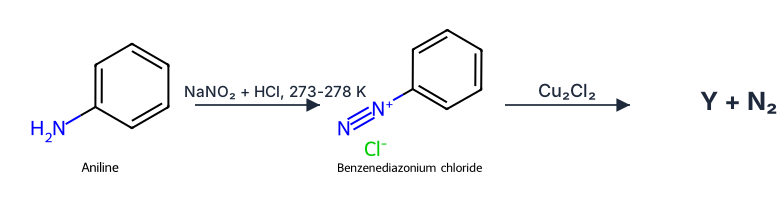
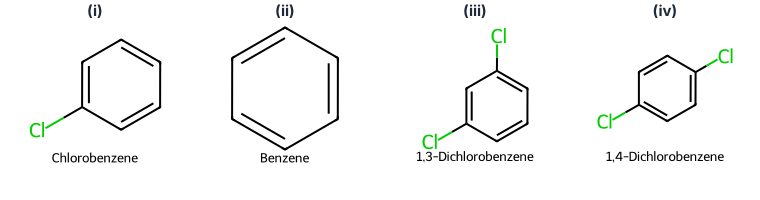
Q.Identify the compound Y in the following reaction.
Concept understanding — Inductive Effect on Acidity
Inductive Effect on Acidity – From Intuition to Precision
Imagine you are holding a rope tied to a heavy box. If you pull the rope, the box moves toward you. Now imagine the rope is made of rubber bands — the pull still reaches the box, but it gets weaker the farther away you are. That is exactly how the inductive effect works inside a molecule.
The Core Intuition
An acid donates a proton (H+). After it does, the remaining part (the conjugate base) carries a negative charge. The stability of that negative charge determines how willing the molecule is to give up the proton. More stable conjugate base → stronger acid.
Now, some atoms or groups are electron-withdrawing — they pull electron density toward themselves through the sigma bonds. If such a group is attached near the acidic proton, it pulls some electron density away from the negative charge on the conjugate base. That spreads out (delocalises) the negative charge, making the conjugate base more stable. The acid becomes stronger.
Conversely, electron-donating groups push electron density toward the negative charge, concentrating it and making the conjugate base less stable. The acid becomes weaker.
The inductive effect operates through sigma bonds only. It does not involve pi bonds or resonance. It is a permanent, through-bond polarisation.
The Precise Statement
Inductive effect on acidity: The acidity of a compound increases with the presence of electron-withdrawing groups (EWGs) near the acidic site, and decreases with electron-donating groups (EDGs). The effect is strongest when the group is closest to the acidic proton, and diminishes rapidly with distance.
Mathematically, for a series of substituted carboxylic acids:
R-COOHwhere R = substituent
The acid dissociation constant Ka changes as:
- If R is electron-withdrawing (e.g., −Cl, −NO2, −CF3): Ka increases → stronger acid.
- If R is electron-donating (e.g., −CH3, −C2H5): Ka decreases → weaker acid.
Why Distance Matters
The inductive effect falls off with distance because sigma bonds are localised. Each bond attenuates the effect by roughly a factor of 2–3. For example, compare:
| Compound | pKa | Explanation |
|---|---|---|
| CH3COOH | 4.76 | Reference (no EWG) |
| ClCH2COOH | 2.86 | Cl withdraws through one bond |
| Cl2CHCOOH | 1.29 | Two Cl atoms, stronger withdrawal |
| Cl3CCOOH | 0.65 | Three Cl atoms, strongest withdrawal |
| CH3CH2COOH | 4.87 | Ethyl group is electron-donating (slightly weaker acid) |
Notice: ClCH2COOH is about 100 times stronger than acetic acid (ΔpKa≈1.9). But if the Cl is moved further away:
| Compound | pKa |
|---|---|
| ClCH2CH2COOH | 4.08 |
| ClCH2CH2CH2COOH | 4.52 |
The effect fades as the chlorine moves farther from the carboxyl group.
Do not confuse inductive effect with resonance effect. Inductive effect operates through sigma bonds and is distance-dependent. Resonance effect operates through pi bonds and can act over long distances. For example, −NO2 is both strongly electron-withdrawing inductively (through sigma bonds) and by resonance (through pi bonds). But −Cl is electron-withdrawing inductively but electron-donating by resonance — the net effect on acidity depends on which dominates.
The Key Takeaway
Inductive effect on acidity: Electron-withdrawing groups (EWGs) increase acidity by stabilising the conjugate base through sigma-bond polarisation. Electron-donating groups (EDGs) decrease acidity. The effect is strongest when the group is closest to the acidic site and diminishes with distance.
Acidity∝Number and strength of EWGs near acidic site
Acidity∝Distance from acidic site1
The inductive effect on acidity is a recurring theme across the NCERT Class 11 and 12 Organic Chemistry chapters, and ‘inductive effect and acidity of carboxylic acids’ is one of the most common important-question types in CBSE boards, JEE Main and NEET organic chemistry. Comparing acid strengths using electron-withdrawing and electron-donating substituents is a skill tested in nearly every organic reasoning-based MCQ.
Why this formula?
Inductive Effect on Acidity: Why It Works
The inductive effect is a through-bond electron displacement caused by differences in electronegativity. When we ask why it affects acidity, we must first understand what acidity means at the molecular level.
The Core Idea: Stabilising the Conjugate Base
Acidity is governed by the equilibrium:
HA⇌H++A−
The stronger the acid, the more it favours the right side. This happens when the conjugate base A− is more stable. The inductive effect directly influences this stability.
Why Electron-Withdrawing Groups (EWG) Increase Acidity
Consider a carboxylic acid with an electronegative atom (like Cl) attached to the carbon chain:
Cl−CH2−COOH
- The inductive pull: The Cl atom is more electronegative than carbon. It pulls electron density toward itself through the sigma bonds.
- Effect on the O–H bond: This electron withdrawal travels along the carbon chain, reducing electron density around the O–H bond. The bond becomes more polarised, making the H⁺ easier to remove.
- Stabilising the conjugate base: After losing H⁺, the negative charge on the carboxylate ion (RCOO−) is delocalised by resonance. But the inductive effect further stabilises this negative charge by pulling electron density away from the oxygen atoms. This makes the conjugate base less reactive (more stable), shifting equilibrium toward dissociation.
Key insight: The inductive effect doesn't just weaken the O–H bond — it stabilises the anion that forms after deprotonation.
The Quantitative Relationship: Hammett Equation
For substituted benzoic acids, the effect is quantified by the Hammett equation:
log(Ka0Ka)=σρ
Where:
- Ka = acid dissociation constant of substituted acid
- Ka0 = acid dissociation constant of unsubstituted benzoic acid
- σ = substituent constant (measures inductive + resonance effect)
- ρ = reaction constant (sensitivity of the reaction to substituent effects)
Why This Formula Holds
The derivation comes from linear free-energy relationships:
- Free energy change: For any acid dissociation:
ΔG∘=−RTlnKa
- Effect of substituent: A substituent changes ΔG∘ by an amount proportional to its electronic effect:
Δ(ΔG∘)=−RTln(Ka0Ka)
-
Separability assumption: The total effect of a substituent on any reaction can be factored into:
- A substituent-specific term (σ) — how strongly it pulls/pushes electrons
- A reaction-specific term (ρ) — how sensitive the reaction is to electronic effects
-
Empirical validation: Hammett found that for meta and para substituted benzoic acids, plotting log(Ka/Ka0) against σ gives a straight line. This confirms the additive nature of inductive effects.
The Inductive Effect Constant (σI)
For purely inductive effects (no resonance), we use Taft's separation:
σ=σI+σR
Where σI is the inductive component. The formula for σI itself comes from comparing rates of hydrolysis of esters — reactions where resonance effects are minimal.
Why σI Values Are Additive
For a substituent X at distance n bonds from the reaction centre:
σI(X at position n)=2.7nσI(X at position 1)
This fall-off factor (2.7 ≈ e) arises because:
- Inductive effect propagates through sigma bonds
- Each bond attenuates the effect by a factor related to bond polarisability
- The exponential decay is a consequence of successive polarisation of each bond
Practical Exam Tip
When comparing acidity of two compounds:
- Draw the conjugate base of each
- Identify which has more electron-withdrawing groups near the negative charge
- More EWG → more stabilised conjugate base → stronger acid
The formulas above are quantitative tools, but the qualitative reasoning — stabilising the anion — is what you need for most exam questions.
Remember: The inductive effect is distance-dependent and additive. Two Cl atoms at the same position have roughly twice the effect of one. But a Cl at the β-carbon has much less effect than one at the α-carbon.
The key idea is the Sandmeyer reaction: the diazonium group (−N2+) is replaced by a chlorine atom using a cuprous chloride catalyst.
Reasoning:
- Aniline reacts with NaNO2+HCl at low temperature (273-278K) to form benzenediazonium chloride, C6H5N2+Cl−.
- This diazonium salt is then treated with Cu2Cl2 (cuprous chloride in HCl). The Sandmeyer reaction substitutes the diazonium group with a chlorine atom, releasing N2 gas.
- The product is chlorobenzene (C6H5Cl). No further substitution occurs under these conditions.
The compound Y is chlorobenzene, C6H5Cl, corresponding to option (i).
The reaction is the Sandmeyer reaction: the diazonium group is replaced by chlorine using Cu2Cl2, giving chlorobenzene (C6H5Cl) as product Y.
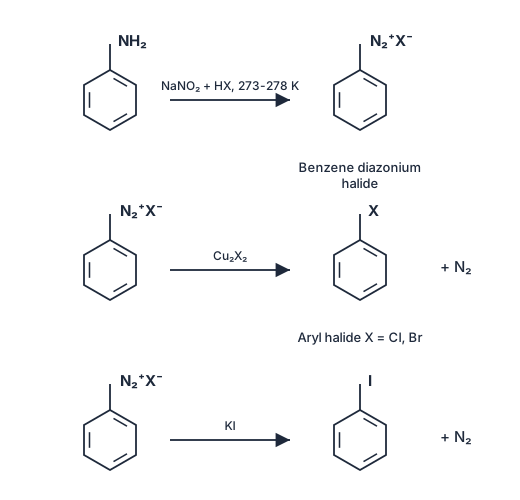
The key to this question is recognising the Sandmeyer reaction — a classic method for replacing the diazonium group (−N2+) with a halogen using a copper(I) halide. Let’s walk through the chemistry step by step.
- First step: Diazotisation Aniline (C6H5NH2) reacts with NaNO2 and HCl at low temperature (273–278 K). This converts the amino group into a diazonium group:
C6H5NH2+NaNO2+2HCl273−278KC6H5N2+Cl−+NaCl+2H2O
The product is benzenediazonium chloride, a key intermediate in aromatic substitution. The low temperature is critical — diazonium salts decompose above about 5°C.
- Second step: The Sandmeyer reaction The diazonium salt is then treated with Cu2Cl2 (copper(I) chloride). This is the classic Sandmeyer reaction, where the diazonium group is replaced by a chlorine atom. The mechanism involves a single-electron transfer from Cu(I) to the diazonium ion, generating an aryl radical, which then abstracts chlorine from Cu(II) to form the aryl chloride.
C6H5N2+Cl−Cu2Cl2C6H5Cl+N2
The nitrogen gas (N2) bubbles off, driving the reaction forward.
- What about the options?
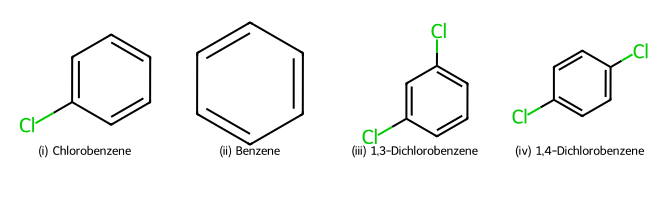
- (i) Chlorobenzene — This is the direct product of the Sandmeyer reaction with Cu2Cl2.
- (ii) Benzene — This would require reduction of the diazonium group (e.g., with H3PO2), not with Cu2Cl2.
- (iii) 1,3-Dichlorobenzene and (iv) 1,4-Dichlorobenzene — These would require two chlorine substitutions, but the reaction conditions only introduce one chlorine. No further chlorination occurs here.
A common mistake is to think that Cu2Cl2 causes a second substitution or that the reaction is a simple displacement. It is not — it’s a radical mechanism specific to the Sandmeyer reaction, and only one chlorine is introduced.
Remember the mnemonic: Sandmeyer for Cl, Br, CN using CuX or CuCN; Schiemann for F using HBF4; and Gattermann for Cl, Br using Cu + HX.
- Confirming the product The reaction is clean: one diazonium group, one chlorine atom replaces it, and nitrogen is lost. The product is chlorobenzene, C6H5Cl.
The compound Y is chlorobenzene, option (i).
Concept: Sandmeyer Reaction
The Sandmeyer reaction is a method to replace the diazonium group (−N2+) with a halogen (Cl, Br, I) or a cyano group (−CN) using a copper(I) halide or copper(I) cyanide as a catalyst.
Method: Sandmeyer Reaction for Chlorination
Step 1: Identify the starting material and the reagent.
- Aniline (C6H5NH2) is first converted to benzenediazonium chloride (C6H5N2+Cl−) at low temperature (273–278 K) using NaNO2+HCl.
Step 2: Apply the Sandmeyer reaction condition.
- The benzenediazonium chloride is treated with Cu2Cl2 (copper(I) chloride).
Step 3: Write the reaction.
- The diazonium group (−N2+) is replaced by a chlorine atom (−Cl), and nitrogen gas (N2) is released.
C6H5N2+Cl−Cu2Cl2C6H5Cl+N2
Step 4: Identify the product Y.
- The product is chlorobenzene (C6H5Cl).
Final Answer
Y = Chlorobenzene (C6H5Cl) → Option (i)
Common Mistakes in This Diazonium Reaction Problem
This question tests your understanding of the Sandmeyer reaction — specifically the replacement of the diazonium group (−N2+) with chlorine using Cu2Cl2.
✗ Mistake 1: Thinking Cu2Cl2 gives substitution on the ring
Why students make it:
They see Cu2Cl2 and assume it chlorinates the benzene ring directly (like electrophilic substitution), producing dichlorobenzenes.
How to avoid:
Remember: Cu2Cl2 in the Sandmeyer reaction replaces the diazonium group (−N2+) with a chlorine atom at the same position. It does not add extra chlorines to the ring.
Correct result: Only one chlorine replaces the −N2+ group → chlorobenzene (C6H5Cl).
✗ Mistake 2: Choosing benzene (C6H6)
Why students make it:
They recall that diazonium salts can be reduced to benzene using H3PO2 (hypophosphorous acid) or ethanol, and confuse the reagent.
How to avoid:
Memorise the reagent–product mapping:
| Reagent | Product |
|---|---|
| Cu2Cl2 | Chlorobenzene |
| Cu2Br2 | Bromobenzene |
| CuCN | Benzonitrile |
| H3PO2 / C2H5OH | Benzene |
Here, Cu2Cl2 cannot give benzene — it gives chlorobenzene.
✗ Mistake 3: Forgetting that N2 gas is released
Why students make it:
They focus only on the product structure and ignore the stoichiometric clue.
How to avoid:
The equation shows N2 is evolved. This means the diazonium group (−N2+) leaves completely. The only thing that can replace it is a single atom or group from the reagent — here, Cl from Cu2Cl2.
✓ Quick Summary Table
| Mistake | Why it happens | How to avoid |
|---|---|---|
| Choosing dichlorobenzenes | Confusing Sandmeyer with electrophilic chlorination | Sandmeyer replaces — does not add |
| Choosing benzene | Confusing Cu2Cl2 with H3PO2 | Memorise reagent–product pairs |
| Ignoring N2 evolution | Overlooking reaction stoichiometry | N2 means the group is replaced, not modified |
Final correct answer: (i) Chlorobenzene
Showing the 12 most recent of 14 on this concept.
- GSEB Higher Secondary Certificate (HSC) Examination 2026Set ANNUAL1 markMCQQ.Which acid has lowest pKa?(a) C6H5COOH(b) HCOOH(c) C6H5CH2COOH(d) CH3CH2COOH
›Reveal solutionSolution
Among simple carboxylic acids, acidity decreases as alkyl/aryl substituents (electron donors) are added onto the carbon bearing -COOH; formic acid (no such substituent) is the strongest.
Acid strength of a carboxylic acid depends on how well the conjugate base (carboxylate, RCOO⁻) is stabilised — electron-donating alkyl groups destabilise the negative charge (reduce acidity), while the acid gets stronger as such donation is minimised or offset by electron-withdrawing character:
- HCOOH (formic acid) — H directly attached to the carbonyl carbon, no alkyl group to donate electron density; the strongest of the four, pKa ≈ 3.75 (lowest pKa).
- C6H5COOH (benzoic acid) — the ring can donate some electron density by resonance and is only mildly electron-withdrawing overall; pKa ≈ 4.2.
- C6H5CH2COOH (phenylacetic acid) — the CH2 spacer insulates the ring's effect, closer to a simple alkyl acid; pKa ≈ 4.3.
- CH3CH2COOH (propanoic acid) — an ordinary alkyl acid, with the alkyl group's +I effect destabilising the carboxylate the most; pKa ≈ 4.87 (weakest, highest pKa).
Lowest pKa = strongest acid = HCOOH.
✓Final answer(b) HCOOH.
- GUJCET 2025Set 031 markMCQQ.For which compound pKa is highest? (A) HCOOH (B) CH3CH2COOH (C) C6H5CH2COOH (D) ClCH2CH2COOH
›Reveal solutionSolution
[!TLDR]
Propanoic acid is the weakest acid here, so it has the highest pKa.
Concept
A higher pKa means a weaker acid. Electron-withdrawing groups (like −Cl, phenyl) stabilise the carboxylate and increase acidity (lower pKa); electron-donating alkyl groups reduce acidity (raise pKa).
Solution
Compare approximate pKa values:
- (A) HCOOH (formic acid): ≈3.75 (strongest, no destabilising alkyl chain).
- (B) CH3CH2COOH (propanoic acid): ≈4.87 (electron-donating ethyl group, no withdrawing group) — weakest acid, highest pKa.
- (C) C6H5CH2COOH (phenylacetic acid): ≈4.3 (phenyl mildly withdraws).
- (D) ClCH2CH2COOH: ≈4.0 (−Cl is electron-withdrawing, increasing acidity).
The highest pKa is propanoic acid.
[!ANSWER]
(B) CH3CH2COOH
- GUJCET 2024Set 131 markMCQQ.Which of the following carboxylic acid has least pKa value among all? (A) NO2⋅CH2⋅COOH (B) CH3⋅COOH (C) HCOOH (D) C6H5⋅COOH
›Reveal solutionSolution
Strongest electron-withdrawing group → strongest acid → lowest pKa. NO2CH2COOH wins.
Concept. An electron-withdrawing substituent stabilises the carboxylate anion, raising acid strength (lowering pKa).
Approximate pKa values: nitroacetic acid ≈1.7, formic ≈3.75, benzoic ≈4.2, acetic ≈4.76. The powerful −NO2 inductive effect makes nitroacetic acid the strongest acid, so it has the least pKa.
✓Final answerOption (A) NO2⋅CH2⋅COOH
ANSWER: (A)
- GSEB Higher Secondary Certificate (HSC) Examination 2024Set ANNUAL1 markMCQQ.Which of the following compound has highest Ka Value?(a) NO2CH2COOH(b) BrCH2COOH(c) CCl3COOH(d) CH3COOH
›Reveal solutionSolution
Trichloroacetic acid (CCl3COOH, pKa about 0.7) has the highest Ka because three chlorine atoms together exert the strongest cumulative electron-withdrawing effect. Answer: (c).
Acid strength is governed by how well the conjugate-base carboxylate is stabilised by the electron-withdrawing (-I) substituents. Comparing the four:
- CCl3COOH: pKa about 0.66 (three Cl atoms, very strong cumulative -I)
- NO2CH2COOH: pKa about 1.68
- BrCH2COOH: pKa about 2.9
- CH3COOH: pKa about 4.76 (no EWG)
Although a single -NO2 is a stronger individual withdrawing group than a single -Cl, the cumulative effect of THREE chlorine atoms in CCl3COOH outweighs the single nitro group, giving it the lowest pKa / highest Ka.
✓Final answer(c) CCl3COOH.
- GUJCET 2022Set 171 markMCQQ.Which is the incorrect order of increasing acidic strength for the following? (A) CH2FCH2CH2COOH<CH3CHFCH2COOH (B) CH2ClCOOH<CH2FCOOH (C) CH3COOH<CH2ClCOOH (D) HCOOH<C6H5COOH
›Reveal solutionSolution
HCOOH (pKa 3.75) is a stronger acid than C6H5COOH (pKa 4.20), so (D)'s order is wrong.
Concept. "Increasing acidic strength" means the item on the right must be the stronger acid.
- (A) F on β-C (closer to COOH) is more acidic than F on γ-C → order correct.
- (B) F is more electronegative than Cl → CH2FCOOH stronger than CH2ClCOOH → correct.
- (C) CH2ClCOOH stronger than CH3COOH → correct.
- (D) Claims benzoic acid stronger than formic acid, but formic acid is actually the stronger of the two → incorrect order.
✓Final answer(D) HCOOH<C6H5COOH is the incorrect order.
ANSWER: (D)
- GSEB Higher Secondary Certificate (HSC) Examination 2022Set ANNUAL1 markMCQQ.Which acid has the lowest pKa?(a) CH3COOH(b) C6H5CH2COOH(c) C6H5COOH(d) CH3CH2COOH
›Reveal solutionSolution
Lower pKa = stronger acid; acidity here is governed by how well the conjugate base (carboxylate anion) is stabilised.
Approximate pKa values: benzoic acid (C6H5COOH) ≈ 4.2 (the phenyl ring is directly conjugated to -COOH, and the -I effect of the sp2 ring stabilises the carboxylate); phenylacetic acid (C6H5CH2COOH) ≈ 4.3 (the CH2 spacer partially insulates the ring's effect); acetic acid (CH3COOH) ≈ 4.76; propanoic acid (CH3CH2COOH) ≈ 4.87 (the extra electron-donating alkyl group is destabilising for the anion, making it the weakest acid here). Benzoic acid, having its ring directly attached to -COOH, has the lowest pKa.
✓Final answer(c) C6H5COOH has the lowest pKa.
- GUJCET 2021Set 151 markMCQQ.Which compound having maximum value of pKa from following? (A) o−O2N−C6H4−OH (B) p−O2N−C6H4−OH (C) m−O2N−C6H4−OH (D) C6H5OH
›Reveal solutionSolution
Fewer/no electron-withdrawing groups → weaker acid → highest pKa = plain phenol.
Concept: An −NO2 group withdraws electron density and stabilises the phenoxide anion, increasing acidity (lowering pKa). Removing it makes the phenol the weakest acid, i.e. the largest pKa.
- (A) o-, (B) p-, (C) m-nitrophenol all bear −NO2 → more acidic, smaller pKa.
- (D) C6H5OH has no −NO2 → least acidic → maximum pKa.
✓Final answer(D) C6H5OH
ANSWER: (D)
- GUJCET 2021Set 151 markMCQQ.Which compound having maximum acidic strength of the following? (A) 4-methoxy benzoic acid (B) 2-methoxy benzoic acid (C) Benzoic acid (D) 4-nitrobenzoic acid
›Reveal solutionSolution
Electron-withdrawing −NO2 (para) most stabilises the anion → strongest acid.
Concept: Groups that withdraw electron density stabilise the carboxylate and raise acidity; electron-donating groups (like −OCH3) lower it.
- (A) 4-methoxy and (B) 2-methoxybenzoic acid — −OCH3 donates by resonance, weaker acids.
- (C) Benzoic acid — reference.
- (D) 4-nitrobenzoic acid — −NO2 withdraws strongly → maximum acidic strength.
✓Final answer(D) 4-nitrobenzoic acid
ANSWER: (D)
- GUJCET 2020Set 071 markMCQQ.Which of the following acid has highest pKa value? (A) FCH2COOH (B) O2NCH2COOH (C) NCCH2COOH (D) C6H5CH2COOH
›Reveal solutionSolution
Highest pKa = weakest acid; C6H5CH2COOH has the least electron-withdrawing substituent.
Concept — inductive stabilisation of the carboxylate. Stronger electron-withdrawing groups (−NO2>−CN>−F) stabilise the conjugate base and lower pKa. The phenyl group withdraws least, so phenylacetic acid is the weakest acid and has the highest pKa.
✓Final answer(D) C6H5CH2COOH
ANSWER: (D)
- GSEB Higher Secondary Certificate (HSC) Examination 2020Set ANNUAL1 markMCQQ.Conjugate base of which of the following acid is weak?(a) CH3CH2CH(I)COOH(b) CH3CH2CH(F)COOH(c) CH3CH2CH(Br)COOH(d) CH3CH2CH(Cl)COOH
›Reveal solutionSolution
The stronger the acid, the weaker (more stable, less basic) its conjugate base; among these halo-substituted acids, the most electronegative halogen (F) gives the strongest acid and hence the weakest conjugate base.
A strong acid ionises readily because its conjugate base is comparatively stable and has little tendency to re-accept a proton (i.e. it is a WEAK base). Acid strength here is controlled by the -I (electron-withdrawing inductive) effect of the halogen substituent close to -COOH: this effect is strongest for the most electronegative halogen and weakens down the group, F > Cl > Br > I. So CH3CH2CH(F)COOH (the alpha-fluoro acid) is the STRONGEST acid of the four, and correspondingly its conjugate base (the fluoro-substituted butanoate anion) is the WEAKEST base/conjugate base of the set.
✓Final answer(b) CH3CH2CH(F)COOH.
- GSEB Higher Secondary Certificate (HSC) Examination 2019Set ANNUAL1 markMCQQ.For which acid the value of pKa is highest? (para-substituted benzoic acids)(a) p-Nitrobenzoic acid (4-NO2-C6H4-COOH)(b) p-Toluic acid / p-methylbenzoic acid (4-CH3-C6H4-COOH)(c) p-Anisic acid / p-methoxybenzoic acid (4-OCH3-C6H4-COOH)(d) p-Chlorobenzoic acid (4-Cl-C6H4-COOH)
›Reveal solutionSolution
pKa is highest for the weakest acid; electron-donating para substituents raise pKa (weaken acidity) while electron-withdrawing substituents lower pKa (strengthen acidity).
Acid strength of a substituted benzoic acid depends on how the para substituent affects stability of the carboxylate anion (its conjugate base) via induction and resonance:
-
p-NO2 (-NO2 is strongly electron-withdrawing by both induction and resonance) stabilises the anion most -> strongest acid -> LOWEST pKa.
-
p-Cl (weak electron-withdrawing by induction, small resonance donation) -> mildly increases acidity -> pKa close to/slightly below benzoic acid.
-
p-CH3 (weak electron-donating by hyperconjugation) -> mildly decreases acidity -> pKa slightly above benzoic acid.
-
p-OCH3 (strong electron-DONATING by resonance, lone pair on O conjugates into the ring and pushes electron density toward -COO-) destabilises the anion the MOST -> weakest acid -> HIGHEST pKa.
Ranking (approx. real pKa values): p-NO2 (3.42) < p-Cl (3.98) < unsubstituted (4.20) < p-CH3 (4.34) < p-OCH3 (4.47).
✓Final answer(c) p-Anisic acid / p-methoxybenzoic acid (4-OCH3-C6H4-COOH) has the highest pKa.
-
- GSEB Higher Secondary Certificate (HSC) Examination 2018Set ANNUAL1 markMCQQ.Which of the following compound has highest acidic strength?(a) p-methylbenzoic acid (COOH with para CH3)(b) o-nitrobenzoic acid (COOH with ortho NO2)(c) benzoic acid(d) p-nitrobenzoic acid (COOH with para NO2)
›Reveal solutionSolution
o-nitrobenzoic acid is the most acidic because the ortho -NO2 group withdraws electrons most strongly (ortho effect).
Acidity of substituted benzoic acids depends on the substituent:
- Electron-withdrawing groups (like -NO2) stabilise the carboxylate anion -> increase acidity.
- Electron-donating groups (like -CH3) decrease acidity.
Ranking:
-
p-CH3 (p-toluic acid): weakest (EDG).
-
benzoic acid: reference.
-
p-NO2: strong EWG, more acidic.
-
o-NO2: the ortho position gives an additional 'ortho effect' (steric + inductive proximity), making o-nitrobenzoic acid the most acidic (pKa ~ 2.2, lower than p-nitrobenzoic acid ~ 3.4).
✓Final answer(b) o-nitrobenzoic acid.
🎓Unlock everything free for 14 days
- ✓Full step-by-step solutions
- ✓Concept-first explanations
- ✓Methods, shortcuts & mistakes
- ✓PYQ mapping + timed mock tests
Full access for 14 days. No credit card required.