Q.Discuss the nature of C–X bond in the haloarenes.
🔒You're viewing a preview — the full solution, concept, methods & PYQ mapping are locked.
🔒 Start your 14-day free trial to unlock the full solution →Concept understanding — Inductive Effect on Acidity
Inductive Effect on Acidity – From Intuition to Precision
Imagine you are holding a rope tied to a heavy box. If you pull the rope, the box moves toward you. Now imagine the rope is made of rubber bands — the pull still reaches the box, but it gets weaker the farther away you are. That is exactly how the inductive effect works inside a molecule.
The Core Intuition
An acid donates a proton (H+). After it does, the remaining part (the conjugate base) carries a negative charge. The stability of that negative charge determines how willing the molecule is to give up the proton. More stable conjugate base → stronger acid.
Now, some atoms or groups are electron-withdrawing — they pull electron density toward themselves through the sigma bonds. If such a group is attached near the acidic proton, it pulls some electron density away from the negative charge on the conjugate base. That spreads out (delocalises) the negative charge, making the conjugate base more stable. The acid becomes stronger.
Conversely, electron-donating groups push electron density toward the negative charge, concentrating it and making the conjugate base less stable. The acid becomes weaker.
The inductive effect operates through sigma bonds only. It does not involve pi bonds or resonance. It is a permanent, through-bond polarisation.
The Precise Statement
Inductive effect on acidity: The acidity of a compound increases with the presence of electron-withdrawing groups (EWGs) near the acidic site, and decreases with electron-donating groups (EDGs). The effect is strongest when the group is closest to the acidic proton, and diminishes rapidly with distance.
Mathematically, for a series of substituted carboxylic acids:
R-COOHwhere R = substituent
The acid dissociation constant Ka changes as:
- If R is electron-withdrawing (e.g., −Cl, −NO2, −CF3): Ka increases → stronger acid.
- If R is electron-donating (e.g., −CH3, −C2H5): Ka decreases → weaker acid.
Why Distance Matters
The inductive effect falls off with distance because sigma bonds are localised. Each bond attenuates the effect by roughly a factor of 2–3. For example, compare:
| Compound | pKa | Explanation |
|---|---|---|
| CH3COOH | 4.76 | Reference (no EWG) |
| ClCH2COOH | 2.86 | Cl withdraws through one bond |
| Cl2CHCOOH | 1.29 | Two Cl atoms, stronger withdrawal |
| Cl3CCOOH | 0.65 | Three Cl atoms, strongest withdrawal |
| CH3CH2COOH | 4.87 | Ethyl group is electron-donating (slightly weaker acid) |
Notice: ClCH2COOH is about 100 times stronger than acetic acid (ΔpKa≈1.9). But if the Cl is moved further away:
| Compound | pKa |
|---|---|
| ClCH2CH2COOH | 4.08 |
| ClCH2CH2CH2COOH | 4.52 |
The effect fades as the chlorine moves farther from the carboxyl group. …
Why this formula?
Inductive Effect on Acidity: Why It Works
The inductive effect is a through-bond electron displacement caused by differences in electronegativity. When we ask why it affects acidity, we must first understand what acidity means at the molecular level.
The Core Idea: Stabilising the Conjugate Base
Acidity is governed by the equilibrium:
HA⇌H++A−
The stronger the acid, the more it favours the right side. This happens when the conjugate base A− is more stable. The inductive effect directly influences this stability.
Why Electron-Withdrawing Groups (EWG) Increase Acidity
Consider a carboxylic acid with an electronegative atom (like Cl) attached to the carbon chain:
Cl−CH2−COOH
- The inductive pull: The Cl atom is more electronegative than carbon. It pulls electron density toward itself through the sigma bonds.
- Effect on the O–H bond: This electron withdrawal travels along the carbon chain, reducing electron density around the O–H bond. The bond becomes more polarised, making the H⁺ easier to remove.
- Stabilising the conjugate base: After losing H⁺, the negative charge on the carboxylate ion (RCOO−) is delocalised by resonance. But the inductive effect further stabilises this negative charge by pulling electron density away from the oxygen atoms. This makes the conjugate base less reactive (more stable), shifting equilibrium toward dissociation.
Key insight: The inductive effect doesn't just weaken the O–H bond — it stabilises the anion that forms after deprotonation.
The Quantitative Relationship: Hammett Equation
For substituted benzoic acids, the effect is quantified by the Hammett equation:
log(Ka0Ka)=σρ
Where:
- Ka = acid dissociation constant of substituted acid
- Ka0 = acid dissociation constant of unsubstituted benzoic acid
- σ = substituent constant (measures inductive + resonance effect)
- ρ = reaction constant (sensitivity of the reaction to substituent effects)
Why This Formula Holds
The derivation comes from linear free-energy relationships:
- Free energy change: For any acid dissociation:
ΔG∘=−RTlnKa
- Effect of substituent: A substituent changes ΔG∘ by an amount proportional to its electronic effect:
Δ(ΔG∘)=−RTln(Ka0Ka)
-
Separability assumption: The total effect of a substituent on any reaction can be factored into:
- A substituent-specific term (σ) — how strongly it pulls/pushes electrons
- A reaction-specific term (ρ) — how sensitive the reaction is to electronic effects
-
Empirical validation: Hammett found that for meta and para substituted benzoic acids, plotting log(Ka/Ka0) against σ gives a straight line. This confirms the additive nature of inductive effects.
The Inductive Effect Constant (σI) …
The key idea is that the C–X bond in haloarenes is shorter and stronger than in haloalkanes due to resonance involving the aromatic ring.
Reasoning:
- In haloarenes, the halogen atom (X) donates one of its lone pairs into the π-electron system of the benzene ring. This creates partial double-bond character in the C–X bond.
- This resonance stabilisation makes the bond shorter and stronger than a typical single bond. It also makes the bond less polar than in haloalkanes, where no such resonance exists. …
The C–X bond in haloarenes is shorter, stronger, and less polar than in haloalkanes due to resonance delocalisation of the halogen lone pairs into the aromatic ring, giving it partial double-bond character.
1. The core question: what makes the C–X bond in haloarenes special?
When you first study haloalkanes, the C–X bond is a straightforward polar covalent bond — the halogen is more electronegative than carbon, so the bond is polarised δ+ on carbon and δ− on halogen. That polarity drives nucleophilic substitution reactions.
But in haloarenes (like chlorobenzene, bromobenzene), the bond behaves very differently. It is shorter, stronger, and less reactive toward nucleophiles. Why? The answer lies in resonance.
2. The resonance picture: lone pairs join the party
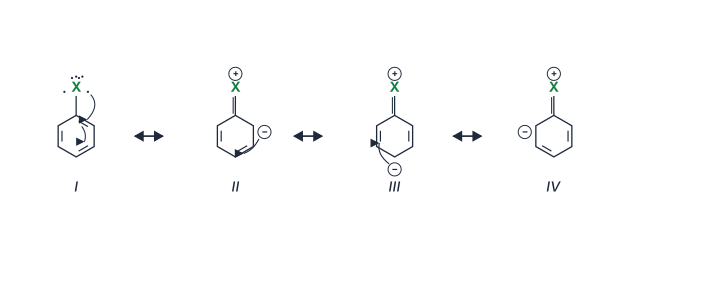
The halogen atom in a haloarene has three lone pairs of electrons. One of these lone pairs can delocalise into the π-electron system of the benzene ring. This is possible because the halogen’s p-orbital overlaps with the p-orbitals of the adjacent carbon atom in the ring.
Draw the resonance structures for chlorobenzene:
- The major contributor is the usual Kekulé structure with a C–Cl single bond.
- But there are minor contributors where the lone pair from chlorine forms a π bond with the ring carbon, pushing the π electrons around. This puts a negative charge on the ortho and para positions, and a positive charge on chlorine.
The key consequence: the C–X bond now has partial double-bond character. A double bond is shorter and stronger than a single bond. This is the single most important idea for understanding haloarene chemistry.
3. Step-by-step consequences of this partial double-bond character
1. Bond length decreases.
A C–Cl single bond in a haloalkane is about 177 pm. In chlorobenzene, it shrinks to roughly 169 pm. The resonance hybrid has a bond order between 1 and 2, pulling the atoms closer.
2. Bond dissociation energy increases.
Because the bond is stronger, more energy is needed to break it. The C–Cl bond dissociation energy in chlorobenzene is about 400 kJ/mol, compared to ~330 kJ/mol in chloroethane. This directly explains why haloarenes are much less reactive in nucleophilic substitution — you simply cannot break the bond as easily.
3. Polarity decreases.
In a haloalkane, the bond is highly polarised. But in a haloarene, the resonance delocalisation spreads the electron density. The positive charge that would normally sit on carbon is partially neutralised by the π donation from the ring. The dipole moment of chlorobenzene (1.69 D) is actually smaller than that of cyclohexyl chloride (2.20 D), even though the aromatic ring is more electronegative than an alkyl group. This seems counterintuitive — until you remember that resonance puts some negative charge back on the halogen.
A common mistake is to think that the inductive effect of the ring (which is electron-withdrawing) would increase the polarity. But resonance dominates here, and it reduces the polarity. The net dipole is the sum of both effects, and resonance wins.
4. Reactivity toward nucleophiles plummets.
For an SN2 reaction, the nucleophile needs to attack the carbon from the back. The partial double-bond character makes the C–X bond rigid and planar with the ring — the backside is sterically hindered by the ring itself. For an SN1 reaction, you would need to form a carbocation, but the aryl carbocation (phenyl cation) is extremely unstable because the empty p-orbital cannot be stabilised by resonance (it is orthogonal to the π system). So both pathways are blocked under normal conditions.
5. The dipole is weakened, not reversed. …
Concept: Resonance and Bond Character in Haloarenes
The C–X bond in haloarenes (aryl halides) is shorter and stronger than the C–X bond in haloalkanes (alkyl halides). This difference arises due to resonance involving the lone pairs of the halogen and the aromatic ring.
Method: Resonance Analysis
Step 1: Draw the resonance structures of a haloarene (e.g., chlorobenzene).
The lone pairs on the halogen (X) can conjugate with the π-electrons of the benzene ring. This gives five resonance structures:
- One structure with a C–X single bond (no charge separation).
- Four structures where the lone pair from X forms a double bond with the ring, placing a positive charge on the halogen and a negative charge at the ortho and para positions of the ring.
Step 2: Identify the key consequence — partial double bond character.
Because of resonance, the C–X bond is not purely single; it has partial double bond character. This is because one of the resonance forms shows a C=X double bond.
Step 3: Compare bond length and bond strength.
- Bond length: Partial double bond character makes the C–X bond shorter than a typical C–X single bond (as in haloalkanes).
- Bond strength: Shorter bonds are stronger. Hence, the C–X bond in haloarenes is stronger and harder to break.
Step 4: Explain the effect on reactivity. …
Common Mistakes: Nature of C–X Bond in Haloarenes
Students often lose marks here because they memorise properties without understanding the underlying resonance and hybridisation. Let's break down the key errors.
✗ Mistake 1: Saying the C–X bond is "purely covalent" or "purely ionic"
Why it's wrong:
The C–X bond in haloarenes is polar covalent — it has partial ionic character due to the electronegativity difference between carbon and halogen, but it is not fully ionic.
How to avoid:
Always describe it as polar covalent with a partial positive charge on carbon and partial negative charge on halogen. Use the dipole arrow (→) in diagrams.
✗ Mistake 2: Claiming the C–X bond is weaker than in haloalkanes (reversing the real comparison)
Why it's wrong:
Actually, the C–X bond in haloarenes is shorter and stronger than in haloalkanes — but students often reverse this.
Reason:
The carbon in the aryl ring is sp2 hybridised (more s-character, 33% s), while in haloalkanes it is sp3 hybridised (25% s). Greater s-character pulls the bond closer, making it shorter and stronger.
How to avoid:
Remember: more s-character → shorter bond → stronger bond. Compare:
- Aryl C–X: sp2 (33% s) → stronger
- Alkyl C–X: sp3 (25% s) → weaker
✗ Mistake 3: Ignoring resonance stabilisation of the C–X bond
Why it's wrong:
The C–X bond in haloarenes has partial double bond character due to resonance — the lone pairs on halogen delocalise into the aromatic ring.
How to avoid:
Picture the resonance structures: in the neutral form, X's lone pair sits entirely on X, single-bonded to the ring. In the donating resonance form, one of X's lone pairs forms a second (pi) bond into the ring, giving X a formal +1 charge and pushing extra electron density (negative charge) onto the ortho/para ring carbons.
This shows:
- C–X bond acquires double bond character
- Bond length is shorter than a typical C–X single bond
- Bond dissociation energy is higher
✗ Mistake 4: Forgetting that resonance reduces bond polarity
Why it's wrong:
Students think resonance increases polarity. Actually, delocalisation of halogen lone pairs reduces the partial positive charge on carbon, making the bond less polar than in haloalkanes.
How to avoid:
Compare dipole moments:
- Chlorobenzene: μ≈1.69D
- Chloromethane: μ≈1.87D
The lower dipole moment in chlorobenzene confirms reduced polarity due to resonance.
✗ Mistake 5: Confusing "inertness" with "non-reactivity"
Why it's wrong: …
Showing the 12 most recent of 25 on this concept.
- CBSE 2026Set 56/3/11 markMCQQ.Assertion (A) : Phenol is less acidic than 4-methylphenol. Reason (R) : The presence of an electron releasing group in phenol makes it less acidic. Options : (A) Both Assertion (A) and Reason (R) are true and Reason (R) is the correct explanation of the Assertion (A). (B) Both Assertion (A) and Reason (R) are true, but Reason (R) is not the correct explanation of the Assertion (A). (C) Assertion (A) is true, but Reason (R) is false. (D) Assertion (A) is false, but Reason (R) is true.
›Reveal solutionSolution
Assertion (A) is false because electron-releasing groups like methyl decrease acidity, making 4-methylphenol less acidic than phenol. Reason (R) is true as electron-releasing groups indeed decrease acidity. The correct option is (D).
Understanding the acidity of organic compounds, especially phenols, hinges on the stability of their conjugate bases. When an acid donates a proton (H+), it forms a conjugate base. The more stable this conjugate base is, the more readily the acid will donate its proton, and thus, the stronger the acid.
In the case of phenols, the acidity arises from the resonance stabilization of the phenoxide ion (the conjugate base). Any factor that stabilizes this negative charge on the oxygen atom will increase acidity, while any factor that destabilizes it will decrease acidity.
Electron-releasing groups (ERGs) or electron-donating groups (EDGs) push electron density towards the benzene ring. This increased electron density is then delocalized onto the oxygen atom of the phenoxide ion. By intensifying the negative charge on the oxygen, ERGs destabilize the conjugate base, making the parent phenol less acidic. Conversely, electron-withdrawing groups (EWGs) pull electron density away from the benzene ring, thereby stabilizing the negative charge on the oxygen of the phenoxide ion, making the parent phenol more acidic.
- Analyze Assertion (A): "Phenol is less acidic than 4-methylphenol."
- Let's consider phenol (C6H5OH) and 4-methylphenol (CH3−C6H4−OH).
- The acidity of these compounds depends on the stability of their respective conjugate bases: the phenoxide ion and the 4-methylphenoxide ion.
- In 4-methylphenol, a methyl group (CH3) is present at the para position. The methyl group is an electron-releasing group (ERG) due to both its positive inductive effect (+I effect) and hyperconjugation.
- This electron-releasing effect of the methyl group pushes electron density into the benzene ring. This increased electron density is then delocalized onto the oxygen atom of the 4-methylphenoxide ion.
- By increasing the electron density on the already negatively charged oxygen, the methyl group destabilizes the 4-methylphenoxide ion compared to the phenoxide ion (which lacks this additional electron-donating group).
- Since the conjugate base of 4-methylphenol is less stable, 4-methylphenol is less acidic than phenol.
- Therefore, phenol is more acidic than 4-methylphenol.
- The assertion states "Phenol is less acidic than 4-methylphenol," which is the opposite of our finding.
- Thus, Assertion (A) is false. …
- Analyze Assertion (A): "Phenol is less acidic than 4-methylphenol."
- CBSE 2026Set 56/1/11 markMCQQ.Assertion (A) : The presence of −OH group in phenols directs the incoming group to meta position in the ring. Reason (R) : −OH group in phenols activates the aromatic ring towards electrophilic substitution reaction. (A) Both Assertion (A) and Reason (R) are true and Reason (R) is the correct explanation of the Assertion (A). (B) Both Assertion (A) and Reason (R) are true, but Reason (R) is not the correct explanation of the Assertion (A). (C) Assertion (A) is true, but Reason (R) is false. (D) Assertion (A) is false, but Reason (R) is true.
›Reveal solutionSolution
The −OH group in phenols is an ortho-para director (not meta), but it does activate the ring toward electrophilic substitution through resonance donation of its lone pair. Assertion is false, Reason is true → (D).
Understanding Directing Effects in Electrophilic Aromatic Substitution
When a substituent is already present on a benzene ring, it controls two things: where the next electrophile attacks (orientation) and how fast the reaction proceeds (reactivity). The hydroxyl group in phenols is one of the most instructive examples because it showcases the interplay between resonance and inductive effects.
Why the −OH Group Activates the Ring
The oxygen in −OH carries two lone pairs. Through resonance, one of these lone pairs delocalizes into the aromatic π-system:
Ph−OHPhX+=OX−
This resonance pushes electron density into the ring, making it more nucleophilic and thus more reactive toward electrophiles (which are electron-seeking species). The ring becomes "electron-rich" compared to benzene itself, so electrophilic substitution happens faster. This is what we mean by activation.
ImportantActivating groups increase the electron density of the aromatic ring, making it more susceptible to attack by electrophiles.
Where Does the Electrophile Attack? Ortho and Para Positions
Now let's see where this extra electron density concentrates. When we draw the resonance structures of phenol, the negative charge (representing excess electron density) appears at the ortho and para positions:
Resonance Structure Negative Charge Location Structure I ortho (C-2) Structure II para (C-4) Structure III ortho (C-6) The meta positions (C-3 and C-5) never carry the negative charge in any resonance form. This means the ortho and para carbons are electron-rich and preferentially attacked by electrophiles.
Watch outA common mistake is to confuse the inductive effect (electron-withdrawing through σ-bonds due to oxygen's electronegativity) with the dominant resonance effect (electron-donating through π-overlap). For −OH, resonance wins, making it an activating, ortho-para director.
Step-by-Step Analysis
- Evaluate the Reason (R): The statement "−OH group in phenols activates the aromatic ring towards electrophilic substitution reaction" is true. The lone pair on oxygen donates electron density via resonance, increasing the nucleophilicity of the ring. …
- CBSE 2026Set ANNUAL1 markMCQQ.Weakest acid among the following is(a) HCOOH(b) CH3COOH(c) FCH2COOH(d) ClCH2COOH
›Reveal solutionSolution
Electron-withdrawing groups (like halogens) near the -COOH group stabilise the conjugate base and increase acid strength; electron-donating groups (like -CH3) do the opposite and decrease acid strength.
- HCOOH (formic acid, no alkyl group): pKa ≈ 3.75
- CH3COOH (acetic acid, +I methyl group): pKa ≈ 4.76 - weakest here
- FCH2COOH (F is strongly electron-withdrawing, -I effect): pKa ≈ 2.66 - strongest …
- CBSE 2026Set ANNUAL1 markMCQQ.Which is most acidic?(a) CF3COOH(b) CCl3COOH(c) CBr3COOH(d) CH3COOH
›Reveal solutionSolution
CF3COOH is the most acidic because fluorine is the most electronegative halogen and exerts the strongest electron-withdrawing (-I) effect, best stabilising the carboxylate anion.
…
- CBSE 2026Set ANNUAL1 markMCQQ.Ethanoic acid (pKa = 4.76) on treatment with Cl₂ / red phosphorus gives a derivative of ethanoic acid. The ethanoic acid derivative will have –(a) pKa > 4.76(b) pKa < 4.76(c) pKa = 4.76(d) pKa = 0.00
›Reveal solutionSolution
α-Chlorination (HVZ) gives chloroacetic acid; the –I effect of Cl stabilises the conjugate base, increasing acid strength, so pKa < 4.76 — option (B).
Ethanoic acid (CH3COOH) treated with Cl2/red phosphorus undergoes the Hell–Volhard–Zelinsky (HVZ) reaction, substituting a hydrogen on the α-carbon by chlorine to give chloroacetic acid, ClCH2COOH.
…
- CBSE 2025Set 56/4/11 markMCQQ.For the following question, two statements are given — one labelled Assertion (A) and the other labelled Reason (R). Select the correct answer from the codes (A), (B), (C) and (D) given below. Assertion (A) : Acetanilide is less basic than aniline. Reason (R) : Acetylation of aniline results in decrease of electron density on nitrogen. (A) Both Assertion (A) and Reason (R) are true and Reason (R) is the correct explanation of the Assertion (A). (B) Both Assertion (A) and Reason (R) are true, but Reason (R) is not the correct explanation of the Assertion (A). (C) Assertion (A) is true, but Reason (R) is false. (D) Assertion (A) is false, but Reason (R) is true.
›Reveal solutionSolution
Acetanilide is less basic than aniline because the acetyl group withdraws electron density from the nitrogen via resonance, reducing its ability to donate a lone pair. The reason given is correct and directly explains the assertion.
-
Understanding basicity in amines
Basicity of an amine depends on how readily the nitrogen atom can donate its lone pair of electrons to a proton (or a Lewis acid). Anything that increases electron density on nitrogen makes it more basic; anything that decreases electron density makes it less basic.
-
Structure of aniline vs. acetanilide
Aniline is CX6HX5NHX2 — the nitrogen lone pair is partially delocalised into the benzene ring, which already reduces its basicity compared to aliphatic amines.
Acetanilide is CX6HX5NHCOCHX3 — here the nitrogen is attached to an acetyl group (−COCHX3).
-
The key effect: resonance in acetanilide
The acetyl group contains a carbonyl (C=O). The nitrogen lone pair can participate in resonance with the carbonyl π system, forming a structure like:
CX6HX5−NH−C(=O)CHX3 ⟷CX6HX5−NHX+=C(−O−)CHX3
This resonance delocalises the nitrogen lone pair onto the oxygen, drastically reducing electron density on nitrogen.
- Comparing electron density …
-
- CBSE 2025Set 56/5/11 markMCQQ.CH3CH2CHO and CH3CH2COOH can be distinguished by : (A) Sodium bicarbonate test (B) Hinsberg test (C) Iodoform test (D) Lucas test
›Reveal solutionSolution
Aldehydes and carboxylic acids differ fundamentally in acidity: only the carboxylic acid will react with sodium bicarbonate (a weak base) to liberate CO2 gas, giving a clear visual distinction.
The question asks us to distinguish between an aldehyde (CH3CH2CHO, propanal) and a carboxylic acid (CH3CH2COOH, propanoic acid). The key lies in recognizing their different functional groups and the chemical properties that flow from them.
Carboxylic acids are acidic enough to react with weak bases like sodium bicarbonate, while aldehydes are not acidic at all in the Brønsted sense. This difference in acidity is the most straightforward way to tell them apart.
Let me walk through each option:
1. Sodium bicarbonate test
Carboxylic acids contain the −COOH group, which readily donates a proton. The pKa of propanoic acid is around 4.9, making it acidic enough to react with sodium bicarbonate (NaHCO3):
CH3CH2COOH+NaHCO3⟶CH3CH2COONa+H2O+CO2↑
The evolution of CO2 gas produces effervescence (brisk bubbling), a clear positive test.
Propanal, on the other hand, has no acidic proton. The aldehyde hydrogen is not ionizable, and the α-hydrogens are far too weakly acidic (pKa∼17) to react with bicarbonate. No reaction occurs, no gas is evolved.
This test cleanly distinguishes the two compounds.
2. Hinsberg test
This test is specific for distinguishing primary, secondary, and tertiary amines using benzenesulfonyl chloride. Neither an aldehyde nor a carboxylic acid will give a meaningful Hinsberg reaction. This test is irrelevant here.
3. Iodoform test
Both compounds contain the CH3CH2− group. The iodoform test is positive for:
- Methyl ketones (RCOCH3)
- Compounds with CH3CH(OH)− structure
- Ethanol and acetaldehyde (special cases) …
- CBSE 2025Set 56/6/11 markMCQQ.For the following question, two statements are given — one labelled as Assertion (A) and the other labelled as Reason (R). Select the correct answer from the codes (A), (B), (C) and (D) as given below. (A) Both Assertion (A) and Reason (R) are true and Reason (R) is the correct explanation of the Assertion (A). (B) Both Assertion (A) and Reason (R) are true, but Reason (R) is not the correct explanation of the Assertion (A). (C) Assertion (A) is true, but Reason (R) is false. (D) Assertion (A) is false, but Reason (R) is true. Assertion (A) : Phenol is strongly acidic as compared to ethanol. Reason (R) : Phenoxide ion is more stable than ethoxide ion.
›Reveal solutionSolution
The key idea is that the phenoxide ion is resonance-stabilised, making phenol a stronger acid than ethanol. The Assertion is true, the Reason is true, and the Reason correctly explains the Assertion — so the answer is (A).
-
Understanding the Assertion: Acidity of Phenol vs Ethanol
Acidity is the ability to donate a proton (H+). Phenol (C6H5OH) is indeed a stronger acid than ethanol (CH3CH2OH). The pKa of phenol is about 10, while that of ethanol is about 16 — a difference of six orders of magnitude. So the Assertion is true.
-
Understanding the Reason: Stability of the Conjugate Base
The strength of an acid depends on the stability of its conjugate base after losing H+. For phenol, the conjugate base is the phenoxide ion (C6H5O−). For ethanol, it is the ethoxide ion (CH3CH2O−). The Reason claims that phenoxide is more stable than ethoxide — this is true.
-
Why is phenoxide more stable? The role of resonance
In the phenoxide ion, the negative charge on oxygen can be delocalised into the aromatic ring through resonance. The lone pair on oxygen interacts with the π-electron system of the benzene ring, spreading the negative charge over the ortho and para positions. This delocalisation lowers the energy of the ion, making it more stable.
Resonance structures of phenoxide ion:
C6H5O−↔structures with −charge on ortho/para carbons
In contrast, the ethoxide ion has no such resonance — the negative charge is localised entirely on the oxygen atom. This makes ethoxide a high-energy, less stable species.
-
Connecting stability to acidity …
-
- CBSE 2025Set ANNUAL1 markMCQQ.Strongest acid among the following is -(a) FCH2COOH(b) ClCH2COOH(c) BrCH2COOH(d) CH3COOH
›Reveal solutionSolution
Acid strength of halo-acetic acids XCH2COOH increases with the electronegativity of the halogen X, because a more electronegative halogen withdraws electron density more strongly (-I effect), stabilising the conjugate base (carboxylate anion) better.
Electronegativity order: F > Cl > Br (I not in options)
So the -I effect (and hence acid strength) order is:
FCH2COOH > ClCH2COOH > BrCH2COOH > CH3COOH (no halogen, weakest, since CH3 is even electron-donating by comparison)
…
- CBSE 2025Set ANNUAL1 markMCQQ.What is the relation between acidic strength of A and B? A and B are shown as two substituted benzoic acids.(a) A = B(b) A > B(c) A < B(d) A >> B
›Reveal solutionSolution
Comparing acid strength of substituted benzoic acids depends on whether the substituent stabilises (EWG, increases acidity) or destabilises (EDG, decreases acidity) the carboxylate anion; here OCH3 is a net electron donor and NO2 is a strong electron acceptor.
A carries a -OCH3 group at the para position and B carries a -NO2 group at the para position, both relative to -COOH.
- -OCH3 (compound A): although inductively electron-withdrawing at short range, at the para position its dominant effect is resonance electron-donation into the ring (+M), which pushes electron density towards the carboxylate, destabilising the conjugate base. This makes p-methoxybenzoic acid a weaker acid than benzoic acid. …
- CBSE 2025Set ANNUAL1 markMCQQ.In the following, strongest Acid is:(a) CH₃CH₂COOH(b) CH₃COOH(c) C₆H₅COOH(d) C₆H₅CH₂COOH
›Reveal solutionSolution
Among the four acids given, benzoic acid (C₆H₅COOH) is the strongest because the –COOH group is attached directly to the electron-withdrawing benzene ring.
Acid strength of a carboxylic acid depends on how well the conjugate base (carboxylate ion) is stabilised.
- CH3CH2COOH (propanoic acid) and CH3COOH (acetic acid) — alkyl groups are electron-donating (+I effect), which destabilises the carboxylate anion, making these comparatively weaker acids (propanoic acid, with an extra +I-donating CH₂, is even weaker than acetic acid).
- C6H5CH2COOH (phenylacetic acid) — the phenyl ring is one CH₂ away from –COOH, so its electron-withdrawing effect on the carboxyl group is weak. …
- CBSE 2025Set ANNUAL1 markQ.Arrange the following acids in decreasing order of their acidic strength: CHCl2COOH, CHI2COOH, CHF2COOH, CHBr2COOH
›Reveal solutionSolution
Acidity of a haloacetic acid rises with the electronegativity of the halogen, because a more electronegative halogen exerts a stronger -I (electron-withdrawing inductive) effect, which stabilizes the conjugate-base carboxylate anion more.
All four acids have the same skeleton (CHX2COOH) differing only in the halogen X, so the comparison is purely about each halogen's inductive (-I) effect on the -COOH group.
- A stronger -I effect pulls electron density away from the O-H bond and helps disperse the negative charge on the carboxylate ion (CHX2COO⁻) formed after ionisation, making that ion more stable and the acid stronger.
- The -I effect of halogens follows their electronegativity order: F > Cl > Br > I. …
🎓Unlock everything free for 14 days
- ✓Full step-by-step solutions
- ✓Concept-first explanations
- ✓Methods, shortcuts & mistakes
- ✓PYQ mapping + timed mock tests
Full access for 14 days. No credit card required.